
Translated material
Into space from ekranoplane
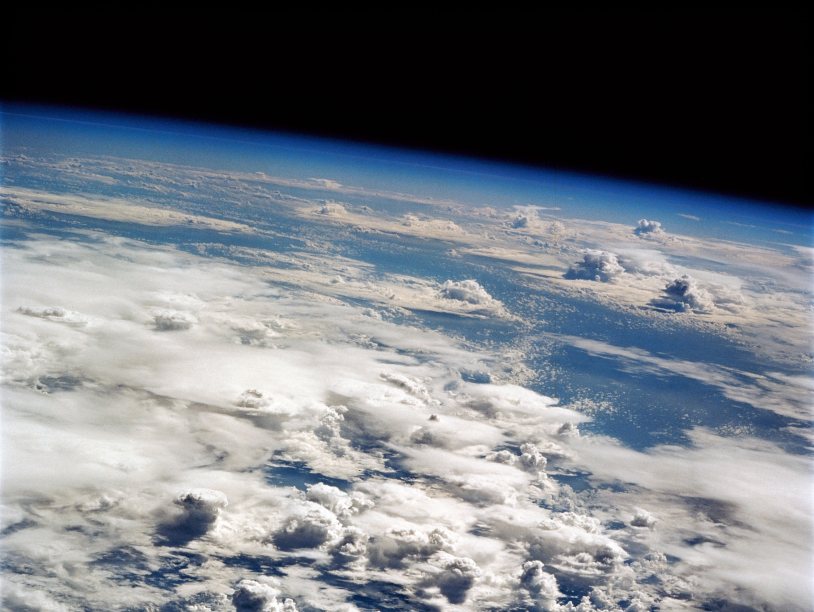
At the dawn of astronautics from two alternative ways to launch space aircraft - a vertical and horizontal start, development and widespread is vertical. Now many possibilities of a vertical start are already almost exhausted, and the airborne cosmic aircraft is becoming the most promising direction. According to Alexander Nebylov , the author of the idea of the screen, the general director of Mipact - Millennium Holding, a resident of the Skolkovo Foundation , today the use of a horizontal start and landing is supported in suborbital spacecraft flights.
Alexey Belyakov , Vice President, Executive Director of the Clister of Space Technologies and Telecommunications of the Fund commented on the company: “Skolkovo supports projects at different stages of the life cycle. Our independent expert board considered it appropriate to approve the project of the Mipact project aimed at creating a technology for using the screen when starting and planting spacecraft. The very diversity of the options for withdrawing and returning from orbit shows that in this area there is a certain “genre crisis”, and we may very soon see the appearance of fundamentally new technically worked and economically effective solutions, which can significantly reduce the cost of cosmos. We pay tribute to the experience of St. Petersburg colleagues in the field of analysis and development of traffic control systems and their perseverance in promoting the idea of an ekranoplan start and are quite ready to assume that their development will be among new successful options. ”
What does the beginning of the flight in space usually seem to us? The missile is installed on the starting platform, engines are turned on, it takes off, the exhaust steps are separated and, finally, the spacecraft is brought to orbit. If we are talking about a reusable ship, as in the Space Shattl project, then the ship, having completed its program, lands on the runway.
However, specialists in space technology do not leave attempts to create launch systems in which not only landing, but also the start of the device will occur on the runway-the so-called “ horizontal launch ”. Most often we are talking about aviation-space systems. A powerful fracture plane takes off when he gains sufficient height and speed, an orbital plane (spaceship) is separated from him, which makes a flight into space, and then returns. Similar systems are often indicated by the term “air start”.
One of the important reasons that make you look for such opportunities: great freedom in choosing the time and place of start. If we want to launch a satellite or spaceship from a stationary platform not to an arbitrary, but to a strictly specified orbit, this can be done at a certain period of time (“starting window”), sometimes quite short. In addition, some projects promise significant fuel saving in comparison with a conventional launch vehicle. In particular, when flying in an atmosphere as an oxidizing agent, you can use simply oxygen from the surrounding air.
It is interesting that for the first time, Frederick Zander, one of the pioneers of missile technology, was the idea of a horizontal launch, when flights into space were still a daring dream. In 1921, he presented the project of a spacecraft, which takes off horizontally, flies in the atmosphere with the help of liquid jet engines, then rises into space and goes to other planets on direct -flow engines. In 1924, Zander published this project in the journal Technology and Life.
Since 1959, the US Experimental Rectlane has been used in the United States, developed by North American Aviation. He started in the air from the heavy bomber Boeing B-52, under the wing of which he hung and landed on his own. In 13 flights, the X-15 managed to rise to a height of more than 50 miles (80.5 km), which in the USA is considered suborbital space flight, and in two of these starts the Joseph Walker pilot rose to a height of more than 100 km, which corresponds to a more stringent criterion of the suborbital space flight used by the FAI .
In the mid-60s, Soviet designers developed the Spiral project. The project was led by G. E. Lozino-Lozinsky, the future creator of Buran. The project provided for the launch of a powerful aircraft that could accelerate to six times sound speed. In the air at an altitude of about 30 km, a manned orbital plane was supposed to start from him. When working on the Spiral project, several Borial devices (unmanned orbital missileplane) were created - reduced prototypes of the future manned orbital aircraft. They even visited space, being launched with the help of a regular, “vertical” launch vehicle. Another development-the MiG-105 subsonic aircraft-was tested, including when starting in the air from the Tu-95 launch vehicle. However, in 1973 the project was stopped.
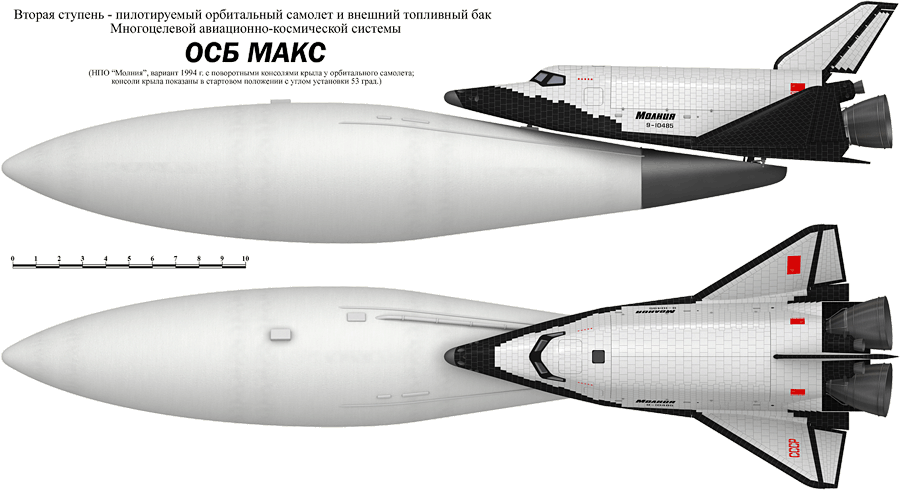
Another project, which was also led by G. E. Lozino-Lozinsky, was called Max ("reusable aviation-space system"). In it, the starting aircraft was supposed to be created on the basis of a turbojet cargo aircraft An-225 Mriya, which could carry a useful load of up to 250,000 kg. These developments were eventually used in the Energy-Buran space program, where a horizontal start was not carried out.
In Germany, in 1961-1974, there was a Senger project similar to the Soviet Spiral, and in the early 1990s he survived the revival as Zenger-2. He also had a horizontal take -off and landing, provided for the separation of the orbital aircraft at an altitude of about 30 km. It was planned that in the Horus orbital aircraft (Hypersonic Orbital Upper Stage, “hypersonic orbital upper step”) will be able to fly up to 6 astronauts, and its cargo compartment contains 2–4 tons. However, the European Space Agency preferred the Aryan-5 launch vehicle to him.
There was also its project for the spacecraft of horizontal launch in the UK. It was called Hotol (Horizontal Take-Off and Landing "Horizontal take-off and landing") and was developed in the 1980s.
In the United States, there was even an ambitious NASP (National Aero-Space Plane) project to create a single-stage X-30 spaceship. The plane was to independently, without the help of a redistent aircraft, take off, reach a near-Earth orbit and return to the ground. Now this project has been suspended. A similar British project is being developed now. It is called Skylon and is a continuation of the Hotol project.
A three -stage air start system is successfully operating in the United States. It consists of the Lockheed L-1011 Tristar aircraft, the Pegas launch vehicle starting from it, which in turn takes artificial satellites into orbit. Since 1990, the Pegasus account has already more than three dozen successful launches.
The countries of Asia are now developing their projects of reusable spacecraft with horizontal take -off and landing. In China, these are “Shenlun” , and in India in Avatar (Aerobic Vehicle for Hypersonic Aerospace Transportation).
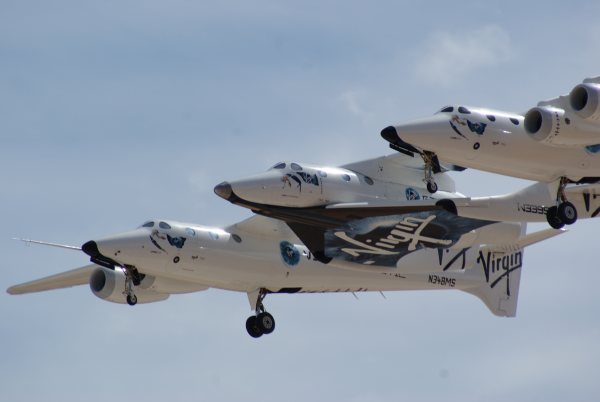
The first cosmic flights carried out by a private company in history were also carried out using a redistent aircraft. The SpaceShipone ship, which made three suborbital space flights in the fall of 2004, was separated in the air from the White Knight airplane (“White Knight”). For the advanced ship SpaceShiptwo, the White Knight Two aircraft has been created, now the aerospace system from these two devices passes test flights at the airport in the Mohava desert.
An interesting project for the horizontal launch of the orbital aircraft is offered by Mipact -Millennium Holding CJSC, created at the International Institute of Advanced Aerospace Technologies ( Mipact ) of St. Petersburg State University of Aerospace Engineering (Guap) together with the Indian company Millennium Aerodynamics Private Limited. The idea is based on the use of the screen of the ekranoplane as an Aircraft-devastated Aircraft, proposed in 1995 by Professor GUAP Alexander Nebylov .
Here it is necessary to make a retreat and tell what ecranoplans are. When back in the 1920s began to design aircraft-monoplanes with wings fixed in the lower part of the fuselage, they soon noticed an unexpected phenomenon. When landing, when the plane was about to touch the ground, the lifting force of the wing suddenly increased, and he continued to fly. It turned out that the device is maintained in flight thanks to the compression and compaction of air under the wing. This phenomenon was called a screen effect. The first article on the description of this effect was published in 1922 by Boris Yuryev ("The influence of the Earth on the aerodynamic properties of the wing"). The screen effect is enhanced with an increase in wing width and with a decrease in flight height.
In practice, at first, the screen effect brought harm to aviation, leading to accidents during landing. But the designers quickly began to try to use it. After all, he allowed to put a much less powerful engine on a mortal, but, nevertheless, receive a significant carrying capacity. But all this, of course, at a low flight height, where the effect manifests itself. Therefore, the main area of the use of the ekranoplanes was flights over the tundra, desert and of course over the sea, that is, where there are no significant uneven reliefs that interfere with a flight at an altitude of 10 meters or less. Later they began to distinguish between ekranoplanes and adherents - devices capable of flying both in screen mode and at large heights, in which the screen effect is used during take -off and landing.
In the USSR, the main design center for ekranoplanes was the Central Design Bureau for Ships on Submarine Wings in Gorky, which was headed by Rostislav Alekseev . One of the first to create an experimental ekranoplane of KM ("ship-makt"), flying at a heights of 4-14 meters above the Caspian Sea. The take -off weight of the device was 540 tons, and the cruising speed was 430 km/h. Then, military aircraft were created: the landing of the eagle , and the ekranoplan-raketens "Lun" . Then appeared the small ekranoplane “Swift”, the amphibian boat-screen “Volga-2”. The project of the rescuer was developed on the basis of the Lun missile carrier.
Robert Bartini also worked on aircraft with a screen effect. In 1972-1976, his VVA-14 plane was tested in the Taganrog Bay.
In 1998, in Omsk, the “Ivolga” ekranoplane, the designs of V. Kolganov, was built in Omsk. In 2001–2011, the Akfistar and Aquilida earnings were created in Russia. A number of Russian design bureaus are operating on the projects of ekranoplanes. Abroad, there was a project of the Boeing Pelican Ultra Boeing Pelican. The designers of China and South Korea declared their plans for the creation of ekranoplanes.
Cosmic use of the screenplane proposed by A.V. Innobyov and “Mipact - Millennium Holding”, consists in launching from the surface of the sea - the most suitable for the ekranoplanes of the elements. Calculations show that the screen with its own weighing of 1600 tons is able to raise an orbital plane with an initial mass of 500 tons and a landing weapon of 60 tons. A small orbital plane with 350 kg of a payload can be launched from an ekranoplane weighing 400 tons.
The screen plane can deliver an orbital plane to the desired start point, which can be far from the settlements and be optimal for withdrawing the apparatus to the selected orbit. Flight over the sea will also solve the problem of the runway, because not every airfield is suitable for takeoff of a heavy expanding aircraft on Earth.
It is also proposed to use the ekranoplan as a landing site for an orbital aircraft returning from space. At the same time, landing should be carried out on the ekranoplane flying above the sea.
Doctor of Technical Sciences, General Director of Mipact - Millennium Holding, Alexander Nebylov, commented on the current state of development of the company: “We are trying to gradually solve the necessary problems, creating and designing individual systems that will be needed for the orbital aircraft and for the screen. One of these tasks is the creation of accurate and reliable sensors for small distances, for example, to measure small altitude of the screen over the excited sea.
The integrated version of the launch of an aerospace aircraft using an ekranoplane is difficult to implement, since both of these components are still in the project, and not in the metal. It is difficult to build an aerospace plane, since there is no engine that works well in the entire speed range, from subsonic to cosmic ones.
A heavy screen, which is needed is also only in the project, and a specific development that would allow you to check all these experimental and theoretical results in practice, so far. There is no complete clarity with the possibility of multifunctional use of a large ekranoplane, which is important for investors. In this regard, the project is difficult to compare and, as far as I know, the Russian space agency is not yet able to support it. Attempts to attract the attention of the state to this project have not yet been crowned with success, although foreign colleagues highly evaluate it and believe that this is a very promising direction.
But, of course, the state has more urgent tasks that require budget investments. And in general, most likely, it should be an international project, if it had been able to arrange it like that, there would be more benefit for everyone.
The task of creating an orbital aircraft with a horizontal start is of the nature of world, civilizational significance, because it would solve many problems, but there are great difficulties.
One of the main difficulties is the absence of an engine that works well at low speeds and at cosmic speeds (about 33 sound speeds). This problem needs to be solved gradually, and we do this, create systems that will be used on a cosmic aircraft and on the ekranoplan. These are different systems, since the working conditions of these two devices are completely different.
The aviation speed of the screen plane will allow the orbital aircraft the necessary initial speed, at which its hypersonic wing will be able to create the necessary lifting force for lifting.
That is, the hypersonic wing is designed to work at very high speeds, and an ekranoplane that gives an initial impulse will allow you to approach these speeds, after which the hypersonic wing of the aircraft begins to work, and it can fly itself. That is, the ekranoplane can act as an accelerator.
The screen plane can have a carrying capacity, more than any aircraft, which will launch a spacecraft with the desired mass. Cryogenic installations for refueling a spaceship with liquefied hydrogen immediately before the start will also be appropriate on the ekranoplane
In addition, planting on the ekranoplane is very important. This will do without a heavy wheel chassis and increase the useful load of the orbital aircraft. That is, you can organize landing not as at the airfield, but actually perform a docking: two devices are brought together, their speed is equalized, they are joined with each other. In fact, all mechanisms for docking are on the ekranoplane, and not on an airborne cosmic aircraft. The rejection of the wheel chassis will increase the useful load, for example, by 30%.
It is not surprising that in different countries such projects exist, since many understand that the prospects are over a horizontal start. At one time, these two directions - a vertical start and horizontal start - were developed simultaneously both in the USSR at the beginning of the space era and in other countries.
As a result, it was possible to ensure a solution to the problem using a vertical start, including thanks to the preferences of the military, since it was possible to carry out launches from the mine. The horizontal launch, since it was open, the military did not really love. As a result, only a vertical start remained, and the horizontal was gradually covered. However, now many possibilities of a vertical start are almost exhausted, and it is necessary to gradually revive the aviation line of the horizontal start of the aerospace aircraft again. You can start with the creation of relatively light demonstrators (the legendary G.E. Lozino-Lozinsky thought and spoke about this). In recent years, the support of a horizontal start and landing in the projects of suborbital flights of space tourists is noticeable. ”