
Translated material
Andrey Lankov: Commerce at Kim Il Seine
Andrey Lankov  North Korea
 Andrey Lankov
 Andrey Lankov Self -isolation Tatyana Gabrusenko "Kim Il Sun today"? Andrey Lankov Structure of Education and Science in Korea Fedor Tertitsky Intercorean adaptation
  Korean transition Korea from the times of Kim Il Sen
  Korean contrasts Modernization in East Asia, 1945 - 2010. Natural death of Korean Stalinism
 North Korea
We continue to publish a cycle of articles of a wonderful vestibule, and the Ssociated Professor University of Kukmin (Seoul) Andrei Lankov about how North Korea lived under Kim Il Sene when she was the most controversial society in world history.
See also:
Andrey LankovAll those thirty years that I have been engaged in North Korea, I have to deal with an enviable regularity with another wave of conversations (more precisely, not even talking, but publications in the press) that the North Korean government, they say, "finally allowed the markets." Similar messages appeared in the world press in the 1984-85, and in the early 1990s, and in 2000-2003. These conversations are quite funny, because the North Korean government could not “allow markets” for one simple reason: it never prohibited them.
In the late 1960s, the great leader, the sun of the nation, comrade Kim Il Saint spoke out on this issue quite definitely and unequivocally. He said that at this historical stage the existence of markets is inevitable, although in the historical perspective they are, of course, doomed.
Indeed, in North Korea, the times of Kim Il Sena, the markets existed, although they played a limited role in the supply of cities with food and essential goods. In most cases, these markets worked only three days a month, gathering in a certain place, usually on the outskirts of the district center.
A number of goods and products were prohibited for sale in those days. In particular, it was impossible to sell grain, alcohol and the vast majority of industrial goods in the markets. In practice, a ban on the sale of grain was generally observed, although it was still possible to buy rice on the market if desired (from under the floor, of course). The ban on alcohol trade was observed worse, and industrial goods from around 1980 not only regularly appeared on the market, but also made up almost a large part of what was really sold there.
However, the North Korean markets from the time of Kim Ir Sen were small and non -casual. In most cases, they were simply a large space on the outskirts of the district city, which was fenced off by a high concrete fence. The merchants were located right on the ground: they deployed pieces of film (a considerable shortage in those days, by the way) and laid out their goods on them.
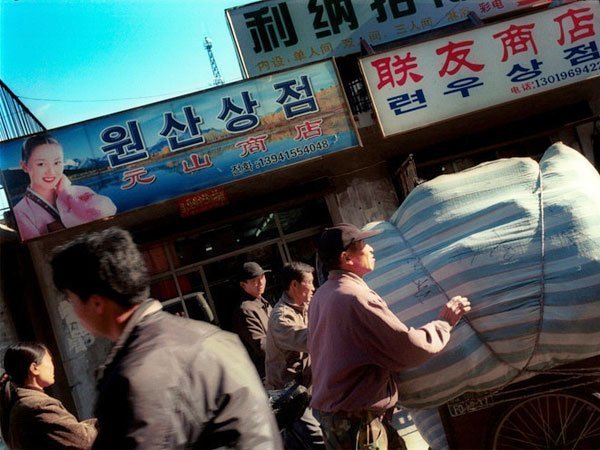
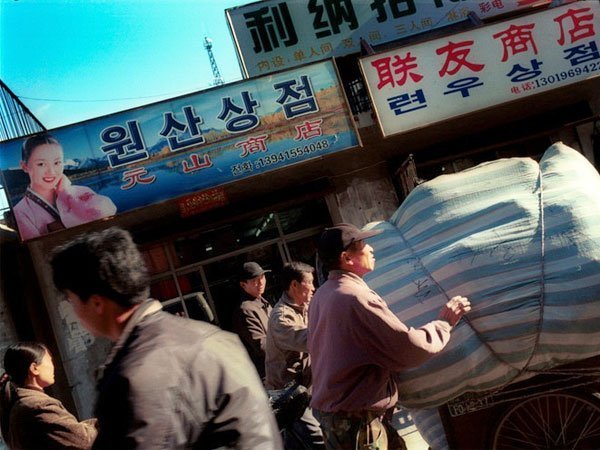
The number of goods in the markets increased markedly in the early 1980s in connection with two circumstances: firstly, in 1982-84 it was allowed to invite relatives from China to North Korea. There are many North Koreans of such relatives: at present, about two million ethnic Koreans take root in China, most of which are descendants of immigrants from the northern provinces of the Korean Peninsula, who went to Manchuria in the late 19th century. These relatives began to visit North Korea not so much with sentimental as with commercial purposes, using such trips as a preposition to legalize small shuttle trade.
On the other hand, the revival of market trade was also greatly facilitated by the fact that since 1984, the work of the home -made brigades, known as the “brigades on August 3”, was officially allowed. It was theoretically believed that these brigades work within the framework of state enterprises, the waste of which they should have used as raw materials. In the first years of the existence of this system, it was in general. Working at home and using industrial waste, the brigades produced a diverse consumer goods: mop, wooden combs, hair hair clips, etc. Such products were sold through commission stores, and often directly, through the market.
However, commercial trade (that is, trade for money, and not for cards and coupons) in Korea, Kim Il Sena, was not limited to markets alone. Since the late 1970s, foreign exchange stores also appeared in North Korea.
This was due to the fact that in the territory of North Korea since the beginning of the 1960s there have been a large number of (about 95 thousand people) of immigrants from Japan. These immigrants were ethnic Koreans, who in the late 50s and early 60s believed the stories about the socialist paradise, decided to leave Japan, where they were then subjected to serious discrimination. In the realities of this paradise, many of them were disappointed immediately upon arrival, but there was no way back.
In most cases, these immigrants received considerable money transfers from those relatives who at one time prudently decided that one should not rush to paradise and it was better to remain in the capitalist Japanese hell for some time. Quite quickly, the North Korean government discovered that these transfers are an important source of currency income. As a result, the DPRK has become a socialist country with one of the almost liberal currency regimes.
It was understood that immigrants or other currency owners can come to the currency store at any time and buy high -quality imported goods there, which were absolutely inaccessible not only to ordinary North Koreans, but also by most nomenclature. In its assortment, large currency stores, including those who had in the center of Pyongyan, the main North Korean currency - the department store Rakvon (literally “paradise”), in terms of the assortment approximately corresponded to small Japanese department stores.
However, conversations with the North Koreans of middle and older and older confirm: although commercial trade - in the form of markets, in the form of foreign exchange trade, and in the form of selling a deficit from hand - in North Korea in Kimirsen times, but relatively few used it. No matter how scarce to us the then supplies seem to us, the vast majority of the North Koreans were satisfied with them and resorted to the services of commercial trade only in extreme cases. Everything began to change when state trade and the card system was not able to satisfy even the most minimal needs of the population.
See also: Andrey Lankov Self -isolation Tatyana Gabrusenko "Kim Il Sun today"? Andrey Lankov Structure of Education and Science in Korea Fedor Tertitsky Intercorean adaptation Korean transition Korea from the times of Kim Il Sen Korean contrasts Modernization in East Asia, 1945 - 2010. Natural death of Korean Stalinism