
Translated material
Your agricultural industry at all costs
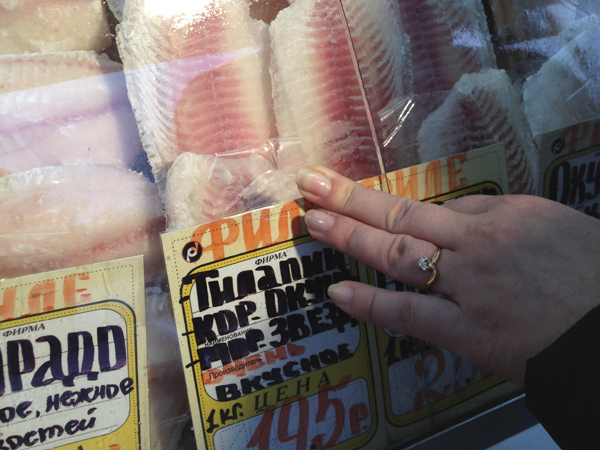
Russia tried to influence economic sanctions on manufacturers and suppliers of imported products, but how did they affect the Russians themselves? Polit.ru talked with representatives of large supermarket networks, as well as with buyers in them, and found out why people below the average wealth protect the figure, people of average abundance at all costs are fighting for foreign goods, and people of high prosperity will be happy to accept the domestic manufacturer.
On August 7, a list of food products prohibiting the sale of meat, fish, birds of all species, sour -milk products, fruits, vegetables and nuts supplied and supplied by the United States, Canada, Australia, Norway, and the countries of the European Union was published on the website of the Russian Federation. A reduction in the range of products in the Russian market will last a year and will not relate to children's food and goods, which the Russians themselves will buy abroad. Vladimir Putin decided to take such measures in response to the sanctions of the above countries due to the situation around Ukraine.
The ban is customs - it means rather the impossibility of legal import into Russia and the sale of products by entrepreneurs than the inability to conclude contracts with suppliers or import products through third countries.
The influence of Russian purchasing demand on Western agriculture is strong: most of all the “counter -sanctions” will be affected by export of dairy products from Finland, Lithuania, fish from Latvia, Estonia and fruits with vegetables from Poland. For the EU, the reduction will be at least half of import to Russia, for the United States - at least 80%. According to the EU , in 2013, Russia accounted for about 10% of their total exports of agricultural products, which is about $ 12 billion - this is a quarter of the Russian agricultural port.
Since the trade war is waged between the country, whose economy occupies 3% of the global GDP against a number of countries with at least 40% of the global GDP, the Russian Ministry of Agriculture said that the list will definitely not be expanded, or maybe it would be reduced. The Minister of Agriculture Nikolai Fedorov said that the country will need 3-4 years and 137 billion rubles to replace the import of products. additional state support.
During the year, until August 6, 2015, Western countries will “swell” about their own grown fruits, vegetables, meat and fish. Already now, as part of the campaign for increasing the internal consumption of apples, the Poles will have to eat 677 thousand tons of these fruits in excess of the norm of 600 thousand tons - that is, twice as much. The Polish newspaper Puls Biznesu began a campaign in support of domestic apples with an editorial article on the Internet under the heading “Sweet Putin: Eat Apples, Drink Sidr”.
At the same time, Russian distributors of products are preparing measures to conquer customer demand in the new conditions and supporting their own profitability. Thus, the Auchan company plans to strengthen the presence in the range of goods of its own brands that are fully produced in Russia, expand cooperation with existing local suppliers and attract new suppliers to cooperation through simplified introduction of their products and signing agreements. This was told by Polit.ru Director for external communications "Auchan Russia" Maria Kurnosova.
“There is no excitement in stores now, we will not allow the goods shortage, and there is no reason for this,” says the executive director for corporate services X5 Retail Group (supermarkets "Pyaterochka", "Crossroads", "Carousel") Sergey Bakumov. - Countries that are banned, not the only suppliers of products in those categories that are listed in the government list. Over the past few years, within the framework of the Code of conscientious practices, we regularly conduct procurement sessions in regions with local manufacturers, we conclude agreements on cooperation with regions administrations. ” He added that to a large extent, grocery stores will depend on the possibility of Russian manufacturers to satisfy the demand for prohibited imports and their offers at vacation prices. “We hope that they will not be unreasonably overstated,” he said.
According to Ekaterina Kumanina, director of external relations of Dixy Group of Companies, their network is already adapting the assortment in accordance with the restrictions introduced, but does not foresee significant changes in the work. According to most of the categories, Russian suppliers are provided by the dominant share of supplies to Dixy. 100% of meat, poultry, dairy products on the shelves are domestic, and the share of imported milk is not more than 0.5%. There are no problems with vegetable products: Russian agricultural producers fully provide market needs.
“There is a small percentage of the Norwegian red fish, but the channel of the supply of more useful wild varieties of salmon from the Far East has already been previously worked out - non -nonsense, kizhuch, pink salmon,” says Kumanina. “European cheeses are represented more noticeably, it will not be easy to replace them with similar positions, but as a result, demand will be redistributed towards other tastes within the category, including cheeses from Russia.”
The largest difficulties in finding alternative replacement cause fruits, says Ekaterina Kumanina. The maximum share of European deliveries in certain seasons in this category reached 50%. “We see the opportunity in the redistribution of orders to the countries of Asia, Latin America, Africa, and about the load of our Russian partners from the Kuban, Krasnodar and Stavropol Territory, as well as manufacturers from Serbia, Macedonia, Turkey, and Belarus. However, some varieties familiar to buyers, for example, pears, can be replaced by alternative tastes from other countries for some time. ”
The greatest loss can be obtained by the elite supermarkets of the ABC of Taste, the Globus Gurme and the similar, the vast majority of which are foreign foods. However, the press service of these supermarkets refused comments.
According to the Levada Center survey, most Russians believe that the economic sanctions of Russia will not create problems for their families-38% of the population stated this. At the same time, only 5% calls it a “very serious problem” and 20% “rather serious”. “ I love Baltic products, I can’t confuse them with anything and buy them only - in the nearest supermarket to my house I go to, they always have them,” says Oleg Minin, a buyer from the Dixie supermarket. - But other supposedly imported products sold here are actually a semi -finished product made in Russia. Perhaps other foreign products are in other retail chains, higher than the class, but I cannot afford to buy there. Yes, I don’t need it: I live on buckwheat with pasta, as in Soviet times - but the figure is good - not like thick Americans . ”
A similar opinion is expressed by the customer of the ABC of Taste Lyudmila Rebrova: if the store presents a domestic product of good quality, she will prefer it imported. The buyer believes that the sanctions will not affect her table in any way: “I buy meat products exclusively ours, the cheese is also, only I prefer the imported fish,” she says. - And God with them - with imported sour -milk - I am quite satisfied with our kefir and milk. Twice a year, my family and I buy oysters, arrange a stomach holiday for ourselves - if they are not, then we will go on vacation, we will come to them for a year ahead. ”
The buyer of the “Crossroads” Yana Smirnova has a different opinion: “ Again to see the blue skinny Russian chickens on the shelves, small sour apples, incomprehensible semi -hard yogurts? Well, no, ”she is indignant. “Ours do not know how to produce tasty and high -quality, we will never have a replacement for the cheeses of Dor Blue, Kamamber, Mozarella, will not be their peaches without wormholes and their own delicious fermented milking.” She is sure that with the exclusion of imported products, the Russians will lose a lot and is ready to look for ways to buy foreign products familiar to her. “I do not want to be thrown back into Soviet reality with buckwheat, fermented cabbage on my balcony and canned goods. I am not ready to live in a country in which everything appeared 50 years later than in Europe, America or even in Asia, ”she concludes.