
Translated material
Time to pay for the Crimea
In this world, clearly not the best of the worlds, there are no free breakfast. You have to pay for everything sooner or later
For Russians, the time of reckoning for the annexation of Crimea, the ruin of the East of Ukraine and the support of Vladimir Putin with his Ukrainian policy have not yet come. But the first rings of the thunderstorm have already thundered. Both an ordinary consumer and lovers to eat deliciously and rejoice at the programs of state channels will soon feel that the enemies are not asleep. Polish apples, Latvian sprats and German cheeses will disappear from the market, fly up products for food, rise in price of loans, and the ruble, on the contrary, will become cheaper. And this is just the beginning
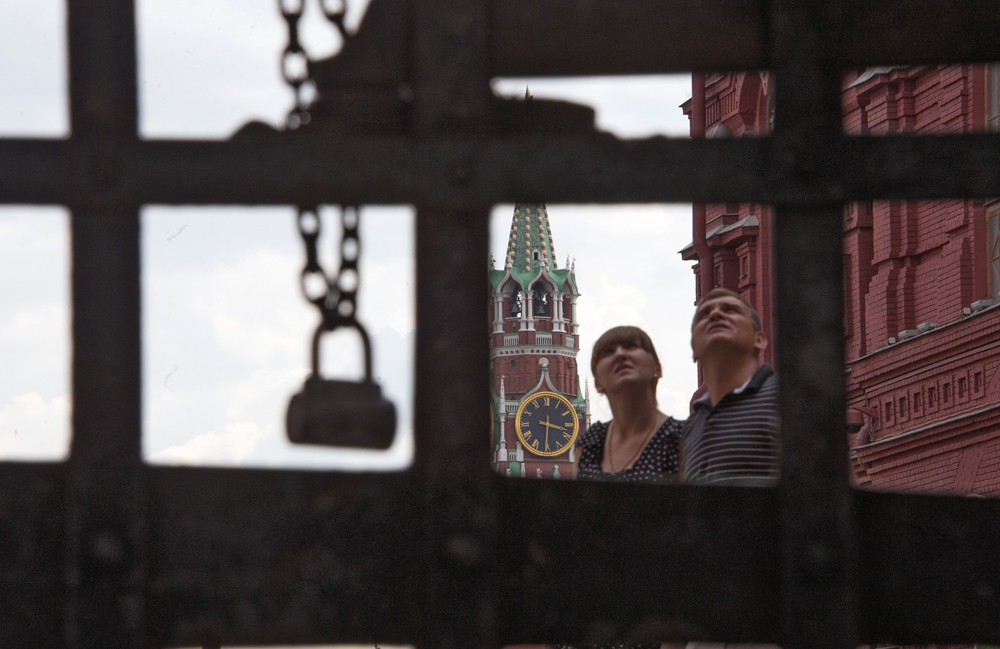
How many more Russians are ready to give for the Crimea. Moscow, August 2014 /Photo: Ilya Talev /Kommersant
Western countries were not going to starve Russia with hunger. The sanctions of the USA, the EU and Japan, which Norway can also join (it is not included in the EU), in relation to the sectors of the Russian economy establish restrictions on borrowing Russian banks and companies (no more than 90 days), prohibit the import of double technologies into the country (that is, those that can be used both for peaceful and for military purposes) and oil and gas equipment. Rosneft, for example, has already announced that she may have to postpone projects in which state -owned companies partnerships with the American Exxon Mobil (look more on page 30). I did not have plans to prohibit the import of French wines, Lithuanian “milk” and Spanish olive oil.
We will not let ourselves eat
But the country's leadership decided to help ill -wishers. On August 6, Vladimir Putin with his decree No. 560 “On the application of individual special economic measures in order to ensure the security of the Russian Federation” ordered for a year to ban the import of food from countries that adopted sanctions against Russia. The government reacted instantly and already on August 7 prohibited the import of meat, poultry, fish, crustaceans, mollusks and other “water invertebrates” (so in the government of the government), sausages, dairy products, nuts, vegetables and fruits. And by the evening, the customs stopped passing the wagons with overseas food: the border on the castle, neither a day, no ruble, nor a gram of the enemy will not give it! Thank God, children's food did not fall under the ban, which was specifically stipulated. Obviously, the authorities decided not to provoke the vocal mothers: Crimea, of course, is ours, but something also needs to be fed for something. Food imports traditionally make up a rather noticeable share in the consumer basket of the Russian. In 2013, 36% of retail food turnover had to, according to Rosstat. This share is relatively stable, since 2005 it ranges in the range of 33–36%. About half of the import - from countries that imposed sanctions against Russia. According to the calculations of the Institute of Complex Strategic Research (ICSI), imports in 2013 accounted for 43 % of the cost of the population for food (this is the maximum, in the previous thirteen years this indicator fluctuated in the range of 35–43 %).
The highest share of imports in the consumption of fruits and berries, beef (most of the Brazil and Paraguay, which do not fall under the sanctions), cheeses, pork (more than 40 % were supplied from Canada, whose pigs are now Non-graters in Russia), animal oil. Import food is by no means “elite” products. These are also quite “ordinary” Ukrainian sweets, Finnish oil and Norwegian salmon, packaged in Russian factories. So far, sanctions have not been imposed against Ukrainian food, but his access to the Russian market is already limited by the forces of Rosselkhoz and Rospotrebnadzor.
Buyers will notice not only the disappearance of the usual brands. It will rise in price of Russian food: it will not be possible to find an instant replacement for European food imports, the supply in the market with stable demand will be reduced, and manufacturers will not be able to increase prices. The government is waiting for this, therefore, simultaneously with the restriction of imports, it will think about how to control prices in the domestic market.
There is such experience: in 2008, officials introduced the regulation of prices for the main food products - “products of social significance”. The value of the trading margin and selling prices of manufacturers was regulated. This did not end in any good: the Prosecutor General and the FAS were engaged in the “speculators”, the merchants were forced to compensate for the lack of profit on the main goods, accelerated by raising prices for those that were not included in the list. In a difficult situation were bread and dairy: they were forced to work almost at a loss.
“No need to take it here more. Feed your Europe! ”, The Russian customs officer said to the Ukrainian, who was traveling with the author on the Kyiv -Moscow train and having a certain number of vegetables and fruits with him. And really, why do we need nonpatriotic enemy apples from under the Zhytomyr?
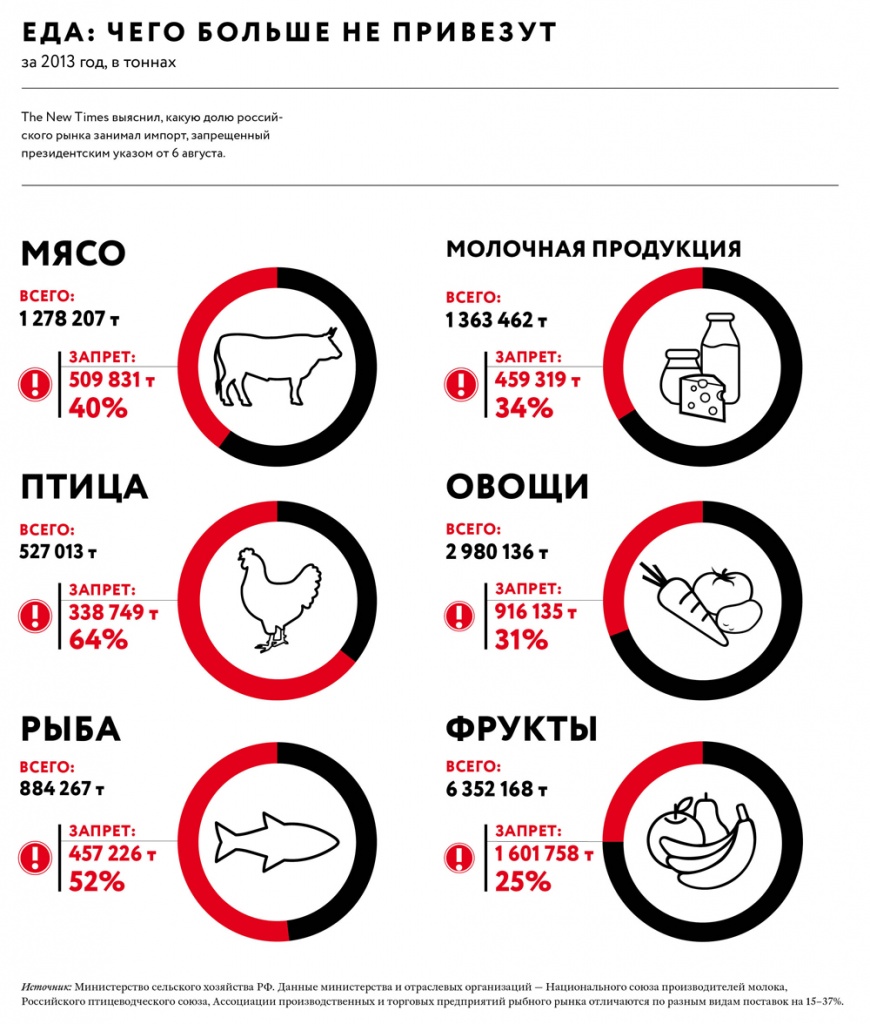
About the dangers of sanctions
International trade is a game with a non -lwear amount. In other words, the principle of “I won, he lost” - in this case does not work. The seller (new markets, revenue and profits), and the buyer (reduction of prices through competition, increase in diversity) won. The desire to "harm the enemy" is natural human weakness. But to do this, without hitting at the same time on “your own”, is almost impossible in international trade. Therefore, vengeance is a bad adviser in issues of export and import.
Sanctions against Russia were very difficult to give to Western countries. They swayed for a long time. Nobody wants to lose income and jobs - therefore, the pro -Russian lobby is so strong in European countries: according to the first estimates of the “response” of the Russian government, the EU countries can cost $ 12 billion. But introducing “response sanctions”, Russia certainly punishes itself. The effect of double punishment arises: “Teacher, you imposed me 20 lashes, and it is so new and fair that add 10 more strokes to the same place from me personally.” Explicit masochism! For Russia, food imports from Europe are more important than for Europe - the opportunity to feed Russia. Now, if the Kremlin in the midst of winter ordered to disable Europe from gas and oil supplies, this would be a serious injury for her. And prohibiting the import of food, we punish ourselves more than Europeans, Americans and Australians.
Closed sky
The masochistic problem of autumn is even more effective by other response measures discussed by the government. They are caused by EU sanctions that have destroyed the “Dobrolet” (Aeroflota Lawkoster flying to the Crimea). Due to the sanctions with him, contractors for leasing, maintenance, insurance protection, provision of aeronavigation information, etc.
However, it was the sanctions that destroyed the “good) - it is unknown. “Goodlet” began to fly about a month ago, its main direction was Moscow - Simferopol, and the cost of transportation was determined not by the market, but by politics. Even private low -cost airlines, and politically motivated, do not take root in Russia.
Russian officials are ready to take revenge for sanctions against “good deale”. The ban on Trans -Siberian flights from Europe to Asia for European companies is discussed. This answer, as well as the restriction of product imports, will hit both sides. At the Trans-Siberian flights of Europeans, Aeroflot earns, receiving a fee of $ 300-400 million per year for them. In response to the ban on Trans -Siberian flights, the EU can generally close the sky for Russian companies. After that, a mutual refusal to issue entry visas will be a logical step.
Last Thursday at a government meeting, Prime Minister Medvedev said that Russian response sanctions may also affect the automotive industry, aircraft and shipbuilding. In the first two sectors, Russian production (if you do not take into account the assembly of foreign cars in our country) is completely uncompetitive, shipbuilding has potential, but it has long been in a difficult situation. So the government continues to stubbornly invent measures that will hit “their own” more than “strangers”.
One thing is gratifying: Russian response deprives Russians, and Aeroflot - money, but so far do not concern finance and visas. After all, response measures against countries that have imposed sanctions could theoretically look like this: 1) to ban the visit of these countries, 2) banks to banks and other financial institutions from these countries, as well as their Russian daughters, any operations with Russian clients, 3) in the case of individual sanctions or began the persecution of the Yukos case - to confiscate all over Russia - to confiscate all over Russia. Property belonging to legal entities and individuals from these countries.
Sanctions are also harmful because if I started, it is already very difficult to stop, if it is impossible.
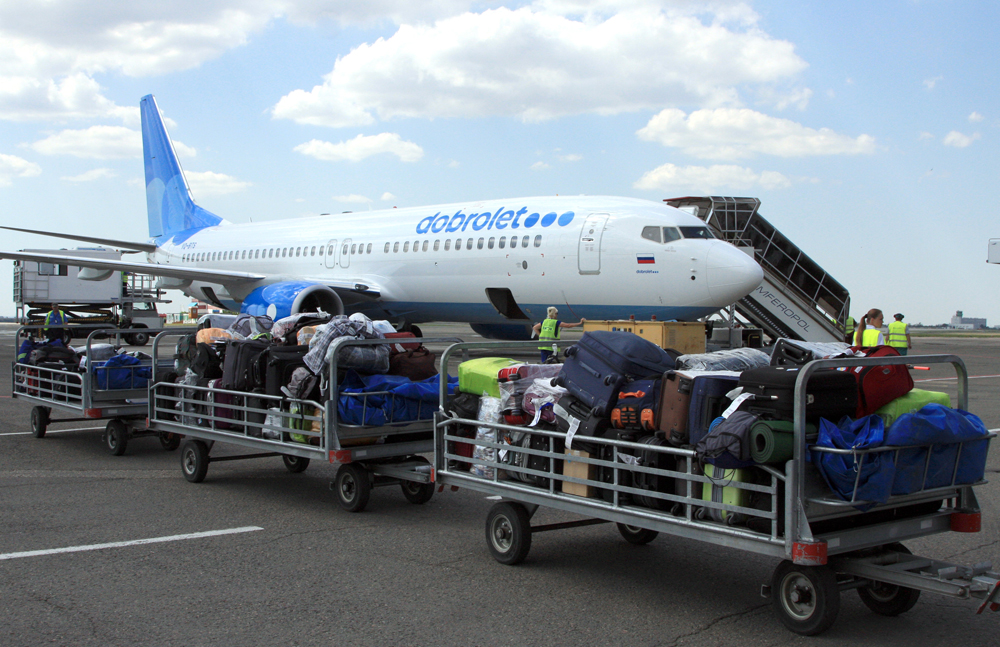
In the near future, the "good launch" will not take off. Simferopol, June 2014 /Photo: Alexey Pavlishak /ITAR-TASS
Toxic country
Bankers call “toxic” assets that seem normal, but turn out to be poisoned: “bad” loans, stages of dummy companies, bonds of companies that have crossed loans and cannot cope with payments. A new wave of sanctions, introduced by Western countries against Russia at the turn of July-August, makes the whole country toxic, and not just corporations, banks and people who fell into sanctions lists.
The problem is that no one knows - who will be on the sanctions lists tomorrow. Now imagine yourself, say, in the place of the American investment bank, which is hired as the organizer of the eurobonds of the eurobonds, the Russian company, together with the German producing somewhere in the Urals, for example, diesel locomotives and selling them by Russian Railways. If it were a year ago - No Problem: the desired project, a rich buyer, a good European partner. Now, the project, most likely, will not receive approval, since the buyer of diesel locomotives, and in the case of the development of events - their manufacturer, can fall under sanctions. And this applies to almost any projects.
"
The worst scenario is if our politicians get into a rage. They will find a new trading partner in Iran. They will decide to compensate all state banks, state -owned companies and companies of Putin's friends loss from sanctions
"
Point sanctions against Gazprom, Rosneft, Sberbank, VTB, Gazprombank, Web, etc. - this is, of course, a problem. Russian banks are powerful and desired borrowers. The lack of the ability to refinance debt will be a heavy burden on the central bank and state budget. One Sberbank on April 1 had $ 39 billion debt in foreign currency. According to Morgan Stanley, over the next 12 months, Russian state and private companies and banks should return $ 161 billion. Without refinancing, this is impossible.
In separation from international capital markets, with a murdered pension system, the only source of funds for Russian banks and companies will be a budget and a printing press. The companies valuable for the state will receive money from the State University of Gosinvests, which in the future will lead to the acceleration of inflation and the fall of the ruble exchange rate. In this sense, the question of restricting the supply of imported food can become irrelevant - it will become too expensive.
But the main problem is the sudden toxicity of any Russian assets, even those that will never fall under sanctions. It forces investment banks and direct investment funds to quickly cut limits allocated to investing in Russian assets and hastily think what developing markets can replace Russia in their portfolios.
The worst scenario is if our politicians get into a rage. They will find a new trading partner in Iran (according to a number of media information, a multi -billion dollar transaction “Oil in exchange for machines, metals and grain” is being prepared. They will decide to compensate to all state banks, state -owned companies and companies of Putin's friends loss from sanctions. Gosinvestfonds and the Central Bank of the holes in banking balances will begin to patch up and finance large infrastructure projects. This is not a “creeping” scenario, but a sharp increase in inflation and the fall of the ruble. Probably, such a scenario will reduce the popularity of Ukrainian policy Putin among the population of Russia. But, most likely, the political regime by that time will become so authoritarian that the opinion of the population will already cease to interest him. We'll have to pay for the Crimea and Donbass.