
Translated material
Great and terrible Sergey Lapin
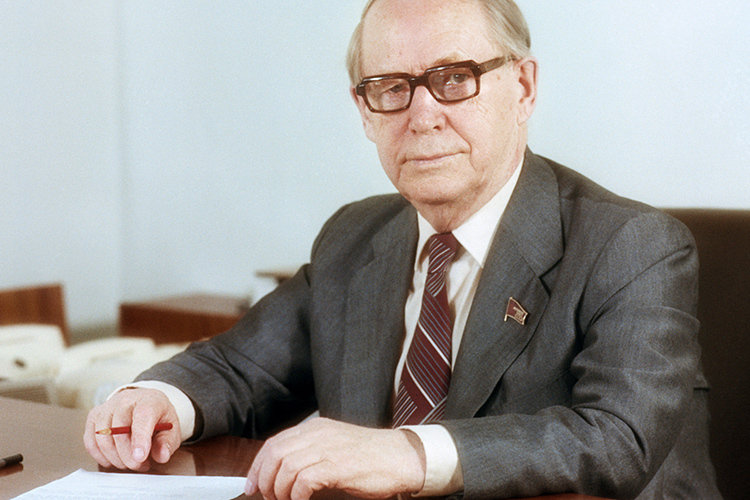
Sergei Lapin led Soviet television for 15 years-from 1970 to 1985. Under him, TV has become the powerful propaganda mouthpiece as we see him now. C OLTA . RU publishes the chapter from the future book of television critic Yuri Bogomolov, dedicated to Sergey Lapin.
Telena are mirrors, which reflect the administrative structure of TV, and its creative atmosphere, and other specific signs of this complexly organized machine. Sergei Lapin symbolized the era of Soviet TV brighter than others.
The history of our TV is already distinctive that for several decades it has developed in the conditions of a totalitarian regime with all the ensuing features: strict censorship, strict ideologization, hypertrophy of the propaganda function of political broadcasting to the detriment of communication, lack of competition in the etheric space. Artistic broadcasting was optional. Here, the political leash was somewhat lengthened, and the ideological collar was weakened a bit - so that experiments sometimes became possible.
Only, perhaps, in the early 60s of the last century, the party and the government realized to the end the significance of the TV as an instrument of power. It was in 1962 that the Committee on Broadcasting and Television was headed by Kharlamov historian Mikhail Averkievich, who had long climbed the career ladder associated with the party-propaganda activity in the apparatus of the Central Committee of the All-Union Communist Party of Bolsheviks: lecturer, head of the department of propaganda and agitation department, head of the subordinate subordination of external relations. A couple of years, from 1949 to 1951, he worked as deputy chairman of the Committee of Radio Broadcasting under the Council of Ministers of the USSR, in which the TV show took first place. And it seemed so important from the point of view of its role as the State Institute that the withdrawal from the post of one head of the department and the appointment of another was carried out as a deeply secret operation. The same as the displacement from all the posts of Nikita Khrushchev.
At midnight October 13, 1964, secretary of the Central Committee of the CPSU L.F. Ilyichev and N.N. Host of months arrived in the Gosteleradio building on Pyatnitskaya, 25. At two o’clock in the morning, Ilyichev introduced the new chairman of the State Committee urgently gathered.
That first night he did not go home, stayed in the workplace. He looked through the programs of all three types of broadcasting, drawing attention to the fact that they were not mentioned before the end of the Plenum of the CPSU Central Committee - Khrushchev was not mentioned - this warned him in the Central Committee of the party. On October 14, he also spent the next night in the committee. Everything is visual and transparent here: the motives for which one boss loses its position and the other is assigned, the priorities in the work of the boss, the meaning of which is the tracking of domestic political information ...
A important TV function is sitting and all night the figure of the ex-ex-seagter and the shadows discarded to him-his statements, orders, orders ...
It is clear that the situation was extraordinary for Monia. At the top of the power Olympus there was a change of scenery and a change of guard. In such cases, personnel moves also occur at the lower steps of the power pyramid. The fact that the new leadership of the country considered it necessary, first of all, not only to block the possible attempts to resist from the loyal shifted Secretary Generals of power structures, but also to change the authorities of TV, indicated the understanding of the very top of the roles of the TV - at least as a translator of supreme solutions. Suddenly it became clear that from now on, if the question arose about intercepting power, the seizure of bridges, mail and a telegraph could not be limited. From now on, it was primarily required by control over TV.
They agreed and made friends in Vienna, where Lapin, being an ambassador to Austria, often communicated with the then chairman of the Presidium of the Supreme Council Brezhnev.
By the end of the 60s, the situation upstairs was aggravated again, as a result of which a group of party functionaries, led by Alexander Shelepin, turned out to be pushed from the main levers of the country's management. This, in turn, predetermined the fall of Nikolai monthly. This is how he himself describes his removal.
“In April 1970, I also released the chairman of the Committee on Radio Broadcasting and Television. And this is how this liberation was furnished. In an interview with me, Brezhnev praised me for work in the committee, said that the appointment of an ambassador to Australia is a temporary matter: it was necessary to strengthen the “diplomatic front”, etc. But all this was obvious by falsehood, all the more he knew that my wife was sick and was not able to go with me. Brezhnev refused in my request to stay in Moscow in teaching (I did not need senior positions).
I looked at Leonid Ilyich, who, glancing out the window, smoked a cigarette. Everything was clear. I, too, began to look at the sheepskin coating on the windowsill. The conversation lost all meaning. My fate was a foregone conclusion. ”
The fate of Comrade Poestyeva was not a foregone conclusion because he could not cope with his duties, and not because the line of television leadership turned out to be insufficiently verified ideologically. The long -standing, but unofficial principle of personnel policy in the country of Soviets, the principle of personal devotion of the lower boss to a higher, came into force. It is strange that such an experienced party functions as months did not understand this. Or he understood, but could not believe that he personally, months, could become his victim.
Whatever the doomed chief of the TV of the month, the new Secretary General, preferred him to Lapin Sergei Georgievich, with whom he was associated with a long -standing friendly bonds.
They agreed and made friends in Vienna, where Lapin, being an ambassador to Austria, often communicated with the then chairman of the Presidium of the Supreme Council Brezhnev. Having become the Secretary General of the CPSU, Brezhnev sends Lapin to begin to work on an important section of foreign policy activity at that time - an ambassador in China, where the “cultural revolution” raged. Then he returns him to Moscow and puts him on such an important media housekeeping as TASS, and after a couple of years he appoints him the head of the department, whose political weight grows not by day, but by the clock.
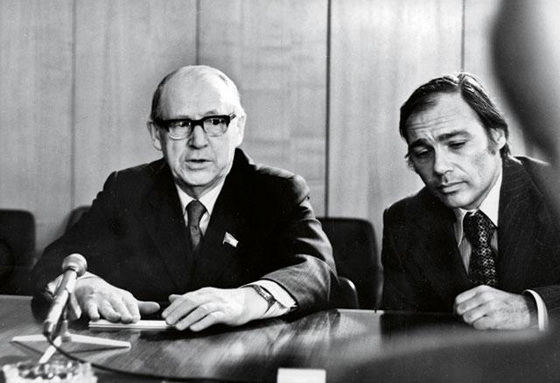 © from the archive V. Pozner Sergey Lapin and Vladimir Pozner
Its political biography is a typical biography of a “party soldier” with some unexpected changes. The social origin of Lapin is from workers. So was recorded in the questionnaire. He himself, in personal conversations, has not once mentioned that he was from the orphanage. He began his career as a teenager working as a postman. The official questionnaire is silent about its specialized higher education. True, there is a short mention that in 1932, Lapin Sergey Georgievich graduated from two courses of the Leningrad Historical Linguistic Institute (why only two courses?). Further it is known that he took up journalism, printing in the publications of the Leningrad and the Leningrad Region. Then he joined the party, and in 1942 he graduated from the Higher Party School (Higher School), which, as usual, opened the path upstairs to the party and state path to her graduates.
The period of the war is not quite clear in the biography of the future head of TV. It is known that, being a faithful communist, he was not torn to the front line; The donkey in the State Committee on Radio Front and Radio Broadcasting, where by the end of the war he rose to the post of deputy chairman of the committee.
After the end of the war, his career went sharply up. In 1953, he goes to work at the Foreign Ministry. And after three years, he became an extraordinary and plenipotentiary ambassador to Austria, where his fateful meeting with the future Secretary General Brezhnev took place.
1960-Foreign Minister of the RSFSR.
1962-Deputy Minister of Foreign Affairs of the USSR.
1965-Ambassador to China.
1967-CEO of TASS.
By 1970, Sergei Lapin had a serious political weight, so to speak. With him, he ascended the television throne of the Council of Soviets. And then traces of the achievement of the TV industry under his rule.
Official certificate
The period 1970-1980 is known as the time of global reorganization, political and technological restructuring of the USSR CT system. The average daily broadcast grew from 1673 in 1971 to 3700 hours in 1985. A new OTRK television center (Olympic television and radio complex) was put into operation to the Moscow Olympiad, after which the television center in Ostankino became one of the largest in the world at that time. In the second half of the 1970s, the satellite of the Rainbow, the screen and “horizon”, which significantly increased the possibility of a space television broadcast, were added to the Lightning satellite.
***
It was an absolutely non -public head of TV. Non -public in the sense that he was personally heard and even more clearly visible on the TV. The shoemaker preferred not to use boots.
There is only one video recording of its phenomenon to the people in the program "Time". This is where Brezhnev awards the chairman of the GOSTELEDDOM Star of the Hero of Socialist Labor. And then an embarrassment happened. The award handed by Brezhnev slipped out of the hands of the awarded. Lapin sank to his knee, lifted the order and reassured Leonid Ilyich: "Nothing, our guys will cut it out."
On the Internet, the record miraculously preserved in its original form. Curious ones can find her here on this link .
Already in the post -Soviet time, a documentary was created about him with the eloquent heading “Behind the Iron Mask. Sergey Lapin. " He is compared there with the great and terrible goodwine.
The authors of the film about the lord of Soviet TV Sergei Lapina, by the way, recalled that the chairman personally took care of the creation of a full -length animated film “The Wizard of the Emerald City”. He really liked the fairy tale about a man who created a city of skillfully painted paper, cardboard and papier-masha. It was a fairy tale about a separate artificially created world in which its creator settled. Perhaps this is how the new leader of TV understood his task, sitting on the throne of the television kingdom, becoming a new great and terrible deceiver Goodwin.
One correction allowed himself to make a television goodwill in the animated version - citizens of the emerald city do not wear green glasses. So that not so transparent to be an allusion. In order to not catch the eye of the resemblance between the fairy tale and the television of special purpose.
The great and authoritarian ruler of TV already in the First College fired his first deputy George Ivanov. Evgeny Kiselev said about how this happened on the air of the Echo of Moscow : “Ivanov was late for the first meeting of the college, in my opinion, in the elevator, burst out there, when Lapin had already started the meeting, and Lapin looked:“ Who are you? ” He replied: “I'm actually your first deputy.” He says: "You are no longer my first deputy." Ivanov: “Sorry, this is not yours, but nomenclature.” “I am withdrawing you from your duties with my decision.”
There is another story about the administrative decisiveness of Comrade Lapin. The young journalist jumps into the building of the television and radio committee on Pyatnitskaya, 25. All the elevators in a spacious lobby are crowded by the staff of the institution. And only about one person costs one person. A journalist is attached to him with the words: “What a disgrace! There are so many people in the committee and so few elevators. We need more elevators! ” To which I heard in response: "It is necessary not more elevators, but fewer people." The next day, they say, an order was issued signed by Lapin to reduce the state by one and a half thousand people.
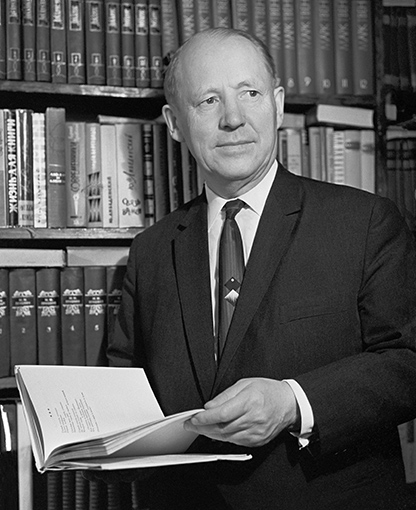 © ITAR-TASS
Arriving on TV, the new boss changed all the main editors. Behind the employee’s late for five minutes, his dismissal followed. He cut off and laid all the long -haired and mustachioed. He forbade women to appear at work in short skirts and trousers. On his initiative, singers and singer Vadim Mulerman, Valery Obodzinsky, Maya Kristalinskaya, Aida Vedishcheva, Larisa Mondrus, Emil Gorovets, Nina Brodskaya were expelled from the air ... Most likely due to the fifth point.
His strong -willed, without explanation, by the decision was removed from the air, popular at that time, the program “Club of Funny and Resourceful”. He was refused a television house to the leading “Kinopanorama”, the favorite of the Soviet people to Alexei Kapler, after which the program itself was looking for a new presenter for a long time, until she tried a dozen candidates, she stopped at Eldar Ryazanov.
To get some idea of the style of television management, we turn to the memoirs of one of the responsible telefunkers of that time, Vilen Egorov:
“The day after the elections to the Supreme Soviet of the USSR, the GOSTERDODODODODOM BODELD was held. I then was responsible for a live broadcast from voting points in Moscow and other cities of the country. This first meeting could be the last. By that time, almost all my colleagues - the main editors of central television - were already removed from their posts by the new chairman, and that day the stream of his tough accusations had hit me, the essence of which was the following: why did you show a half -empty polling station where they voted for Leonid Ilyich, and the crowded halls in Kharkov, where the people festively supported the future deputies? After all, this was the only direct transmission of elections in the country that all of Europe accepted. By your program, you quarreled television with a party asset ... And then what kind of text it is: “I go to the polling station, and there are new houses, shops on the street.” Who needs this window dressing? In response, I vigorously blurted out: “I walked along the street where there were new buildings. We need to choose the roads that lead to the elections.” Silence reigned, and I continued: “It was impossible to put such a program on the air in the summer in the summer, in the heat, when it was known that the voters had already left for the cottages. And the time of the broadcast chose the leadership.” Silence again. Then the Lapinsky conclusion followed: “Either you, Comrade Egorov, are answering personally to me for every word on the air, or we do not work with you.” I only managed to say “good”, went up - and to the door. Suddenly I hear: "Wait!" He turned and barely resisted not to ask: “Well, what else?” And he went out from the table, held out his hand to me and simply said: “Goodbye.” Present at the meeting of E.N. Mammadov, the first deputy Lapina and one of the smartest leaders of the GOSTELEDIO, threw me ahead of me: “Wait in the corridor.” Then, in his office, Enver Nazimovich said: “In my opinion, Lapin believes that you are an honest guy.” (Memories of Vilen Egorov. Internet Museum of TV.)
“Sergey Georgievich, hello, this is Utesov says. You do not know why you cut me a second time? "
The "Honest Guy" soon proposed the idea of a new program with the participation of the best people of labor - an interview with outstanding personalities called "Frank conversation". It seems to be ideologically not digging. Lapin digged in: “So your program is a frank conversation, and the rest is our television - a conversation?! No, Comrade Egorov, we will not follow you ”(ibid.).
On Lapin's conscience, the closure of the “Find Man” program. Now this administrative gesture seems especially symbolic. This program helped relatives and friends find each other after many years. Leading Agnia Barto went to explain. Like, how so. After all, it is so important when people find each other in decades. You yourself have lost your relatives, would you really not want to meet them? “I would not want to,” she had an answer. - Yes, and not necessary. I am a different person, they are other people. This is not necessary. "
... Vladimir Voroshilov first came up with a show called “Auction”, with the help of which it was supposed to promote consumer goods to the buyer. Lapin did not like the face of the host, the program was closed. A little later, Voroshilov made a television toy from a children's toy called “top” and adult intellectual mysteries. For the first ten years, the game went in the record. And only when the teenacial was convinced that the “ChKG” does not question the foundations of the Soviet system and does not hesitate to the cornerstone of its stones, it allowed this fun into live air.
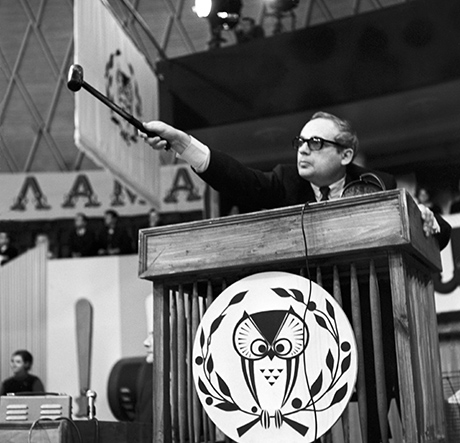 © ITAR-TASS First Game Transfer of Central Television live the auction. The author of the project and the host is Vladimir Voroshilov
Although one person nevertheless spotted a “counter” in her and guessed her unsaebridity. That was, of course, Lapin, with whom Voroshilov once had a frank dialogue. Vladimir Yakovlevich himself told about him on the air of the Echo of Moscow. I quote on the site: "What are you doing in your program?" Then I, a young man, replied: “We teach people to think, solve problems.” He says: “Here you are a state criminal!” "How?" - I was taken aback. “Look, you teach people to think, they think about this issue. Look at the street. Life also raises questions to them. And God forbid they will begin to think there, on the street, over the questions that they are posed by life! After all, nonsense will turn out.”
And now you can marvel at how deeply learned the essence of the Soviet regime one of his faithful sons - Sergey Lapin. He correctly understood his super -task - if possible to deprive people of the skills of thinking over the past, present and even more future.
... The most idiotic order of the powerful Goodwin, who would make Madame Mizulina, was a ban on taking Alla Pugacheva close -up. Певица слишком приближала к губам микрофон, что вызывало ассоциацию с оральным сексом.
…Кинорежиссер Алексей Симонов, работавший в 70-х годах в объединении «Экран», рассказал в радиоэфире «Эха Москвы» о своем непосредственном столкновении с человеком, которого он и его коллеги называли не Великим и Ужасным Гудвином, а байбаком. Это такой крупный сурок, но мелкий грызун.
Симонов сделал картину об Утесове и об Одессе. Картину сильно покусали начальники разных уровней и рангов. Автор не стерпел и кинулся к герою своего фильма. Дальше цитирую сайт радиостанции:
«И вот Утесов после долгих уговоров и отказов и тому подобное наконец подошел к телефону, набрал данный мною номер и сказал: “Это народный артист Утесов говорит. Мне бы Сергея Георгиевича”. Немедленно соединили. “Сергей Георгиевич, здравствуйте, это Утесов говорит. Вы не знаете, зачем у вас меня второй раз обрезают?” И я вижу по его абсолютно каменной физиономии, что там происходит ровно та же самая реакция. “Я видел. Мне нравится. Да, хорошо, спасибо большое”. Он сказал, чтоб без него меня обрезали. Вот так я столкнулся первый раз с редактурой Лапина».
Тут требуются некоторые пояснения. Лапин при всем своем радикальном авторитаризме в рамках своего ведомства питал большую слабость к высокой культуре. И это было не мифом. Слишком много живых свидетельств сохранилось.
Журналист Андрей Мальгин припомнил:
«Как-то Засурский (декан факультета журналистики МГУ. — Ю.Б. ) пригласил Лапина на встречу со студентами журфака. Я ее хорошо помню. Это был примерно 1976 год. Аудитория была забита до отказа: всем хотелось увидеть живого сатану. Лапин оказался ироничным, образованным человеком, говорил какие-то очень смелые вещи. Он наизусть цитировал запрещенную поэзию, например. Мы все не верили своим ушам».
У Эдуарда Сагалаева есть история, как ему довелось ехать в какую-то командировку с Лапиным, как они всю ночь напролет читали друг другу стихи Цветаевой, Пастернака, поэтов Серебряного века...
Да и каждый, кто удостаивался личного знакомства с «телевизионным Сталиным» — так его еще называли, — не уставал восторгаться литературной эрудицией высокопоставленного начальника.
Тут, видимо, и ключ к загадке, почему Лапин дал добро на съемку «Иронии судьбы», тогда как глава кинематографического ведомства Филипп Ермаш этому категорически воспрепятствовал.
Воспрепятствовал он именно потому, что в сценарии было слишком много лирики, да еще и не эстрадной и потому подозрительной. И ровно по этой же причине сценарий «Иронии» глянулся Лапину. А Лапин произвел достаточно сильное впечатление на Рязанова при личной встрече:
«Я поразился тогда Лапину — такого образованного начальника я встречал впервые. Но еще больше я поразился тому, как в одном человеке наряду с любовью к поэзии, с тонким вкусом, эрудицией уживаются запретительские наклонности» (цитирую по фильму «За железной маской. Сергей Лапин»).
Точно так же можно поразиться тому, что такой образованный человек слыл еще и отчаянным антисемитом. Об этом тоже ходили легенды. Были и убедительные примеры, одним из которых поделился Евгений Киселев.
Снимался документальный фильм-обозрение о 67-м годе. Ну и нельзя было обойти Шестидневную войну между Израилем и арабами. Там были кадры, когда израильские танки идут в наступление, победно сметая все на своем пути. А за кадром звучала бравурная музыка. Во время просмотра Лапин обернулся к авторам, глаза были злые: «Что? Ваши наступают?» (сайт «Эха Москвы»). Авторы, перепугавшись, сами выкинули. То есть обрезали. Непонятно, в какой раз: в первый? Или все-таки во второй?
***
Относительно совместимости вкуса, эрудиции с запретительскими наклонностями в советское время можно было не удивляться. Это было, да и сегодня остается делом житейским. Просто многие люди тогда ставили внутри себя звуко- и светонепроницаемые перегородки: вот я — сладострастный библиофил, а вот — непреклонный идеологический вертухай.
***
Когда ТВ было невинным, как дитя, казалось, что оно изобретено для Ираклия Андроникова и его рассказов о мастерах культуры и еще для трансляций футбольных и хоккейных матчей. Что ТВ — это такое техническое изобретение, которое само по себе гарантирует правдивость того, что оно показывает. Гарантирует в силу своей сиюминутности. И что перед телекамерой нельзя солгать. То есть солгать можно, но ТВ скорее любого детектора лжи выдаст тебя.
Первый исследователь отечественного ТВ Владимир Саппак даже взял на себя смелость сформулировать: «Телевидение — рентген характера».
Про характер — может, это и преувеличение. Но про искренность и естественность человека в рамке экрана ТВ в пору своего зарождения не врало. Оно было еще очень невинным — опять же в силу своей сиюминутности. Потому советская власть с большой настороженностью отнеслась к этому достижению человеческого разума. Она — как та придворная дама из шварцевского «Голого короля», что останавливала наивную Принцессу, едва та раскрывала рот: «Умоляю вас, молчите. Вы так невинны, что можете сказать совершенно страшные вещи».
Как раз самой «страшной правдой» для Советов и была их патологическая лживость. Власти поэтому приходилось сильно осторожничать и быть все время начеку, пока не появилась технология видеозаписи.
Впрочем, и без нее советское ТВ со временем научилось достоверно привирать. Это было ему тем легче делать, что у массовой публики за десятилетия жизни во лжи заметно атрофировался вкус к подлинности факта, события и самого человеческого характера. А уж когда появилась технология видеозаписи, позволявшая сначала зафиксировать реальность, а потом ее отредактировать, то и проблем не стало. Более того, расширились возможности манипулирования «картинкой» и сотворения идеологических миражей из идеологических клише.
Штука, однако, в том, что советское ТВ, обманывая зрителей, не могло до конца обмануть Жизнь. В жизни всегда находятся наивные свинопасы и невинные младенцы, которые ненароком глаголют «страшные вещи», то бишь истины.
На прощальной летучке всесильный начальник ЦТ сказал: «Я верно послужил своему времени, желаю вам послужить — вашему».
Лапин ошибся. Он послужил не времени, а временщикам. Он был в силе, пока они были сильны, и мгновенно ослабел, едва советский режим перестал быть для него «железной маской». Тут-то и выяснилось, что грозный теленачальник был не Великим и Ужасным Гудвином, а Великим и Ужасным Обманщиком.
Пришедший к власти Горбачев отправил Волшебника Изумрудного города на пенсию. Да и сам Изумрудный город, отстроенный Лапиным, приказал долго жить. Не дольше, чем прожил Советский Союз. И он развалился на куски. Да вот проблема: его население никуда не девалось. С ним надо было как-то работать. И телевизионную реальность заново отстраивать.
И тут выяснилось, что прежняя служба была всего лишь службишкой. Настоящая служба впереди, и чтобы ей соответствовать, надо телевизионным гудвинам рискнуть поработать без железных масок.
To be continued.