
Translated material
Life to Auschwitz
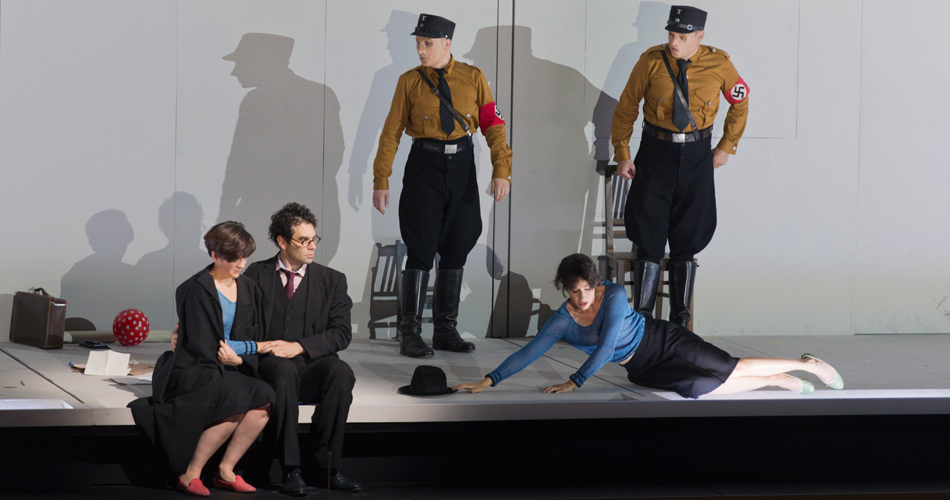
The 53-year-old Frenchman Mark-Andre Dalbavi became the main modern modern composer in Salzburg, along with Wolfgang Rome. The works of the famous representative of the “spectral music” generated by the ideas of Messian, Stokhausen and Liegeti (one of the founders of the movement called them the holy trinity) sound in several concerts. So, in the program of the Vienna Radioxymphonic Orchestra, under the control of the new star of Cornelius Mayster, the “La source” entered ( “ La Source D ' un REGARD ” (2007), Playing Olivier Messian) and sonnets of the medieval poetess Louise Laba for counteratradenor and orchestra (2008). Sonnets are dedicated to Philip Zarussian, and he performed them at the festival.
In 2010, the first opera Dalbavi Jezualdo was put in Zurich. It is dedicated to the legendary killer composer, who lived in the 16th century and has become a cult figure in the art of the XX century. The then quartermaster of Salzburg, Alexander Pereyre, apparently liked it, and this year Salzburg shows the Charlotte Salomon ordered by the Charlotte Salomon festival. The new opera is devoted to a Jewish artist from Berlin, who tried to escape from the Nazis with French relatives and who died in Auschwitz. Work on the party ended a few days before the start of rehearsals.
 © Salzburger Festspiele / Ruth Walz
In recent years, the legacy of Charlotte Salomon (1917-1943) has become widely known thanks to many exhibitions, its work was shown even on the last “document” in a cassel dedicated to modern art: there is no above the artist of the past. During life, things were different. Despite the Jewish origin, the girl managed to enter the Higher Art School in Berlin (father, a Jew, was a participant in the First World War and fell under the plot of the so-called privileges for veterans). But her victory at the training competition was canceled due to her origin. After that, Charlotte quit her studies.
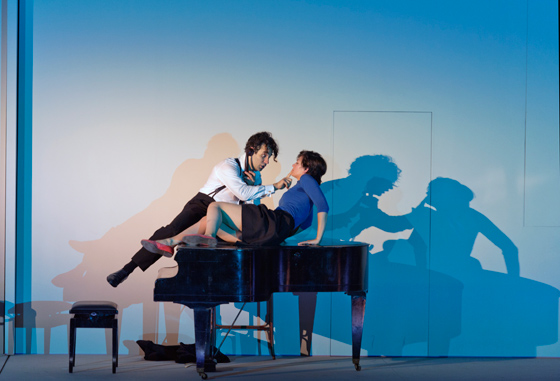
Attempts of assimilation turned into a tragedy, a society to which she and her family belonged from birth, suddenly decided to delete millions of people from her history. Most of the graphic works of Salomon arose in the late 30s and early 40s. In the Goisha series, she tells the story of life, her novel with the teacher of the vocals of her stepmother (which she herself was in love), describes the experienced in Berlin after the Nazis came to power, exile to the Cote d'Azur, staying in the French concentration camp Gürs, where she was interned as a Jewish.
 © Salzburger Festspiele / Ruth Walz
The drawings are accompanied by explanatory texts inscribed in the overall composition, which is why they become like a huge dramatic comic book; It is often mentioned by music suitable for certain fragments, as if the author thought about the production. The artist gathered 796 sheets in a certain sequence, entitled “Life? Or the theater? ”, They look like a ready -made play or a movie scene. Today, these gouas are stored in the Jewish Museum of Amsterdam.
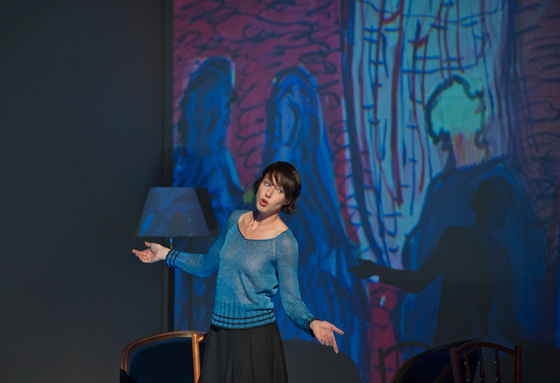
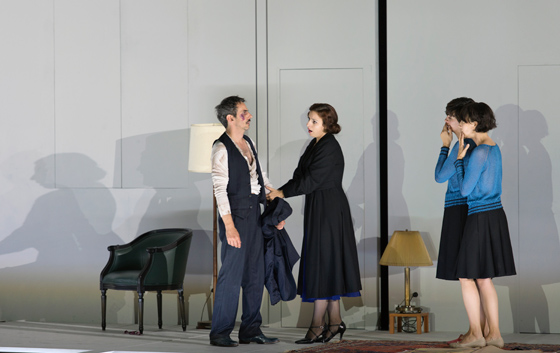
Such a fate is another argument to the approval of Adorno about the impossibility of poetry after Auschwitz. She is able to suppress any librettist. From the first version of the libretto and the author, who was too literally engaged in a description of the fate of Salomon, had to refuse. The final text appeared only nine months before the premiere. The libretto of Barbara Honigman focuses on the history of his first love for the notorious egocentric Amadeus Duberglon (he is sung by Canadian tenor Frederick Antun) and the history of the family. Charlotte's mother and grandmother committed suicide. The image of Charlotte on the stage is doubled: in the play of Luke Bonda it is played by a brilliant duet-the dramatic actress Johanna Voculey from the Vienna Burgtheater and the French Metzo-Soprano Marianna Krebass. More precisely, they play two Charlotte: Voculek (it is known, in particular, the role of Gudrun Enslin in the film “Complex of Baader -Mainhof”) reads the German text on behalf of Charlotte Salomon, Krebass sings the franco -speaking part of Charlotte Kan (Kan is the name of the father of the artist).
 © Salzburger Festspiele / Ruth Walz
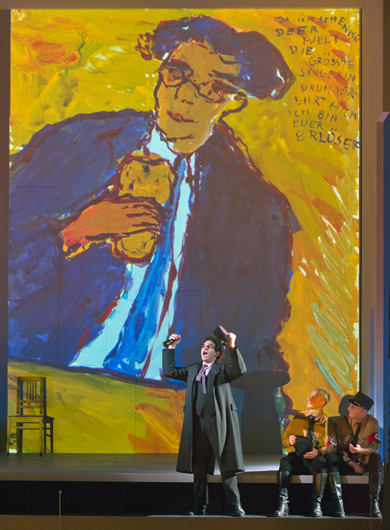
The Felsenreitschule scene is divided into 12 large and small rooms, where rapidly changing scenes are played out (Johannes Scheuts artist worked a lot with Jurgen Gosh and Roland Shimmelpfennig). Inspired by expressionists and the work of Salomon, which are approaching the comic book, are projected onto the white walls - sometimes it seems that Dalbavi’s music is more in a dialogue with them than with a libretto, the prosaic fragments of which nevertheless threaten the musical space. At some point, the partitions disappear, the scene elongated in length is flooded with light. The clarity of the look corresponds to the clarity of music. It has many quotes, both recycled and straight. For example, the “ L ' Amour ” aria from the “Carmen” Bizet, which the stepmother Paulinka (Mezzo-soprano anaik Morel) sings, can be heard both alive and in a historical record (the stepmother was a famous singer, her voice was preserved by the records). Jewish motives and Nazi melodies sound.
 © Salzburger Festspiele / Ruth Walz
The conductor - as in Zurich, Dalbava himself stood behind the remote control of his work - extracts impressionistic lightness from the Salzburg orchestra of Mozarteum, then dodecafonial endlessness. Such a combination of eras and styles, looking as an Ommage not only of a single life, but also culture as a whole, would like Gerard Mortier, whose memory is dedicated to the production.
The opera does not talk about the final of life by Salomon, the text that appears in the form of the credits is notonon. In 1943, she married the Austrian doctor Alexander Napuler. Soon, respectable French citizens issued the newlyweds to the Gestapovites, the couple was arrested and deported first to Drancy, and then to Auschwitz. Probably, immediately upon arrival, Charlotte was sent to the gas chamber. She was in the fifth month of pregnancy.