
Translated material
Alternative shrimp
Last Saturday, August 9, the Minister of Agriculture of the Russian Federation Nikolai Fedorov on the air of the Vesti program said that Russia has determined for itself new priority trends in imports that will replace countries that have fallen under the food embargo.
According to Fedorov, Azerbaijan, Uzbekistan, Armenia, Tajikistan and to some extent Kyrgyzstan can be carried out to Russia. In addition, the minister identified Iran, Morocco and Egypt: “They need our products, in particular, in grain and vegetable oil, and we need vegetables, fruits, berries and citrus fruits, ” he explained. One of the alternative sites under consideration is Latin America, a powerful and promising market.
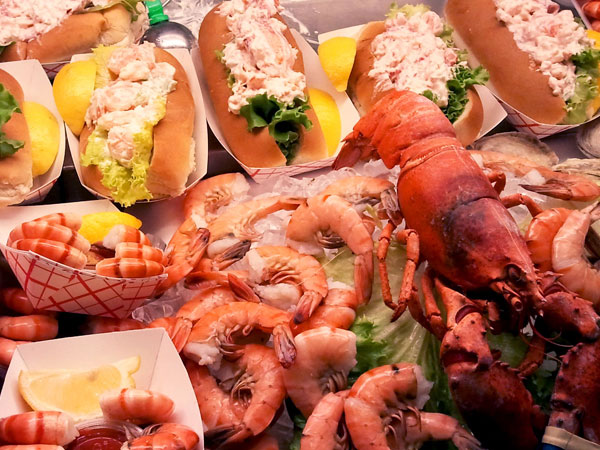
Some products, previously fully imported, now manage to find an alternative in Russia. So, for example, the absence of Norwegian fish in the market is compensated by Russian suppliers. It will not be possible to replace or find a worthy alternative only to elite cheese varieties and seafood. But Nikolai Fedorov noted that these losses for the country will not become a very heavy blow, as they relate to premium goods and make up a slight segment of the market.
Introduced restrictions pushing Russian manufacturers to decisive action. Farmers near Moscow are ready to produce Foie Gra and Hamon, as well as other products that are now inaccessible to the Russians, Izvestia reports. True, to launch production, farmers need financial support, which they expect to receive from the budget or from investors.
China is already holding strategic positions: Baorong opens the area of direct export of vegetables and fruits in Russia in the Dunnin County, Interfax reports with reference to the chairman of the Association of the applied economy of the province of Heilunjiang Chunjianoo. At the Dunnin checkpoint, direct communication will be commissioned for the export of vegetables and fruits to Russia. It is planned that the Baorong zone will become a logistics center for exporting agrarian products to the Far East of Russia.
Another Russian partner, Belarus, is ready to occupy a niche of Europe on the issue of supplies of products to Russia. In the near future, official representatives of the parties will discuss the issue of increasing the export of Belarusian goods to Russia. The Minister of Agriculture of Belarus Leonid Hare sees a good opportunity for the country to significantly increase the volume of food supplies to the Russian market. The assortment will be expanded due to pasta, vegetables, undergraduates and sweets. Belarusian farmers are seriously configured to replace Dutch potatoes and Polish apples. President of Belarus, Alexander Lukashenko, promised Russian colleague to President Vladimir Putin to realize the absolute transparency of borders in the spirit of partnerships, Interfax reports .
Together with Belarus, he will try to occupy the niche of European goods and Kyrgyzstan. From there, onions, beans, potatoes, fruits, chicken meat, eggs, as well as meat and dairy products can be supplied to Russia. Some problems may arise with an import of meat: in this country there are no special Vetlaboratories with a certificate of the Customs Union.
The course to increase export volumes to Russia is taken by Japan. She intends to do this regardless of external circumstances, RIA Novosti reports . “The exports of Japanese agricultural products to Russia are still too small. Of course, if we could already compete (with other countries that the restrictions apply to), then the removal of a competitor could become a big advantage, but so far, unfortunately, we do not consider ourselves competitors. We would like to increase the supply of Japanese products to Russia. This could contribute, for example, a revision of restrictions on the import of fish products introduced due to an accident at the Fukushima-1 NPP. In any case, Japan would like to increase the export of agricultural products to Russia, regardless of external circumstances, ”Maiko Kubo, a representative of the Ministry of Rural, Forestry, told the agency.
Brazil will increase meat exports to the countries of the Customs Union. The Ministry of Agriculture of Brazil reported that the Rosselkhoznadzor allowed a record number of suppliers to the Russian market: 89 companies producing animal products in Brazil were accessed to the Russian market. “As a result of this, Brazil will significantly increase its export of meat and dairy products to the countries of the Customs Union, thereby strengthening the international partnership in the field of agriculture and the relations of trust and friendship between the two countries (Russian Federation and Brazil),” the statement of the Minister of Agriculture of Neri Geller said . The Chilean representative office is also optimistic to increase supplies to Russia, but has a number of reservations.
In those countries that Russian counter -sanctions affected directly, the discontent of entrepreneurs and farmers has already manifested itself. For example, France turned to the European Commission with a request to take measures to combat the consequences of the Russian ban on imports of food products from Europe, The Localreports . This appeal followed the meeting of the French president with food producers, who are seriously concerned about the Russian food embargo. Manufacturers insist on the importance of European and French exports to Russia, and the European Commission still promised to pay attention to fruits and vegetable producers and farmers, in whom the difficulties have already begun.
Greece is also not at all happy with the loss of one of its largest markets. “Very difficult times are coming for us. All Greek strawberries, apples, oranges, nectarines and other greens, which used to be exported to Russia, will now be in our small domestic market, and this will necessarily collapse prices for fruits in Greece, which will put many farms on the brink of bankruptcy, ”the Russian newspaper quoted the Greek entrepreneur as saying. According to him, you will have to try to reorient supplies to the Greek Islands, but the losses will still not be avoided. In Athens, they calculated that Russia imports 25 percent of all peaches and about 50 percent of strawberries from Greece. Local farmers supply products to Russia in the amount of 450 million euros, which is almost a quarter of the entire fruit export of Greece.
Italian manufacturers of Parm ham are not ready to part with the Russian market yet. “We do not need this now - at the moment when we manage to maintain the level of sales only in foreign markets. We cannot afford to lose this sales channel, ”the ITAR -TASS agency President of the Consortium of Paramian ham Consortium quotes Paolo Tanar. Last year, the earnings of participants in the association in Russia reached 2.5 million euros, and many companies invested in the development of their activities in the Russian market.
The Russian food embargo can lead to the bankruptcy of Estonian agricultural enterprises, which, having lost the Russian market, will lose access to other markets, including Lithuania. Romania estimated direct losses at 40 million euros, indirect losses are so high that this problem will be discussed at the EU level. In Lithuania, the sanctions will hit the dairy industry and meat production, and Muslim countries are considered as an alternative market there.
In total, the economic losses of the European Union from the sanctions introduced by Russia are estimated at 40 billion euros, this figure is given by the EUOOBSERVER. RBC experts Daily calculated that in total last year to Russia from the EU received products worth about 11.8 billion euros, almost 40% of the products were banned with the introduction of the embargo, which is approximately 4.5 billion euros of losses. The Eurostat offers its data , according to which the Russian Federation accounts for 10% of the total agricultural and grocery exports of 28 countries of the European Union totaling 12 billion euros, which will amount to losses for the next year.
Recall that on August 7, Russia introduced an annual restriction on the import of a number of goods from the USA, EU countries, Canada, Australia and Norway. This measure was a response to sanctions against a number of Russian companies and officials who were introduced against the backdrop of Ukrainian conflict. The government approved a list of products prohibited from imported from the above countries, it included, for example, beef, pork, poultry, fruits, dairy and fruit and vegetable products, nuts and other products.