
Translated material
Riddles of earthly spheres

Soviet writers dedicated to geology many beautiful works. And today you can enjoy reading the popular science books of Obruchev, Fersman, fiction of Kuvaev and Efremov. They will immerse you in the world of romance, in the kingdoms of the taiga and deserts, where courageous bearded people go on routes, where cards are drawn with a pencil by hand where there are no computers and satellites. Soviet books will tell you about how the land was investigated in the last century. What is this science today? Why do the current graduate of the school go to the geological faculty, why should he engage in geology? The answers to these questions are usually contained in popular science literature, but try to find something fresh in geology in our stores. Shift and deducted: Tom "Geology" from the children's encyclopedia "Avant+" and the book "Earth. Meteorites, volcanoes, earthquakes ”, which this year was released by the small Publishing House of Century-2 from the Moscow Region Fryazin with the support of the Dynasty Foundation. The book was written by Professor of Moscow State University Nikolai Vladimirovich Koronovsky, one of the most competent people in this area. Nikolai Koronovsky - a specialist in the Big Caucasus, the volcanism of the Mediterranean folded belt; He reads courses on general geology, tectonics and magmatism, conducts educational practices, he has written several textbooks. He headed the department of the dynamic geology of the Faculty of Geological Faculty of Moscow State University in 1986, and in the same year I became a student of this department. The very first lecture was given to us by Alexander Yakushova, the oldest employee of the faculty, the author of the textbook “General Geology”, according to which we later studied. The textbook of Yakushova co-authored with Koronovsky reprinted in the year of my issue, 1991.

In post -piercing time, Nikolai Koronovsky turned out to be the only one who talked about the geology of the wide audience. He is the author of articles in the journal "Nature"; The “Geology” mentioned above was almost half written by him, his colleagues in the faculty wrote the other half. Koronovsky was in the program of Gordon in 2002 [1], lectured in the television program “Academy” [2], played at the festivals of science of Moscow State University. The book "Earth. Meteorites, volcanoes, earthquakes ”is a logical stage in the author’s popularizer activity. He concentrated his experience in a small volume by book standards - on only 176 pages. The book is devoted to modern theories and models with which geologists describe the structure of the Earth and the processes occurring on its surface. The author exhaustively gives the history of ideas from which tectones of the plates consisted. Starting with the idea of the Draf of the continents of Alfred Vegener, the new model was crowned with an explanation of ocean rift zones using the concept of spreading (spreading), invented by American marine geologists Hess and Ditz in the early 1960s. “It was a brilliant hunch,” Nikolai Vladimirovich spoke about this discovery about this discovery at the first lecture on magmatism. We still studied from the textbooks of the 1960-1970s in the paradigm of fixism, that is, geosynclinal theory, and static continents. And in the lectures and at seminars we were told about tectonics of plates, magnetic anomalies of the ocean bottom, and the pioneral formations according to which the zones of subduction are formed.
Tectonics of the plates combined numerous facts accumulated by geologists in previous centuries, and explained the riddles that appeared in the second half of the twentieth century, during large -scale international programs to study the bottom of the oceans.
Further I I will hit V reasoning about Basics Geology , intentionally simplifying them For clarity , and If You are not amateur articles O science V Plane journalist , then Here It's time leave reading And Go directly To book N. IN . Koronovko GO , where Theoretical Part Ped Shana Details . Although she An abundant special terminology , fight Xia this Not costs author By The course of the narrative Gives Explanations , a At the end Books There is Dictionary . At the same thing With him Can And start off read book .

Continental and oceanic slabs, zones of sub production, spreading, transformed faults, plumas, these complex models made it possible to understand how the picture of continents and oceans observed by us, why volcanoes arose in certain places of the Earth. Previously, in order to explain the existence of mountains and oceans, the earth was represented in the form of a blowing rubber ball, which goes different folds as the forces were applied to it. Now I had to separate the upper layer of the planet from the planet from the rest of the ball and make it slide horizontally. Since this layer is inflexible and the basis under it is an asthenosphere, although it is considered a viscous, but stone, the earth's crust breaks, cracks, wrinkles in a variety of places, like the first pancake in a pan. The slabs of the cracked earth's crust crawl into each other, a mantle substance begins to penetrate into the cracks between them, which, as it were, patches the surface of the planet. These conflicts of the slabs of the earth's crust are called tile tectonics with a key theoretical model in modern geology. The slab tectonics explained the oceans and the outskirts of the continents, mountain ridges in the middle of the continents and deep -sea grooves. And to explain the phenomenon of the Hawaiian islands that are sitting in the middle of the plate, I had to enter a new design - plumas. This is streams of a hot mantle substance circulating inside the planet. The plow rises up, and a Pacific plate floats over it, and it burns through it through. Since the plate continues to move, it is baking on it stretching. This one was on the Hawaiian volcanic islands. The model of mantle plows was confirmed in the 1980s thanks to seismic tomography-technology that interprets the deformations that occur inside the Earth during earthquakes.
From the theoretical foundations, the author of the book proceeds to the consideration of the catastrophic phenomena that geology is engaged in, and a lack of new theoretical constructions is manifested here. Tectonics of slabs explains why the Elbrus volcano is located in the Caucasus, and in Sicily - Etna and why high mountains are located around the Mediterranean Sea and earthquakes often occur. But to predict when the volcano will erupt or when it starts to shake, it cannot. For this task, some more complex models are needed.
Earthquakes in the book are devoted to a special chapter. Their reasons have long been not a secret for science. These are deep factors - accumulated by millions of years of tension of the earth's crust, and the movements of ocean plates, and lunar tides, and even human activities - large reservoirs, pumping out oil and gas, underground nuclear explosions. The impossibility of predicting the earthquakes, no matter how you thicken the network of seismographs, it became clear, according to Koronovsky, back in the 1980s. Some harvesting of the earthquakes can observe some harbinger; Sometimes they can even say about the probability of an earthquake in a particular region, but when and where exactly it shakes is almost always unknown. For all the technical sophistication, theoretical models, and centuries of accumulated facts, geologists cannot predict catastrophic phenomena, which means that they cannot prevent people about dangers. And in this lies a large mystery that science has encountered. The combined forces of all sciences were thrown to search for a solution. Geology and geophysics more than ever need fresh ideas.
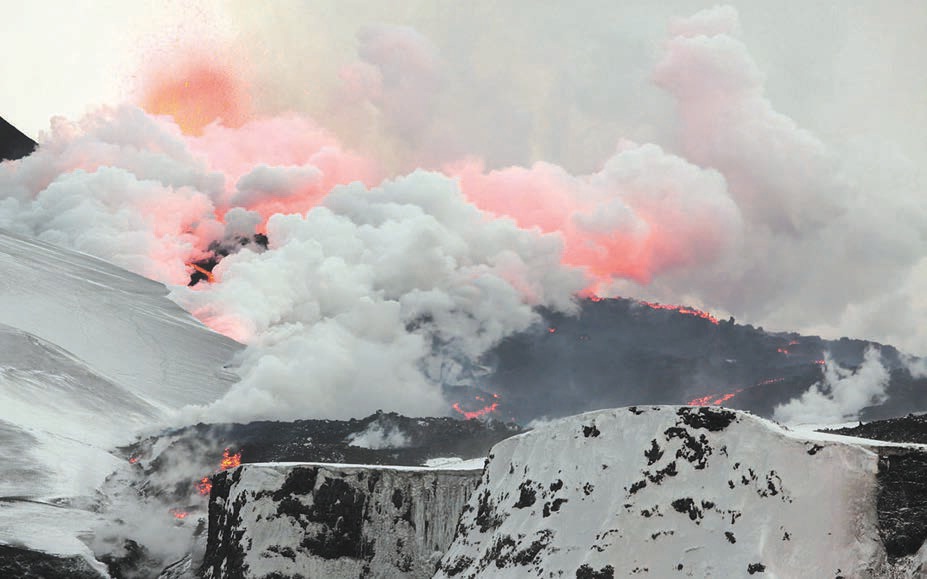
One of the advantages of the book is the detailed explanations of past disasters from the point of view of modern representations and the analysis of the latest disasters known to us in media coverage. The author talks about the earthquake in Japan in 2011, which caused the accident at the Fukushima-1 nuclear power plant, the eruption of the Eyayafyadlayokyudl volcano in Iceland in 2010, which paralyzed the air traffic of Europe, about the earthquake in the Indian Ocean in 200 4 4, which caused the deadly tsunami. Details N.V. Koronovsky reconstructs the history of the island of Santorin in the Aegean Sea, where he worked.
The author generously provided the narrative with examples of the latest works of Russian scientists, and this is another dignity of the book. The emphasis on the achievements of Russian science gives it special value.

Part of the book is dedicated to meteorites and traces that they leave in the earth's crust - astrocks and minerals of shock origin. Traditionally, these objects are in the field of studying geologists, which each meteorite crater are explored along and across, cleaner than investigators. The last revolutionary discovery in this area is still a little famous public. We are talking about iridium anomaly in the rocks of the late Cretaceous period, discovered in the late 1970s. Scientists explained the anomaly with a blow of a large meteorite. And ten years later, the Canadian geophysicist Hildebrand tied the origin of Iridia with Crater Chiksulub in Mexico. The consequences of falling a meteorite on the territory of Mexico 65 million years ago were catastrophic and led to the global extinction of the sea fauna.
Geologists, of course, do not undertake to predict the fall of meteorites - this is the case of astronomers; The task of geologists is to find astroble on the surface of the Earth, because there are mining. For example, the Popigai astroble in Eastern Siberia contains a large deposit of stressed diamonds (impact diamonds). Two years ago, Popigay diamonds made a fairly noise [3]. The media suddenly began to reprint the same press release, which spoke of the largest discovery of diamonds in Siberia. In fact, the Popigay diamonds have been known since 1970 and have been very well studied. And why it became known about this discovery only now, read in the book of N.V. Koronovsky.
Geologists are people of observation, fact. They are not a master to invent hypotheses and give explanations, they often have to wait a century until scientists from the exact sciences will invent devices and methods that can advance research in geology. The book will be useful not only to schoolchildren, but also to students and scientists from other areas - physicists, chemists, mathematicians. If your science seems too close to you, come into geology, there are very complex riddles and requiring the development of theory. It was not white spots to geographers on Earth, and for geologists underground there are still full of them.