
Translated material
"Simple a good product is important"
The format of art residence has been known for a long time. With their help, not only the issue of temporary housing for representatives of creative professions is solved, but also many other tasks: the formation of the city’s brand, overcoming cultural isolation, improving the image of not the most prosperous areas, the development of small cities, the spread of local culture, etc. Such residences can be found around the world - in Holland, Italy, Lithuania, Austria, Norway, the USA, Taiwan and recently in Russia.
The residence usually involves providing housing and receiving a grant for any project: the program can last one or several months, even a year, and at that time the resident works on its project, which can be an artistic statement in almost any field, starting from literature and ending with dance. For example, the creators of the art response of the HCSI in Kronstadt are interested in finding artists who intend to work with the historical and cultural landscape of St. Petersburg and are ready to popularize contemporary art in Russia.
Speaking about residences in Moscow, it is worth mentioning the Center for Creative Industry "Factory", as well as the Rodina residence near Moscow in the village of Nikiforovo (unfortunately, destroyed by a fire in February this year) and an exhibition of resident participants in Nizhny Novgorod.
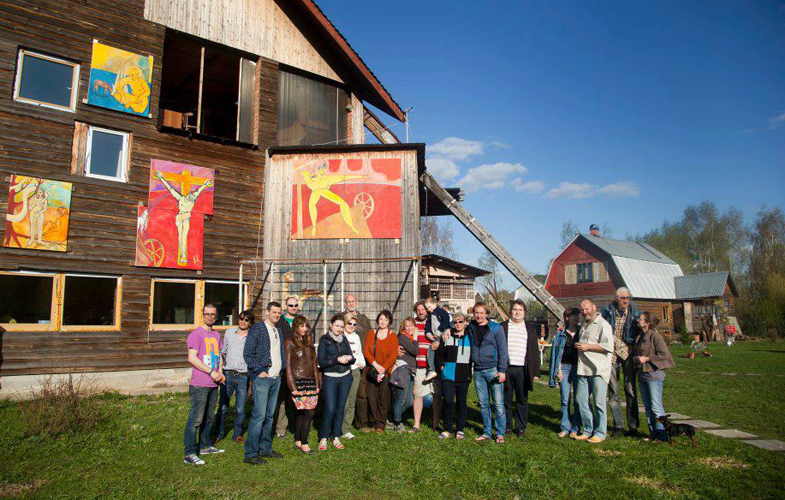
The residence "Homeland" , or squat, as the artists called it, has existed since 2012 and was organized by the efforts of Semyon Peterson: he took off the cottage in the suburbs, and then there were artists who settled there. They came from Moscow, Naberezhnye Chelny, Magnitogorsk. The Homeland did not imply any tough set of rules-usually the artist sets in for several months and leaves the residence after the implementation of his project. Peterson explained that people just live here until they leave. After a fire in February this year, only the ashes remained from the residence. Semyon Peterson is currently collecting funds for the restoration of the "homeland", but does not yet know if the residence will be located in the same place or will move somewhere.
The canvases that survived after the fire of the "Motherland" were exhibited in the friendly hostel Fabrika at the exhibition with the speaking name "Homeland on fire!" Located in the Red October, it positions itself not only as a place for an overnight stay, but also as a platform for creative people. The first Fabrika was opened in Moscow in 2011 (at the moment there are two hostels in the capital with this name). As stated on the hostel website, several dozen exhibitions of contemporary art were held here, including the “feminist pencil”.
In TsTi "Factory", the residence is provided to candidates whose projects belong to a variety of areas - from sculpture and modern dance to theater and literature. The resident’s life dates back from three weeks to three months. The Factory accepts not only compatriots, it also supports the cultural exchange program, providing places in the residence of foreigners who will decide to implement their project in Russia. Each such project ends with a presentation of its results - for example, in the form of an exhibition.
Another residence in Moscow, a little dropping of the general rules of such spaces, is the art-residence "ZIL" . The ZIL project differs from classical residences in that it does not provide housing to participants. Elena Melville, the director of the cultural center, explained this feature by ZIL with the status - the site is a monument of culture: “The problem is that it is very difficult to transfer the non -residential fund in the residential in Moscow due to a certain legislation. In our case, this is impossible: we are a monument, so there are additional encumbrances and restrictions on use. We are unlikely to succeed in such a story, unless we enter into cooperation, for example, with hostels or with someone else who can provide such a service. ” ZIL adopted the British model of the residence: the participant is provided with time and money to implement the project, and then the site for the exhibition. The cultural center covers the participant’s expenses for the project and, upon its completion, provides its own space for the show. In the past and this year, according to Melville, the ZIL art residence received a sufficient number of applications from both professional artists and activists to organize the visited exhibition.
The project is funding from the Moscow City Budget: “We received money for the project at a grant competition from the Department of Culture, which believed in this idea, and the idea itself met the tasks of the organization, so we were provided with financing. There were no sponsorship money, so far, but the scale of our event is not the same to attract such funds. But for the future we will already make sponsorship packages. ” Elena Melville notes that the project showed how to make a good exhibition without attracting large amounts of money: “Everyone says:“ We cannot do a good project, we have very modest financing. ” Attracting a private, independent initiative, we thereby saved abruptly, because we spent, I don’t know, 180 thousand rubles for supplies in addition to providing the site, but for seven full -fledged, cool projects. Despite the fact that the authors did not receive fees, they gave us their intellectual, creative contribution. Therefore, from the point of view of the economy, this is extremely effective, especially when everyone begins to talk about increasing the efficiency of expenses. We got two stories: the effectiveness of the place - it is not idle, it is open to new initiatives - and economic efficiency. This experience is successful, we are extremely satisfied, and now there will be the next competition, we accept applications, and I think that this story will continue. ”
The format of art resident, according to the director of the ZIL Cultural Center, turned out to be necessary and relevant not only for beginners, but also for people who already had art projects: “Our experience showed that photographers like Denis Sinyakov and unknown authors participated. Demand gives rise to a proposal, but there is demand. We all know that there is a parallel structure of culture, non -state, for example, “artplays”, “bottle”, “wineswrus”, but one way or another the number of seats is very limited, so we knew exactly that the demand is on this story. Having offered a free area with a full coverage of expenses, we attracted the part of the community that just enters the market, but even those who already have a creative experience drew attention to our residence. ”
As for visitors to exhibitions with projects of art resident participants, they were not particularly important for them the residence format with special conditions for artists: “I don’t think that all the visitors were fully understood where the project came from: they were just used to coming to ZIL, because something is always going on and showing something here. They, in general, do not care whether they gave the artist from outside or the idea appeared within the institution. Such a genre of the exhibition is still unusual for us, so no one really thinks about the format of the event: the final user is interested in the final product with a living platform. And as such, the mechanisms of the site are not interested in the site, perhaps, except for those who want to try themselves in this format of artistic statement. First of all, this is a project for creators, and not looking. For the latter, just a good product is important, but since applications for the residence are high -quality assessment by experts, we are confident in a certain level of projects. Therefore, when we showed executive projects twice, it was clear that visitors liked it, that is, the product turned out to be of high quality. ”
The life of artists and representatives of other creative professions is unstable, and therefore residences are a successful way to survive a couple of months, and even do something necessary (at least for yourself). How successfully Moscow art residents work in this direction is to judge the reader.