
Translated material
All about his mother
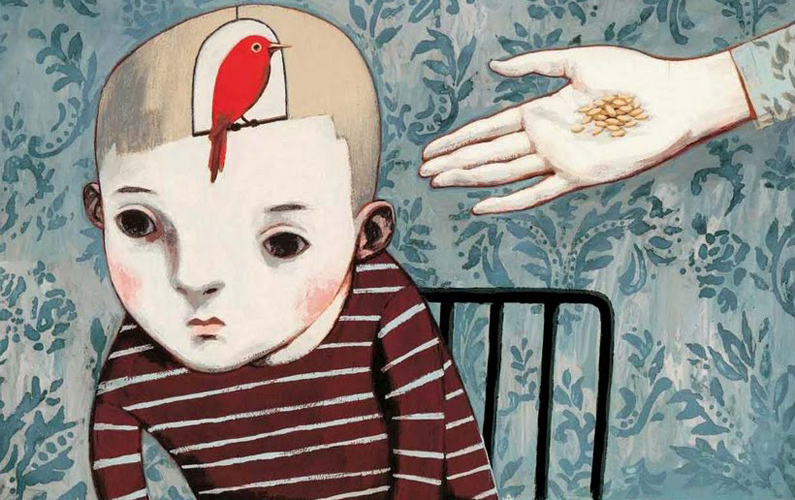
The plot is initially simple and sad: the ordinary Russian mother Lisa, having given birth to a boy Petya, gradually finds out that the boy has autism. And then everything heals him, heals, heals, until he finally finds an effective tool - in the form of Glenna Doman's techniques. If there was such a section “Mother's Feat”, then the book of Elizabeth Zavarzina-Mammy would suit her as well as possible.
Once upon a time I wrote a text about autists for the magazine "Big City" and wrote it unforgivably for a long time-for example, six months. During this time, I clearly understood one thing: the woman who gave birth in a standard Russian maternity hospital with a diagnosis of “RDA” (early children's autism) has not many options for further life. First of all, doctors will advise her to send the baby to the child’s house, from where he will then be transferred to the orphanage, and then the neuropsychiatric boarding school. Especially compassionate will advise the boarding school better with quality - I remember one mother, who was quite satisfied with the boarding school, until her son was shifted with medicines, after which his eyes rolled up for two days and there was saliva from his mouth. “Our state seems to tell parents: give your sick child to us, we will take care of him, because in our healthy society there is no place for such children,” Roman Damenstein, a member of the expert council of the Center for medical pedagogy (one of the few places in Russia, where they are selflessly engaged in self-evaluated).
The second scenario is to consult doctors. It should be understood that the diagnosis of “early children's autism” in Russia has not been made for a long time at all: the pediatricians, as a rule, recorded such children in schizophrenics and did not really understand what to do with them. Sometimes they expected that such a patient, like the hero of the “man of rain”, would recount all the matches in the box in one hundredth of a fraction of a second, and in two - will collect a large -scale panel of cardboard mosaics. In the worst case, parents were explained that everything was in order with the child, and that he refuses to speak or repeats the same monotonous phrase hundreds of times in a row - so he is naughty and we must be more built with him.
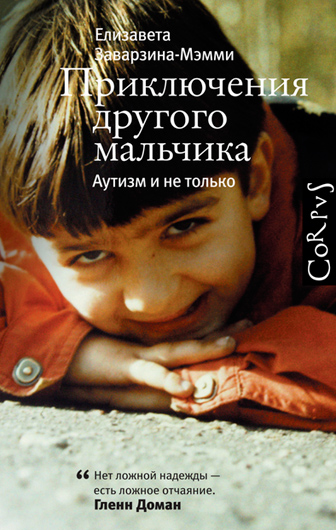 © Corpus
This is not to say that such a range of traditional approaches simplified the life of the author of the book “The Adventures of another boy” Elizabeth Zavarzina-Mammy-a life that shared two halves: before Petit and after.
In the first half there were their own happy childhood, adolescence and youth, loving parents, grandparents. There was a “quite definite idea of how it will take shape:“ Interesting and useful work, a beloved husband and many children, whom we teach everything that we can do, and we will try to make them know more and can do more. ” There was a biofac of Moscow State University, a passion for languages and travel, a foreign husband Maurice, a wonderful daughter of a field: bright eyes, dark curls, "to speak a year, two without hesitation recited a" golden cockerel "."
And then Petya was born. The first two days he was not brought to his mother, they fed through the catheter. At first, he was a calm child, “however, there were some hints that everything was not entirely in order”: he did not reach for toys, at six months, according to the record of the patronage sister, “it hummed, but did not babble”. The mother, of course, had guesses, but the doctors waved away from them - they said that they were stupid inventions.
With anxiety, which is understandable to anyone who is at least somehow familiar with motherhood, Zavarzina closely monitors every movement of Petya: is he crawling on his stomach? Alas, no. Does it move? It cannot, although it rises on all fours. He sat down later than follows - at nine months, with rations and hide and seek is not interested in principle. “And the fields at his age have already begun to speak,” the mother notes, and even in the book, written years later, you feel how painful this comparison was for her. The mother reproduces all the achievements of her son with photographic accuracy: he began to walk in two years, then he began to build turrets from the designer, but he did not want to fold the details in the box. “We examined the pictures in books, tried to draw, but the pencil did not hold in a weak handle, and Petya only carefully looked with huge black eyes. Around the same time, he had the habit of taking me by the finger and showing them to objects, ”writes Zavarzina, not sparing himself.
She, of course, turned to the doctors. Petit's diligently reproduced history looks like this: in two years, they diagnosed with oligophrenia (“And what are you, in fact, were so scared? They are the happiest people” - reproduces Zavarzin in the words of a neuropathologist). She tactfully does not mention how many doctors advised her to get rid of the burden and put her child into the boarding school - but I am sure that there were a lot of such. The value of the “adventures of another boy” is not in beautiful phrases and elegant verbal constructions: on the contrary, often words overtake each other, as if Elizabeth is trying to someone-say, a conditional friend-to retell the history of her child's disease as soon as possible. Another thing is important: this is the first documentary in Russian, in which in detail, step by step, it is shown stubborn-and some kind of not Russian-the mother’s struggle for her son. This is not so much an emotional story as the story of a rational, stubborn, tireless search and selection of methods. There is no one specific way that helps all children with autism - if the Teach system helps one child, for another it may be useless. Neurofidbek helps someone, someone-hippotherapy, someone-medicines. We can say that Zavarzina applies a scientific approach to the rehabilitation of her son. On the one hand, this is not surprising: she is a fourth -generation scientist, a biologist by profession. And on the other, it is completely unbelievable: after all, we are talking about her own little boy, who is sick, and from this a heart is torn, which does not help to reason and experience experiments sensibly.
The story of the Zavarzins-Mammy family is not holy. Petya (twenty -odd years) did not speak, could not study at a regular school (university), you can leave it alone for no more than a day. But this is undoubtedly a success story.
Every day she waited for Petya to speak. A large family, career, travel - everything was put aside, or rather, thrown into the furnace. “You will have to deal with him a lot, and you can put an end to your career,” said one of the speech therapists to Elizabeth. She set up a cross and studied a lot: in the center of medical pedagogy, and even with a folk healer who “cleared the chakras” to Petya and announced that now everything would work out.
But it did not work out - neither after the healer, nor after speech therapists, nor after hippotherapy.
Zavarzina passes all the circles of a standard hell, prepared in Russia of a special child: from erroneously diagnoseds to the inability to ride public transport, because in the crowd Pete becomes worse, he begins to scream, and passengers in the subway - at best: a bad mother, cannot give the child in the ass to calm down. And at that moment, when it seems that everything is irreparably bad, and the plot of the book is on the tape of Mebius: none of the methods known in Russia helps, the mother falls into depression, the boy becomes better, - the legendary American physiotherapist Glen Doman, the author of the same training techniques, appears on the stage.
Then the difficult path to a happy finale begins. And this finale, for Russia is completely atypical, gives hope that everything will ever come up and that the way out, in general, is always there. But this output requires a complete, marginal concentration of the forces of the whole family. Even a wonderful trouble -free fields are forced to go to the externate to help make complex exercises with Petya (it must be twisted, twin, make it crawled, roll it from a hill, learn to breathe correctly). Friends find a sign “We are engaged in the dacha doors. The request is not to disturb ”, and they have to choose: either go about their business - or offer assistance in the most difficult rehabilitation programs of Petit. Just go from the fields to watch a movie or skiing now it will not work.
The story of the Zavarzins-Mammy family is not holy. Petya (twenty -odd years) did not speak, could not study at a regular school (university), you can leave it alone for no more than a day. But this is undoubtedly a success story. Perhaps the “other boy”, despite the amazing achievements in classes on incredibly complex programs, still feels a stranger in the outside world. But the closest people learned to understand him, to contact him, to give him the food for the mind that worthy of him, and to receive an answer from him. Trying to teach the “other boy” to count up to four, they found a way to find out that he can count up to a thousand. We were convinced that Petya managed to learn English by leafing through the dictionary; that he can write an essay, solve a complex problem, distinguish Rembrandt’s picture, and also formulates his own problems perfectly: what exactly does he feel when he cannot say when he is afraid of sounds when it is difficult for him to use his hands. It is important to have an audience of at least several people who will understand what you are talking about. And it doesn’t matter if you have an “autism” diagnosis.
In the film of Lyubov Arcus about the Anton Autonian boy, there is a wonderful episode. Anton is taken from a "good" neuropsychiatric boarding school. Aunts are unhappy with them: he refuses to work in a team, to receive a profession. “But he writes all the time,” Arsus objects. “Why does he write something? Who needs it? " - answers the boarding school.
The book about Pete is in a sense of everyone who knows too well what is bothering him and that he, on the contrary, loves. No wonder Arcus, having read it, wrote: “There are no people“ like everyone else ”. Each person is different in his own way. ”
This is not about the symptoms of autism or treatment methods (although a lot can be learned about this from the “Adventures of another boy”). We are talking about the right to be different and that, deciding to decipher the message of this “other”, we do a job that cannot but have a result if you do it well. It happens that it is very difficult to say and be heard, and hearing is even more difficult. But if you learn the main rule - that you can hear every person, if you respect him, everything will work out.
Elizaveta Zavarzina-Mammy. The adventures of another boy. Autism and not only. - M.: Corpus, 2014. 352 p.