
Translated material
To whom the mother was war
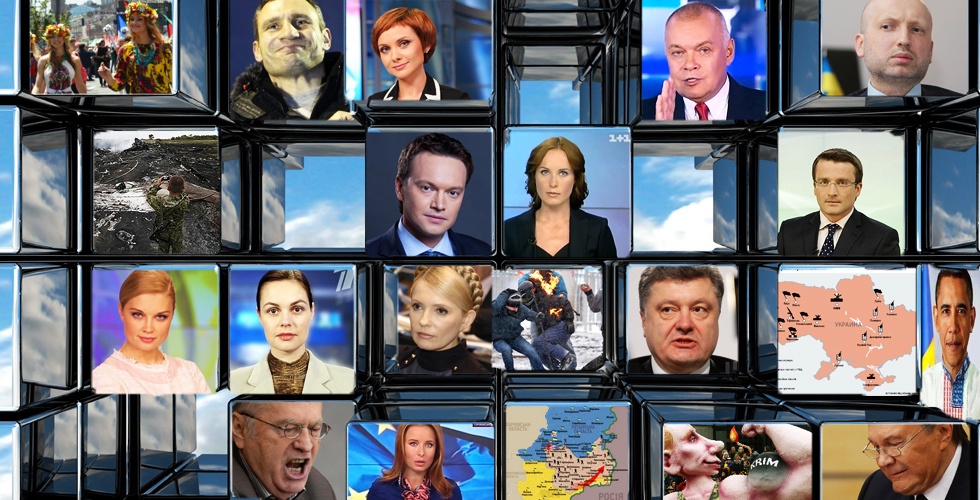
If it were not for the tragic circumstances, this could be called a pleasure for the gourmet - while in Ukraine, you can watch on TV both the Russian channel "Russia 24" and the Ukrainian television channel "24" . As you might guess, both channels are completely the same. Genesis is not given to us just like that, Heidegger teaches, it can only be found in gaps and defaults. With objective information, the same thing: it is not what the media talk about, but what they are silent or not talking about.
Both channels describe the same events. August 9, evening. The Ukrainian channel speaks of six liberated settlements; “Russia 24” also says that the DPR troops liberated “several settlements”. The Ukrainian channel shows a high -rise building in Donetsk and says that the terrorists fired at it; The same house flashes in the reports of Russia 24, and they say that the house "fired at the Ukrainian military." The plots begin with panoramic shooting - shocks in the house, smoke in the background, a destroyed playground and, of course, synchrones of local residents. A resident is cursing to a Russian that there are no normal bomb shelters; In Ukrainian - "they began to shoot from there, we hid here." It is characteristic that civilians do not express sympathy of one side. You can guess that they are already on anyone’s side, they do not care, where shells fly from; They just curse everyone. Actually, the question “whose shells are hit by civilians” is a key question of this war. In modern wars, as Merlo-Ponti wrote, they are not fighting for settlements, but for moral rightness, for whose hell is considered more humane-because all wars are now underway for peace. Peaceful inhabitants in both synchrones call those who, in their opinion, release shells, “they” and “these”; TV channels do not even know how they are similar at that moment. Nobody wants to answer for death; Responsibility lies with both sides to abstract and nameless evil, to a certain “it”. As if “it” has its own will and kills itself. But we know that people are killing.
Further, the plots are repeated literally: the ATO zone, the analysis of the barricades in Khreshchatyk, the rally in Kharkov against Kernes. “Russia 24” claims that they were rally not only against Kernes, but also for and that it ended with a brawl. The Ukrainian channel does not report anything about the fight. The same frames show about the analysis of barricades, but comment on, of course, the opposite; Russian-in the spirit of “In Kyiv, a mess is again, and again some people burn the tires”; Ukrainian-"people finally decided to restore order so that there was no mess."
That is, it is quite normal parallelism: there is such a point of view on Ukraine, there is the opposite, everything is fine-until you remember that the Russia 24 TV channel is not Ukrainian. But he behaves as if he is “also” Ukrainian (in essence, there is no other news there, therefore the illusion is complete). This is especially noticeable here in Ukraine: that the main and only goal of the Russian television channel is to mimic and pretend to be Ukrainian to the details.
The advantage of the Ukrainian media over Russian-even if we assume that there is also propaganda-one, but significant: the Ukrainian media still speak of events in their own country.
All this resembles the plot, conditionally, Schwartz's tales about the shadow, rethought by the Japanese director - with elements of mysticism and thriller. There was a man who had a twin brother who died at birth; And when a person turned 23 years old and he has a job, a house, a bride, suddenly a ghost of a deceased brother appears in the village, who claims that he was a real, and his 23-year-old brother is, on the contrary, a ghost and a dead man. And since the ghost knows how to convince, everyone gradually begins to believe him. And now the real brother no longer has work or at home, and the bride, slightly crying, leaves to live with a ghost, because women love her ears. And the real twin understands that the only weak point of the ghost is his inability to abstract. The zombie does not see himself, he is able to evaluate only others (here such a good morality appears in the film: the only difference between a person and a ghost is the ability to self -criticism).
In a situation where the Ukrainian media suddenly found a dozen ghost brothers, the only way to struggle is to be self-critical. Naturally, Ukrainian media defend the army, play along with their military, dose reports - but at the same time they do not tire of criticizing their own authorities, president, prime minister, ministers and even the military. And they even admit - as far as possible during the war - the opposite point of view.
The plot on the Ukrainian channel “24” about the capture of Maryinka: typical sympathizers of the DPR appear at the checkpoint, and they shout to the Ukrainian correspondent: “And you go to Marinka ... Poroshenko promised that it would not shoot at peaceful people ... Why did you have a little to us ... Why did you come to our land ...” Then it turns into a monologue in the spirit of Most Only confusion and fear remains and remains, and in the end one woman says another: “Why are you saying that, they will cut it anyway.” But the Aydar fighters say on the same channel that people meet them "differently, somewhere good, but not very good." “Ukraine is still losing the Russian trade war” - the fifth television channel. On all channels, the expert’s opinion is repeated that before sending a soldier to the ATO zone, he needs to be prepared for six months, otherwise this is a crime. Russian media accustomed to the fact that those who are against are enemies; In Ukraine, those who are against are not enemies, but for a very long time “their own”. And in the conditions of war, this rule has not changed: both those who demolish tents on Khreshchatyk, and those who protect them, and women from the DPR are still “their own”. “Enemies” are only those who shoot with weapons.
The main and only goal of the Russian television channel is to mimic and pretend to be Ukrainian.
The basis of this behavior of the Ukrainian media is confidence in the viewer and the listener - he is more independent and "he will figure it out." Therefore, for example, Vitaly Churkin’s performance in the Council of Councils is given to “24” in the whole, without comment: from the point of view of Ukraine, the absurdity of his speeches is self -wound, it does not require explanation. Such a focus in Russia would not have passed-the viewer here is not used to understanding something himself, he is not at all used to the “other side”, since Russian propaganda is built on the principle of “not a word, nor half a word to the enemy”. “Russia 24” cannot give a speech without comment, conditionally, the leader of the Ukrainian Radical Party Lyashko - which would also be self -powerful, suppose, simply because our viewer will not understand the “game of contexts”. He definitely needs an interpreter.
Actually, the main goal of this study is to find out what the degree of aggression towards Russia in the Ukrainian media. And also - whether “propaganda is the same” everywhere and whether it is generally in Ukraine. If we take into account how much we were talking about Ukraine as a state and the Ukrainians themselves in five months, it would be logical to assume a “symmetrical answer”. By the way, the main moral foundation of our propaganda is that “there is an information war” and even if he threw it or did not speak, this is normal; In the war, "everyone behaves like that." Actually, the negative ethics on which the ideology of the last 15 years has been built is not “we are good”, but “all the rest are exactly the same” - serves as an excuse here: our propagandists are sure that Ukrainian TV behaves “exactly the same”. That there, too, “we are hated” and “rampant propaganda”.
In Ukraine, until recently, there was one conversational radio station - Era FM. I listen to her all day, and, to my disappointment, most programs are still “boring”-about grain, taxes, illnesses, about mosquitoes and the economy. Here is a conversation with the ex-minister of regional development by Vasily Kuibida. “The war with Russia, of course, wore real estate situation.” There is still a discussion in Ukrainian society-to call it a war or not to call it, the ex-minister is not hiding behind euphemisms, but this is the point. Continues about macroeconomics. Two deputies are sitting in the studio. “Russia can put pressure on Europe, Europe presses on us ...” - “God be with it, with Russia,” one of the participants replies. This is very typical. No one speaks specifically about Russia, does not explore its aggressive nature and militarism - which would be predictable. Here they are not at all inclined to generalizations; It seems that Russia speaks only in extreme cases, preferring euphemisms “Northern Neighbor” and “SusInda of the Power”. What is worth it? Nothing. Actually, they also talk little about Europe and America. The Ukrainian media talk about Ukraine.
Channel "1+1", program "TSN". Seven or eight plots - all about Ukraine: again Khreshchatyk, ATO, wounded. Help the front. Site for sanitary helicopters at the site of the stadium; Sewing the forms. One plot about elections in Turkey. The girl from Slavyansk tells that the militants are bad - O'Kay, this can be called propaganda. Exactly the same girls on Russian TV tell what bad Ukrainian military.
I watched the program to the end. Nothing offensive about Russia and even Putin. Actually, I did not hear anything about Russia at all. There was a plot from Yevpatoria, it lasted exactly three minutes, that instead of milk in packages was water. I wonder how the announcer talks about this. So Ekaterina Andreeva talks about the newborn elephant in the zoo. Here is a classic case when the announcer only with his eyes and a smile expresses his attitude. The same presenter on Tuesday, the 12th, comments on the plot about Putin’s visit to Egypt. Everything is extremely respectful, and only a sad smile at the end.
August 11, the ICTV program is “freedom of speech”. Live broadcast. The survey “will be decided by Russia for military interference”: 62% believe that no, 38% - what yes. The current show in Russia is a cumulative shell, it always hits one point. The Ukrainian talk show is unpredictable. Even if it gathers with a propaganda goal, it ends with mutual reproaches and exposure of each other. The speaker of the Ministry of Defense Andrei Lysenko is a bunch of reproaches. Then they listen to the leader of the party "Gromyansk Position", the former Minister of Defense of Anatoly Gritsenko - and he has a lot of reproaches. Gritsenko himself criticizes Yatsenyuk, Minister of Defense, and President. Then they are attacked with questions of the deputy head of the SBU Viktor Yagun. Questions about roofing, about drug trafficking across the border - in the same ATO zone. "If you are not ready to be responsible for the department, why did you come?" - Throw him when he is trying to get away from the answer. Finally, deputy Lyashko. “Many traitors. We will never win until we deal with the traitors in Kyiv. ” Deputy Lyashko is also the Ukrainian Le Pen. It is interesting that even he does not say anything about Russia (except that he calls her an aggressor). All his pathos is against his own: “The so -called refugees are now heated on the seas. All beaches are occupied by Donetsk numbers. Let them stay under the “grades”. ” The presenter replies: "Tsia nonsense, Vorozhi, is a mystery to the deeds of the Grisen, the stiffly bend the people - hto would not have a stunned one." That is, it hints at the reaction of “some” to the May tragedy in Odessa, making it clear that this is unacceptable. “The hand is hard to fill up” (the hard hand will not hurt), ”Lyashko says further. “We already had a solid hand,” Sobolev replies to him from the Fatherland. "And where is she now?"
When you listen to all this, you understand that in the Ukrainian air there is not enough some kind of familiar element for the Russian media.
In Ukraine, they are violently arguing with each other. Russia as a country on the Ukrainian air - oddly enough, the moment of silence, it is also a reaction to injury. Nobody could imagine that he would have to fight - and still cannot.
The only exception is that in the Ukrainian media there is such a format of transmission - “So what happened to the Russians?”: A psychological slope, an attempt to “figure out”. What is important - with the help of the Russian experts themselves. Ukrainian media, even saying that Russia is building up troops on the border, sends equipment to militants and violating airspace, manage to talk about it as if this is not about Russia, but about some troops or individual militants from Russia. We will not forget that on the air of the state radio in the direct broadcast there are meetings of the Rada. And the deputies, except for the words “Russian aggression” and “voog”, do not use any other words. No surplus value, no one is engaged in symbolic multiplication and expansion of verbal evil.
I have already prepared this text, and suddenly a gift: all day on the air of "Era FM" (August 13) they discuss the humanitarian convoy, as well as - along the way - Russian propaganda. In the morning, a conversation with media experts. The question is - is it necessary to engage in counter -propaganda? Many feel this as a problem - that Ukraine does not contrast propaganda. "We are losing Russian propaganda." But still, the conclusion is this: it is unacceptable for the media. All day they discuss the convoy. They consider this both as a compromise with Russia, and as the fact that “not to accept help” will be a political loss. Half of the calling (by the way, Russian -speaking) warn, scold Putin, they say "we do not need help from the aggressor." However, there are other opinions right there: here is a clear anti-Maidan, here is a conditional Buddhist-Primyrean-“we, more-good us,”. There is no monolithic opinion on the air, again, listeners argue with the "previous speaker." And with all this - not a single insults of the Russians, no words similar to the “fascists” or “punishers” on our air. There is no analogue of the concept of "Ukrainians." Only regret about "zombie". The reaction is rather rational, but emotions do not cross some important line. No Muscovites on the air. Nothing personal about Russians and Russia. Nothing.
When you listen to all this, you understand that in the Ukrainian air there is not enough some kind of familiar element for the Russian media. There is no source of rage, there is no constant mechanism for reproducing emotional excitement. Interesting, you think: where does it work out technically from, at the expense of which formats? You recall that in the Russian radio there are a lot of such interpreters with listeners, as well as “conversations with experts” who are actually engaged in a purely maintenance of the desired level of hysteria. In our country, this takes the form of something “trusting”, “frank”, “new sincerity” as if “without borders”, reaching irrationality, but in fact it is just a “power station of emotions”.
Thanks to her in Russia, in five months, a whole category of listeners and spectators appeared, who, in fact, make up something one with an information field: people who are enraged by the fury from the ether - and returning this rage to him. There is no analogue of such a listener in the Ukrainian air. There are also radicals, classic nationalists of the old school, who are “against Russia, but also against Europe”, against “all this homosexuality”. They have always been, but earlier, and especially now they are marginals and make up about one and a half percent. Their aggression is pushed into the wall of rationality, into the dominant concept of “different opinions” - and disappears, evaporates, having no consequences. Instead, on the Ukrainian air there is another mass type of listener who admires Ukraine, acts of people's self -sacrifice, persistence of the spirit, etc. Conventionally, this is such a variant of Ukrainian “spirituality”: but it is important to note that this spirituality gives rise to oblivion, peace and reconciliation with reality, and not aggression.
Question: Why, here, during the war, the type of hater did not become mass - like on the Russian air? The fact is that there is no source of hatred itself - emanating from the media. There is no source - there is no aggressive type generated by it. Everything is very simple.
The main misconception of Russian propaganda is that in Ukraine they only think about Russia. This is actually not so: Ukraine now speaks first of all about itself, it is all focused on itself. In addition (which is no less important) - Ukraine, with all what is happening, emotionally did not rebuild in a military way. Moreover, the Ukrainian media with all their might strive not to switch to a military way, they want to stay in the format of a “peaceful life”. There is also a party of war - this is the same Gritsenko, for example, and his thesis “this is a war, martial law is needed”; Gritsenko, by the way, uses the phrase “everything for the front, everything for victory”, but this point of view - the militarization of everything - is not dominant.
Russian official media inspired themselves that they were at war with the whole world, and live this faith; They are sure that the same mood reigns on the other side of the glass - but here they are mistaken. No one except the Russian media lives at war. And does not want to. Russian media resembles a Sisyphus, who pushes its stone up every day - forgetting that in front of him is a mirror, warningly placed by the orderlies.