
Translated material
The museum is visible-invisible
If it were not for the story of the sudden dismissal of Alexandra Selivanova , the head of the avant-garde center, through which the Jewish Museum and the Center for Tolerance have learned many recently, it would hardly have occurred to anyone to look more closely at this institution, which opened in November 2012. The whole press came out of him shortly before and immediately after his opening, and now he has opened, he is, and there is nothing more to add to this. Super-technological multimedia exposure dedicated to the neatly designed history of Jews in Russia, which makes the main nucleus of the museum, although it looks highly dynamic in appearance, is still a built-in cabinet-in the sense that it is impossible to do anything new with it, the possibility of changes in it is not laid down, and therefore, and as a information farmer, it can only act (criticism of the museum narrative It can be found in the material of one and a half years ago on Arthid - an interview with Hamom Sokol ). Additional programs of the research center associated with Judaic are too special to fall into the field of view. The only media factor is the activities of the exhibition department (they are led by Maria Nasimova who previously worked at the Vinzavod) with projects like “Andy Warhol: 10 famous Jews of the twentieth century” (Nevary artist about famous Jews) or “Atelic: Solomon Nappelbaum” (Jewish artist about famous non-Jews and Jews), designed for what about them about them They will write the best announcement publications: this is the type of those post-post exhibitions, the thinking of the creators of which dates back to the era when art was called “art”, and which can be announced, but it is impossible to review: after all, it is quite difficult to imagine any debate commentary on the work of the 1980 Warhol in such a trifle place as the Jewish Museum. The work of the Center for Tolerance, standing in the second line in the title of the institution, in principle, remained in the shade - no one seriously drew to delve into what this center is doing. In short, shortly after the opening, the museum was left alone, and meanwhile, the most interesting began inside it - a violent self -determination, in which the real nucleus of the exposition is only a plot motivation for the real structure of the institutional organism.
Of the entire number of museum divisions (there are five of them: the exhibition department, the research center, the children's center, the center of tolerance, the avant-garde center, instead of which the educational department will now open) are truly public, that is, uniting a wide, stable and growing audience around itself (at the same time not celebrated, but aimed precisely at the proposed content) and capable of producing a generally significant (that is, not attached to the topic of Jewish Identity or Judaism) a consistent, articulated intellectual program, was precisely the center of avant -garde, which initially arose as an addition, an Ommage building of the Bakhmetievsky garage (which was saved, of course, thanks to the community and architectural experts, which explained the significance of the construction in time). When the museum, all with a needle, only opened hundreds of his liquid crystalline eyes, there were some doubts that in the framework of such an artificial creation made mainly according to the patterns of most neoliberal institutions (exposure as a reason; cafe as the main content; bookstore as an important addition; all kinds of programs for extrapociety ), the center of the avant-garde will become something more than just another passively more passive the consumed section not designed for production or at least popularizing knowledge.
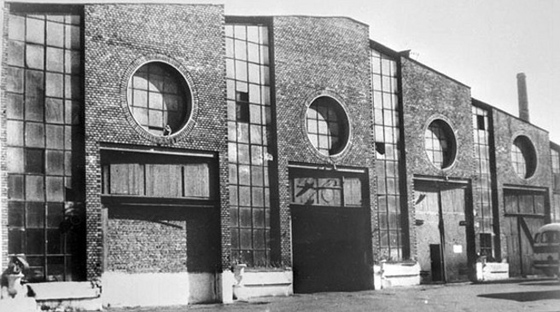 © Jewish Museum and the Center for Tolerance Bakhmetyevsky Garage
But it turned out just the opposite: the historian of Soviet architecture Alexander Selivanov, who was invited to make the Center’s program, was, contrary to the fears of Khaim Sokol, the real researcher of the avant -garde, who also has the experience of the enlightener and popularizer. In the Bulgakov Museum, she organized the New Moscow seminars for several years, dedicated to the culture of the 1920-1930s. These seminars were partly a expert and a stranger: in Moscow there was a whole microenvironment of people who enjoy the exotization of the rich historical past of the USSR-the exquisite form of passisism (sometimes with changing clothes) for the owls and curious ones. Already in the center of the avant -garde, Selivanova got the opportunity to expand this subcultural interest in a more public, universal side - from experts for understanding, she managed to move on to a wider education. For different specialists in the center, more than 200 lectures were given to many topics from early Soviet urbanism and mass monumental sculpture to stories about foreigners in Moscow of the 1920s. Each week several lecture cycles went at the same time; Against the background of the campaign on salvation in the city of Korolev , the frescoes of the proletarian artist Vasily Maslov, his exhibition was made in the center. Two conferences were held: one about architectural modernism, the other dedicated to the memory of Selim Khan Magomedov. In the end - a large exhibition about the myth of Soviet aviation. And although the thinking in which it was made is more likely to depolitize the avant -garde with its air impulse, representing it as the sum of seductively submitted curious artifacts, wittyly buried among themselves, exposure and curators, everything was decided so accurately (the architect of the exhibition was Dina Karaman), which could be considered in principle exhausted. Clear, but not stunning, the exhibition caused noisy approval. It was then that Alexander Selivanov was fired. Without even waiting for the closing of the exposure.
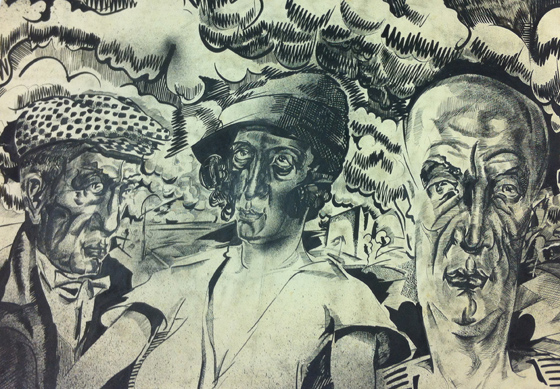 © Royal Historical Museum Vasily Maslov. "Threesome Walk"
The dismissal looked amazing and scandalous, because it seemed to everyone that Selivanova was making a good project in a “respected institution”. Ethnic-religious in essence (and not at all secular-it is forbidden, for example, the mention of the Christmas tree in children's classes), which exists as a kind of “temple of influence” with a prosperous community with super-rich trustees, adds a liberal gloss, developing a “Jewish theme” towards the avant-garde as a “unconditional” cultural value along with bourgeois. Warhol and historical Nappelbaum. But, on the other hand, the avant -garde, no matter how beautiful it can be served, can also be seen as something ambiguous: the flip side of Jewry, striving at all costs to maintain its identity and integrity (then Jewry, which the museum only tells about), has always been Jewishness, striving to tear themselves away from its roots and begin to talk about the land not only for themselves, but also for everyone. This is the fork of Zionism and Communism, on which many Jews ended up at the beginning of the twentieth century and which in the museum in passing is beaten in the Odessa Cafe hall. Of course, the narrative under the patronage of Putin’s museum in this fork resolutely turns to Zionism, and communism, as a clear abuse, remains on the conscience of “several Jews surrounded by Lenin”. But at the forefront, this very communist universalism of the "non -Jewishism", striving to make everyone, receives its materialization - in the broadest sense. This is the property of the avant -garde: behind the “unconditional values” of every cute avant -garde picture, one can suddenly find the radicalism of the revolution. The avant -garde, of course, goes far beyond Jewishness, and this can be good for the reproduction of the institution (how good for this is Warhol), or it may not be. And it would be possible to explain the end of the center of the avant -garde in such a beautiful way, adding to this that all the time of work in the center of Alexander Selivanov as an architectural activist was engaged in the salvation of the Shukhov tower, which turned into a rather loud public campaign. But this explanation, although seductive, suffers from serious ideologism. To understand why the center of avant -garde lived and died, whose lecture projects attracted more and more people, made the museum recognizable and cost much fewer projects, say, the exhibition department, you need to understand what place it occupied in the general structure of the museum and how this structure works.
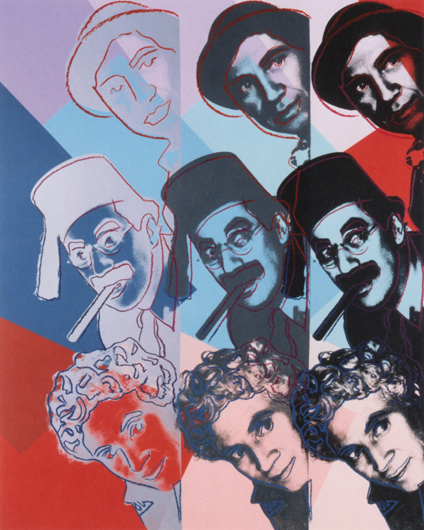 © Collection of the Blavatnik Family. Photoograph Courtesy of Ronald Feldman Fine Arts, New York Andy Warhol. "Brothers Marx"
To begin with, the dismissal of Selivanova was just an episode in the endless turnover of the personnel taking place inside the museum. Only four years of existence were replaced by four executive directors, apart from the development director of Natalia Fishman (during the construction period, the director was Stella Aminova, then Simon Hugud, who was delayed there for a month, and Leonid Agron, who worked for a little less than a year, is now the director Elena Pronicheva). Several PR teams have changed. Several designers. At least two leaders of the children's center. Special project manager. Press Secretary. The head of the Center for Tolerance changed twice: at first they were Anna Makarchuk, she was fired with the team, Alexander Lozinskaya led the center for several months, she was also fired with the team and returned to Anna Makarchuk again. Only the General Director and founder of the museum, Alexander Borod, the research department (the most calm, concentrated and ugly unit of the museum) and the head of the exhibition department, Maria Nasimova, remain irreplaceable. The process of getting rid of old employees and hiring new ones is facilitated by the fact that most of those who work in the museum work on fixed -term contracts concluded for a period of three to six months. In the case of any disagreement or discontent from the employer, the contract is immediately terminated - the weekend of it is not supposed to be. And although people were dismissed by whole departments, it never occurred to anyone to make a public conflict, since the payment system was arranged so that the employee falls into a hopeless situation: he must choose between money and the fulfillment of the terms of the official agreement.
The young institution develops and devours its children. So this is explained by the former executive director of the museum Leonid Agron, who also lost his work: “The replacement of people is normal: after all, the museum is a huge new organization, it is developing rapidly, there are serious challenges in front of it, and often not all attracted people were ready for those tasks, and most importantly, for the speeds that were set.”
An ordinary measure in the race for the effectiveness of the city cultural institution is the ratio of costs and attendance costs. But if you use this criterion, the dismissal of Alexandra Selivanova and the dissolution of the Center for the avant -garde would really be inexplicable: according to the same Agron, “everything that was connected with the personnel of personnel was aimed at increasing traffic, and this event (dismissal of Selivanova. - A.N. ) does not fit into this outline, that the museum’s leadership sometimes has to review its tasks in operational mode. " It remains only to find out what these tasks are.
Indeed, the exhibition about aviation and the lecture cycle on the philosophy of art of Andrei Velikanov were even “too visited”. But the whole point is that the museum does not work entirely in the urban logic in which the Moscow Museum, the Bulgakov Museum, VDNH and other institutions of the Kapkovsky Renaissance work. Of course, there is a cafe in the Jewish Museum, but in fact it is not intended for flaning food and culture consumption, which has blossomed along with new urbanism. We can say that in this urbanistically non -oliberal level, the maintenance of which is provided by the announcements of exhibitions in mass publications, the museum is included only by one division, namely the exhibition department. Changed exhibitions are what is happening at the city level. But here we are more likely not about the real audience that grew around the center of the avant -garde, but about the picture from the vernissage in the media and about the weekend flankers. Nevertheless, the head of the exhibition department remains irremovable, which means that attendance at the city level is not the main criterion for assessing its work. In addition, a private museum can be reported to attendance before itself or by the Board of Trustees, but there is no question of recruiting this grandiose collapse.
So what's the matter? If in the logic of urban consumption the museum structure is involved only in part, then much more they are included in the logic of the federal-institutional. Most of the visits to the Center for Tolerance are school excursions. The task of the museum management is to establish contact with the largest number of officials and provide the maximum number of ties with educational institutions in order to increase the influx of schoolchildren and students. The Center for Tolerance is a curious structure consisting of a couple of hundred iPads, where several dozen short rollers are loaded about tolerance for migrant workers, which are a “natural addition to any modern metropolis”, and tests such as “are you tolerant?” Through which visitors drive away. The content of tests and trainings conducted in the center is almost completely built on the default and equalization of incomparable categories: the problems of beggars, disabled people, migrants, old people and brand new in the class go through a comma, just as students are tested for a sense of irritation to rich people, foreigners, men and women. The question of LGBT, of course, has never risen here. This is precisely the parody castrated tolerance, which only can exist now in Russia, but can exist quite successfully. If it is difficult to imagine a lesson in this kind within the school today, then it is quite possible to allow the existence of a reservation where schoolchildren are taken to learn about the existence of others. The museum does not need high attendance of the tolerance center for its own pleasure: numbers help in institutional expansion. The negotiations of the Center with the Ministry of Regional Development and Putin signed by Putin on the creation of 11 similar centers throughout Russia can be considered the most important success. This happened in 2013, now the situation in society has seriously changed - but probably this will not interfere with the replication of the center. In addition, the center recently received a grant from the Moscow Government (Executive Director of the Jewish Museum Elena Pronicheva, sister of Ekaterina Pronicheva, deputy general director of VDNH and the former first deputy Kapkov, does a lot in order to attract additional sources of funding to the museum).
It is clear that the attendance of the center of avant-garde, although unexpectedly high for such a special educational initiative, still did not reach the school-auto-bus. Now, instead of the center, the museum creates an educational department that will conduct lecture courses on more general topics and, apparently, in the calculation of a more massive school audience. Anna Treskunova, the creator of the school “School of Excellent Knowledge”, where everyone was taught etiquette, modern music and modern art , was appointed its leader.
This method of functioning of the museum can be called non -public publicity: being in the form of a public institution, his main goal, he sets his own self -preservation and reproduction - and builds his personnel policy so that it is convenient to outstat everyone who does not contribute to this. Otherwise, the sowing is such that the museum as a tool through which the community fixes its influence should become impenetrable, protected from any discussions and public disagreements. His task is to exclude himself from public life in her any non -institutionalized manifestations. He see and invisible to society: buses of schoolchildren and negotiations with federal institutions exist in a space that can hardly be called public. The main activity of the exhibition department is also excluded from life: this is a platform responsible for the impression of modernity, protected by the authority of the institution, and they never risk it. The museum is developing to the touch, not knowing its plans, but its vector is set by its structure itself: it screeches those who make it vulnerable. In a funny way, the center of avant -garde with its too alive intellectual program and “too good attendance”, which no one expected, has become an unnecessary gap in this structure.