
Translated material
Secretary putsch
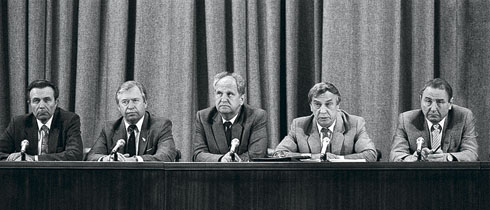
Dozens of books were written about the GKChP, a clear chronology of events was compiled, memoirs of participants, opponents and direct organizers of the coup were published. It seems we know everything about the GKChP. But this is an illusion. The investigative case still has the vulture of "Top Secret." Why? That 23 years hid under this stamp - the New Times was versed
Twenty years ago, one of the authors of these lines, recalled from a vacation to support the GKChP, flew from Odessa to Moscow, armed with a red book of an employee of the external intelligence officer of the KGB of the USSR, in which, at the reversal of the certificate, it was written: "To all officials to provide an immediate assistance to the presenter." Since the receipt of the telegram-post, the road from the KGB sanatorium in Odessa to Ruzhpark * at the Vympla suburban base ** in Balashikha took a little more than four hours. To the amazement of the special forces he was immediately sent back to rest. “You are on vacation. I haven't seen you here! " - said the head of the department. But even more amazing was that the chief of Soviet foreign intelligence *** * a room for storing weapons and ammunition.
** The special purpose group of the KGB of the USSR “B”, or Vympel was created in 1981 on the initiative of the then chairman of the KGB Yuri Andropov for secret power operations abroad.
*** Until the fall of 1991 - the first Main Directorate (PSU) of the KGB of the USSR, now - SVR.
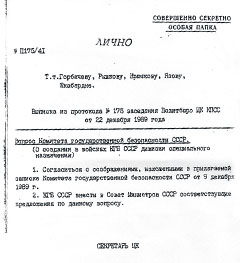
**** Registration No. 2490, dated December 9, 1989, the vulture "Top Secret, a special folder."
***** Protocol No. 175 of the Politburo of the Central Committee of the CPSU dated December 22, 1989, registration No. P175/41, the Grif "Top Secret, a Special folder". Leonid Shebarshin, who was subordinated to Vympel, as the media later reported, defiantly played tennis all day on August 19.
CONSPIRACY
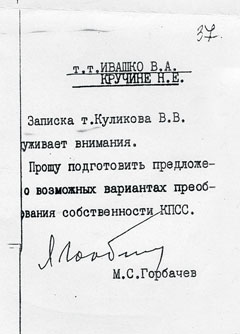
Preparations for August 1991 began in December 1989. From the submission of the KGB chairman Vladimir Kryuchkov, who prepared the note “On the creation of the KGB of the USSR of the USSR special forces” **** , the Politburo of the Central Committee decided to support the proposal of the KGB ***** , and on December 4, 1990, on the basis of directives of the Minister of Defense of the USSR No. 314/3/01 and No. 314/3/02, transferred to the 103rd Guards. Airborne Division of the Airborne Forces and the 75th Motor Rifle Division (ZakVO) as part of the State Security Committee.
It was the KGB chief who became the leader of the Orthodox. Kryuchkov relied not only on the State Security Committee, but also on the leadership of the Ministry of Defense and the generals of the military -industrial complex. Back in September 1990, the Pravda Pravda has published a manifest of the VPK “Status-Overse”, which was signed by 46 generals, from directors of factories to general designers of the country's largest space and military firms. The manifesto was a kind of warning: the military-industrial complex (75% of the country's economy worked for it, and he was the largest landowner) does not intend to share power and property.
And already in December 1990, the conspiracy itself began to take shape. On December 9, as follows from The New Times, the explanatory notes of the interrogated in the GKChP case, Colonel Alexei Egorov * * * held in 1991 the position of assistant to the first deputy chairman of the KGB Viktor Grushko., He and his chef were called to Kryuchkov. There was already General Vladimir Zhinzhin, deputy chief of PSU, in the past - the head of the apparatus of the head of the KGB and the confidant of Kryuchkov. Egorov and Zhizhin were instructed to draw up and write a conspiracy plan: a note on the priority measures “to stabilize” the situation in the country in case of emergency and a possible scenario of events. Also, according to Egorov, they were supposed to prepare the draft decree of President Mikhail Gorbachev and the decisions of the Supreme Soviet of the USSR on the introduction of emergency.
  |
In February 1991, a analytical note prepared in the KGB, “On the Political Settings in the Country”, fell on Gorbachev's table. The note said: “The analysis of the current situation requires a serious critical understanding of how adequate the concepts of democratization and publicity formed almost six years ago are the current practical embodiment ... Given the depth of the crisis and the likelihood of a sharp complication of the situation, it is impossible to exclude the possibility of the formation at the appropriate moment of temporary structures within the framework of the implementation of extreme measures.”
On March 19, 1991, the secret order of Kryuchkov for number 0036 of the KGB Office in Moscow and the Moscow Region, which was under the jurisdiction of the Moscow authorities, was retrained by the central apparatus of the committee - in Moscow there were democrats, Kryuchkov could not leave them such an important control tool.
Then, in March, the operational headquarters of the KGB of the USSR was created on Lubyanka. And in April - the Office for the leadership of special units of the KGB troops.
On August 5, Kryuchkov again called his deputy Grushko, Egorov and Zhizhin. In the same place, in the Kryuchkov’s office, the messenger of the USSR Minister of Defense Dmitry Yazov, the commander of the Airborne Forces, was also present, Lieutenant General Pavel Grachev, in the near future, the Minister of Defense of Russia. According to Egorov, Kryuchkov instructed to prepare another, more detailed analytical note for the introduction of a state of emergency in the country. The work was supposed to be conducted conspiracy. Grachev and Egorov and Zhizhin went to write a document for the operational cottage of the second main department (counterintelligence), located near the village of Mashkino, on the way to Leningrad.
On August 15, the head of the 12th department of the KGB Evgeny Kalgin and the head of the government of government communications Anatoly Baby received a Kryuchkov instruction: to control all negotiations of government communications subscribers *** Senior Operational Controller of the 3rd Department of the 12th Department of the CGB of the USSR, ensign Tatyana Larina in an explanatory note reports the investigation in the case of the State Committee for Medical Sciences: “August 17 on August 17 I started work at 15:00. The controls were objects: Yakovlev A.N., Poltoranin M.N., Silaev I.S., Shevardnadze E.A., Kuznetsov B.A. On August 20 and 21, I had a weekend on schedule. I was called to work on the night of August 21 to August 22 (21.30-8.00). Controlled objects of 181-182 and 183-184 of the working sites: the devices of Rutsky, Yanaev, Khasbulatov, Silaev, Yeltsin, Lukyanov, Burbulis ”..
On August 17, the special forces of the 7th management of the KGB group “A” (known as the Alpha group) were brought into a state of increased combat readiness, the special forces of the PSU-a separate training center (under this name in the documents of the KGB, the group “B” or “Vympel”) appeared). They were transferred to Moscow and posted in the Dzerzhinsky club.
Next-a decree of the GKChP, tanks, de facto arrest Gorbachev, an emergency. The coup happened. And two days later it became clear that the coup failed.
A strange secret
Almost all the oddities of August history were already visible then, in 1991. Firstly, they knew about the preparation of the coup-albeit few, but possessing power and means. The Americans knew about this: Secretary of State James Baker warned his Soviet colleagues. Eduard Shevardnadze and Alexander Yakovlev also spoke about the possibility of a coup of the Politburo.
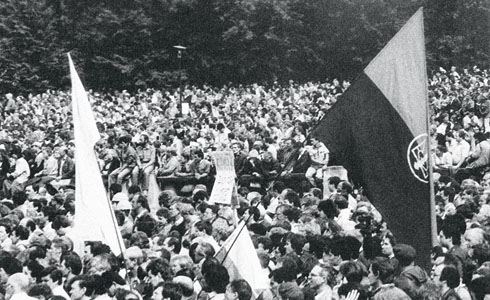
Secondly, the KGB chief Kryuchkov, who was preparing a putsch since 1989, did not take advantage of the power solution (and they had it!) Inaction and frank apathy of the putschists were obvious in those days: on the morning of August 19, after the broadcast of the State Emergency Committee in Moscow and other large cities, all the phones, faxes, planes calmly flew out of Sheremetievo, the aircraft. There were no expected arrests ...
Finally, the most amazing thing: the GKChP case - this ridiculous attempt at first glance - is still classified. As Irina Virgana, daughter of Mikhail Gorbacheva, told The New Times, when she recently requested a protocol of her own interrogation, she was responded with an official refusal. The investigator of the prosecutor’s office for especially important cases of Valentin Filippov, who worked in the GKChP case as part of the investigative group of the prosecutor’s office of the Russian Federation, was informed by The New Times: “The matter is long, but no one has canceled the vulture on it. And in general - all of us who worked in the case of the State Emergency Committee were never collected together. Each was engaged in separate episodes, but no one knew the head of the investigative group Sergei Aristov, who died 7 years ago, no one knew. ” And even the veterans of special forces “A”, which have long resigned, agreed to talk with The New Times about August events only on anonymity.
Silence of wolves
After the coup in the media reports, information appeared that the KGB special forces in the person of its leaders refused to comply with the orders of the State Emergency Committee. For what then, after the end of the coup, the commander of the group “A” Viktor Karpukhin *** Hero of the Soviet Union, Major General Viktor Karpukhin, was one of the founders of the special forces unit of the KGB of the USSR “A”. During the assault on the residence of Hafizullah Amin in Afghanistan, he led one of the combat groups that ensured the success of the entire operation.? Something in this widely circulated in the media legend was clearly “not beating”.
Ordinary employees of groups “A” and “B” really did not want to kill anyone. But they did not solve, then only one person decided - the chairman of the KGB of the USSR Kryuchkov. And he, as it became known during the investigation of The New Times, did not make a fundamental decision to proceed to active actions at least twice.
The first time - at the moment when the entire leadership of the rebellious Russian Federation gathered at the Eltsin’s dacha in Arkhangelsk. Anatoly Sobchak in his memoirs emotionally writes that in this most dangerous for Yeltsin and his team the moment of Alpha was simply late to capture them. But group “A” was not late. 60 fighters of the most famous KGB special forces in the USSR, led by Karpukhin himself, were from Yeltsin and members of the Russian government at a distance of several hundred meters: they are secretly settled at attacks and were completely ready for the assault. According to Karpukhin, he personally contacted Kryuchkov five times and requested the good to capture.
Moreover, intercepting the negotiations of Karpukhin with the KGB chief, security officers from the ninth control of the KGB (now FSO), assigned to Yeltsin’s dachas, contacted Karpukhin and asked “not to wet their own”. "If necessary, we will tie them here ourselves!" - Personal security officers turned to the Ashniki colleagues. But for some reason, Kryuchkov did not give good.
The second time Kryuchkov refused to use group “A” at the time of his own captivity on August 22, 1991 at Vnukovo-2 airport after returning from Foros. And again, the special forces attached to Kryuchkov were not going to give up and give the boss without a fight.
- Drush! - ordered the chief of the KGB to the senior "Ashnik" Korostelev.
- Yes, we will tear them! - the elder of the officers attached from group “A” tried to object.
- Hand over the weapon! - In orderly, Kryuchkov demanded again from Ashnikov.
The legend that the Alpha and Vympel groups did not obey the order of the State Emergency Committee, subsequently allowed these units to survive, but it has nothing to do with the true state of affairs. “Vympel”, and especially closer to Kryuchkov, “Alpha”, who were directly subordinate to the head of the committee, could become the very textbook detachment of “Officers of the Imperial Guard” for Russia, capable of eliminating or arresting the Yeltsin team. But no one asked them about it. Why? Not only the elite of the Soviet special forces of the KGB was perplexed. 
According to the analyst Lemits Fritz Ermart, quoted by Talbott Strowe in the memoirs, “there were no evidence of any movements that had to be expected before the coup. The conspirators did not conduct serious training: there was neither a massive movement of troops and tanks, nor a break in the work of communications, nor the jamming of Western radio programs, nor raids on popular reform leaders. ” Sources of the Americans reported that "tanks and armored personnel carriers on the streets of Moscow did not show signs of combat readiness to seize political power." According to Talbott, Colin Powell, at that time the chairman of the United Committee of the Chiefs of Staff of the United States, called the US Minister of Defense Dick Cheney, who at that moment on aircraft No. 1 together with President Bush: “Something is not happening according to the textbook. These guys were sent to Moscow without instructions! ”
The discourages of the Americans are understandable: the KGB had experience in organizing state conspiracies, and not bad. The same Karpukhin received the hero of the hero for the skilled assault on the Palace of Amin in Afghanistan, and among the commanding staff of the Vympel there were many officers who were responsible for the preparation and conduct of the operation “Storm 333” ** The code name for the conduct of the coup d'etat in Afghanistan, carried out by the combined units of the KGB and Zenit officers in the Zenit. December 1979., which became world classics in the practice of the implementation of state coups. So people who knew the deep foundations of the organization of state conspiracies are not in theory, but in fact, Kryuchkov had enough at hand. One of the main puzzles of the GKChP - why did Kruchkov use their potential?
"Brazh" of the GKChP
Another mystery: how could a multi -permissive Kryuchkov, who helped Andropov suppress the Hungarian uprising of 1956, to allow the coup - this is primarily a responsible special operation - the drunkards and random people, called Dmitry Yazov’s “mash” of the State Emergency Committee, led themselves? After all, the good half of the putschists at the most crucial moment arranged a grand drink. With alcohol poisoning and hypertension. Thus, Prime Minister Pavlov, whose tasks included ultimative negotiations with the Yeltsin government, at the moment when it gathered under the control of group “A” in the country in Arkhangelsk, was deadly drunk. “Doctors who were called to the cottage the next morning have already led me to consciousness,” Pavlov explained to the investigation group his behavior in the most responsible Minutes of the coup. Vice President Yanaev, whose hands during the press conference of the putschists said more eloquently words, as the investigation found out, agreed to become the leader and face of the State Emergency Committee only on the night of August 18 to 19! “And then I trembled and agreed to sign (the statement of the Soviet leadership. - The New Times), specifying this by the fact that I will act as the president for no more than two weeks,” we read in the protocols of Yanaev’s interrogation. And if he had not flinked? Was there a spare option?
And Vasily Starodubtsev *** Hero of the Socialist Labor, the laureate of the USSR Stateistry of the USSR, in 1991 was the chairman of the Union of Agrarians of the RSFSR and the Peasant Union of the USSR., With whom the KGB chief had good personal relations, according to close relatives of Vladimir Kryuchkov, was also invited to the rebellious team at the very last moment. And even then with the only meaning - to symbolize the support of the State Emergency Committee "by the wide masses of the workers of the village." How could Kryuchkov not see that the coup is turning into a rest?
A symbol of the official version of the failure of the putsch quickly became the statement of Vasily Starodubtsev: they say, "there was no one in the GKChP who could shoot their own people." The family of the former chief KGB Kryuchkov adheres to the same version, one of the members of which, asking not to name his name, in an interview with The New Times said that he was still a huge personal shock for Kryuchkov, what to say about 1991. The winners adhere to the same version. In an interview with The New Times, one of the most active members of the Yeltsin team, Gennady Burbulis, who held the post of State Secretary of Russia during the couch, so commented on the lack of determination with the conspirators: “Of course, Kryuchkov’s experience, who knew a lot, understood a lot, suggested to him on the results of the 19th, maybe, perhaps, a sincere idea to protect the usual idea of the usual idea of The Soviet Union, which guided the convinced members of the State Commander -in -law, an absolutely consolidated desire to prevent the signing of the agreement of the Union of sovereign states on August 20 led them to this crime. But they initially did not want blood, they initially did not want the fight against folk performances. ”
Split
There is another version.
The indecision of Kryuchkov, his refusal of the arrest (or elimination) of Yeltsin by the forces of group “A” is simply explained: the means of wiretapping - recall that Kryuchkov’s personal order all negotiations of senior Soviet leaders (including Yeltsin) were put under control - they recorded Yeltsin's call to General Pavel Grachev on the morning of August 19. To the question of Yeltsin "Can I count on you?" He allegedly answered: “This is a difficult question. I will try to do everything in my power. ”
Supporters of this version are convinced that Kryuchkov regarded Grachev’s actions as evidence of the schism in the army elite and, fearing the civil war, did not give a go -ahead of Karpukhin.
But the split was not only in the Ministry of Defense. Of particular interest in an interview with Gennady Burbulis The New Times deserves such a fragment: “There is another circumstance that is often not taken into account. It consists in the fact that in the month of May the Russian Security Committee was created, and General Ivanenko, who was continuously in the White House in my office for three days, and we did this work together, he managed to achieve a clear split in the professional, political and vital position of most KGB officers as a general Soviet office in the regions.
The most important thing in the words of Burbulis is the mention of a split. Materials and evidence collected by The New Times show: there really was a split. Many young high -ranking military and committee employees were completely not interested in the coup. Why?
Without excess blood
If it were not for a series of mysterious deaths, one way or another connected with the coup, everything would really look like a stupid vaudeville, and there would be no complaints about the “patriotic humanism”. But the number of "suicides" after August 19–21 goes off scale. So, a day and a half before his death, one of the members of the State Emergency Committee, Minister of the Interior Boris Pugo, addressed his death for help to the GRU special forces. According to the source of The New Times in the Main Intelligence Directorate, a special group of 5 people from the composition of the so -called "Sunflower" - militants of the GRU specializing in the abduction and elimination of specially protected persons of the enemy. But for unexplained reasons, the group received the order first to nominate a conspiratorial apartment, and when the scouts finally arrived in order to protect the guarded person, they found a dead pugo and his dying wife. Why did Boris Pugo look for professional alternative security for himself a few hours before suicide? Why didn’t he believe his bodyguards from among the attached officers of the "nine"? Why did he turn to the GRU - to the traditional rival of the KGB? 
On Saturday, August 24, Marshal Akhromeev hanged in his Kremlin office, who, according to other putschists, occupied the most aggressive and offensive position. Why did the marshal, having a personal service weapon, hanged himself? Why did you choose such a non -military way of leaving life? What do words mean in his dying note, addressed to the family: “I always put the interests of the state above yours, but now I am acting the other way around”?
On August 26, on the fifth day after the failure of the putschists, the manager of the CPSU Central Committee Nikolai Kruchina is thrown from the balcony of their apartment. On the chair near the desktop, he leaves a folder with documents containing detailed information about the commercial use of the CPSU cash, organized by specially prepared special services employees both within the country and abroad. The case on the suicide of Kruchina is brought into a separate production and immediately classified.
From this moment on, employees of the Central Committee, who owned information about the secret consumption of the party’s funds, strangely get into a dangerous form of “lunatism”, regularly falling out of the windows and from the balconies of their apartments.
On October 6, from the window of his apartment at the age of 81, the predecessor of Kruchina is thrown out as the head of the department of affairs of the CPSU Central Committee Georgy Pavlov.
On October 17, the former head of the US International Department Dmitry Lisovolik falls from the balcony of the 12th floor.
And finally, in sailor silence, an attempt is made to the physical elimination of Vladimir Kryuchkov. According to the Colonel of the KGB of the KGB of the USSR, Vladislav R., who was held in the case of the State Emergency Committee as a witness and visiting Vladimir Kryuchkov in the pre -trial detention center, along with her son, his chef Sergey, a woman, dressed by a nurse, was attached to the KGB chief: “As the ZEKI sitting with Kryuchkov said, a new nurse came that day. She was supposed to instill traditional eye drops to Vladimir Alexandrovich. Kryuchkov’s cellmates were still surprised that it was a new nurse, which they had never seen before. After the first drops of hooks, he lost consciousness, and he had a cardiac arrest. Immediately after this, the "nurse" with "drops for the eyes" disappeared. Kryuchkova “cast” the prisoners sitting with him. They began to rinse his eyes abundantly and provided urgent medical care. ” According to close Vladimir Kryuchkov, who fully confirmed The New Times, the words of Colonel R., after this attempt in prison, Kryuchkov had three strokes and he practically lost his vision.
Investors from the KGB
In the transcript of the hearing in the GKChP case in the Supreme Council of the Russian Federation, a member of the parliamentary commission Aleksandrov said: “August events helped expose the super -targeted function of the party. At the time when the people were brought to impoverishment, and the economy confidently rolled to collapse, the party secretly seized millions, billions from the people for the sake of some ideological ambitions. ”
This is a somewhat naive statement. A few years before the putsch, in 1987-1988, a legislative framework for private commercial activities was created in the USSR - a law on cooperatives was adopted, a monopoly of foreign trade was canceled, and the liberalization of customs legislation began. So no ideological ambitions are only business. But billions were really withdrawn. And the most active participation in this business and in the operations of “Exhaust” were taken by the KGB officers. At the time when “the people were brought to impoverishment,” they built future business empires. It was this activity of part of the KGB officers that, apparently, was the main reason for the split in the committee, the reason for their categorical rejection of the coup plan, intended for Kryuchkov.
Help “On placement in deposit accounts in other banks, associations, enterprises from the current account of managing the affairs of the CPSU Central Committee in 1990-1991.” testifies: funds totaling 1,251, 125 million rubles were placed on these same accounts and deposits. Obviously, this is only the very top of the iceberg.
This document also contains an extensive list of commercial and public structures that have received significant loans from the accounts of the CPSU Central Committee. Particular attention was paid to foreign investments of the party, which were carried out by the KGB officers through the so -called "friends of friends" - businesses who created foreign committee flights. However, not only them.
The first to tell the investigation about the presence of the Institute of “Special Party Persons” was Leonid Veselovsky, who was questioned in the case of the State Emergency Committee about the State Emergency Committee about the State Emergency Committee of the KGB PSU. According to him, the “Party Parties” in the midst of “developed socialism” managed the party’s monetary assets abroad, based on the traditional mechanisms of the market economy: “In November 1990, at the request of the leadership of the CPSU Central Committee (Ivashko and Kruchin), I was transferred from the PSU to the CPSU CPSU, the leadership of the department (Kruychkov, Bobkov). Report Colonel Veselovsky. - By the decision of the Secretariat of the Central Committee of the CPSU, I was appointed to the post of deputy. Head. The sector for the coordination of the activities of economic services ... The basis for my transfer to the Civil Code of the Central Committee was the urgent need for the leadership of the UDC of the Central Committee to create a unit capable of coordinating the economic activity of the party’s economic structures under the changing conditions ... The choice fell on me, since I am an international economist, I have experience of foreign work and was known to most managers of the Central Committee on their activities in the Kommon All -Russian Academy of Sciences. In addition, Kruchina believed that such a serious issue as the organization of economic activity can only be entrusted to the employees of the department ... ” *** 12 is quoted according to the book by E. Albats“ Min of Slow Action ”.
This has been done for decades. On a conspiratorial basis. And in different parts of the world. In particular, The New Times has an extract from Protocol No. 230 of the Politburo of the Central Committee of the CPSU dated December 29, 1980 (registration No. 230, the Grif “Top Secret, a Special folder”) with the decision to provide financial assistance for 1981 ”56 Communist Parties of the world. The transfer of funds was entrusted to the State Security Committee of the USSR.
Help of the Communist Party was provided not only in the party, but also on the commercial line. This was done with the help of such official foreign trade organizations of the USSR as “different export”, “Lelvpromexport”, “Exportles”, “Vneshotorgizdat”. So, in the certificate “On Expensible Debtty of Friends of Friendly Parties” of February 19, 1991 for signatures of the head. International Department of the Central Committee of the CPSU V. Falina and the head. The Department of Socio-Economic Policy of V. Vlasov reports that in connection with the sharp deterioration of the currency position of the USSR, the overdue state debt for the already delivered goods to foreigners is about 3 billion foreign exchange rubles.
The list of foreign commercial enterprises includes the French company Intergra (the supply of meat and meat products), the Austrian Crucian and KR (widespread goods), and Portuguese Kommersio Internsal, and the Spanish Eprahsua/Echosua, and the Greek firm “Age”, and the Cyprus ”and the Cyprus” and the Cyprus ”and the Cyprus” and the Cyprus ” “Loel” (grape juice, jams and shoes), etc.
Even then, the nature of the business, carried out by the unspoken fighters of the party, was like two drops of water similar to today's Russian reality. Another document from the “special folder”, which is at the disposal of The New Times, entitled “On the request of Italian friends” indicates: “To be entrusted to the Ministry of Foreign Trade (Comrade Patholichev) to sell 600 thousand tons of oil and 150 thousand tons of diesel fuel, but Under favorable conditions, with some price reduction, by about one percent and an increase in installment plan for three to four months so that friends can get about $ 4 million from this commercial operation ”(registration No. P94/52).
In those years, the Kremlin’s secret financiers considered themselves eternal and carefully behaved “double accounting” in strictly classified archives.
"Sowing funds" of the KGB
According to the main speaker at the hearing in the case of the State Emergency Committee, the deputy general of the prosecutor of the Russian Federation Evgeny Lisov, “the management of the affairs of the CPSU Central Committee has the opportunity to determine the funds that had at his disposal. Namely, to form cooperatives, small enterprises, joint ventures, investing money in Sberbank and other banks, and thus, to distribute the property values of the party in structures in which they could later bring them to the benefit of financial transactions. ”
It was then, according to another member of the parliamentary commission for the investigation of the case of the GKChP A.P. Surkova, “Directorate of Affairs dumps 700 million rubles to the account of the All -Army Party Committee - not to help military, families, increase the salary, build a house ... for the only purpose that this should be used to create commercial structures that should have crushed the conversion that begun by the Ministry of Defense.”
Employees selected according to the so -called special status were used by PSU. "Partnabore." One of the authors of The New Times himself witnessed as inconspicuous oldles and captains of the reserve at the time of the end of the Red Banner Institute of the KGB of the USSR named after Yu.V. Andropova (now the Academy of Foreign Intelligence of the Russian Federation) overnight became major and lieutenant colonels and never returned in the territory from where they were called to the authorities. At PSU, some of them immediately received positions that allowed to oversee independent directions of work.
The foreign intelligence veteran, who came to PSU on a party set and rose to the colonel of the external counterintelligence department, on the basis of anonymity told The New Times, how the apparatus of the authorized party was created: “Secret conversations with the first secretaries of the CPSU regional committees about the need to move to new economic forms began before Gorbachev. Around the same time, we entered our troops into Afghanistan. Shilov Vladimir Nikolaevich (the first secretary of the Amur Region from June 1990 to August 1991.-The New Times) said that he was promised to give all trade ties with China. Deceived. Nevertheless, with the supply of the KGB, the forces of the first headquarters launched an entire era of the joint venture (joint ventures). In Japan alone, according to my estimates, more than 200 commercial firms were opened with the KGB money. ”
The same source informed The New Times that after the failure of the State Emergency Committee, in addition to large injections associated with the names of the first Russian oligarchs, a lot of money was invested in small and medium -sized enterprises, headed by former KGB officers. "Sowing financing" was allocated including on the activities of numerous private security companies (private security enterprises). Those who were able to rise in this business began to give money to more serious projects.
From the putsch to Putin
Clearing the strings, clinging to the work of the deceased Nikolai Kruchina, the Bank "Russia" attracts special attention. In the New Times, 50 million rubles are recorded in the New Times.
In the public Internet library, Vladimir Prelilovsky in the article on the creators and shareholders of the Bank “Russia”, names are given, in the first post-Soviet time there were few Russian citizens. Among them are Vladimir Kozhin (since 2000 - the manager of the President of the Russian Federation), Vladimir Yakunin (since 2005 - President of Russian Railways), Andrei Fursenko (since 2004 - Minister of Education and Science of Russia) and, of course, Yuri Kovalchuk, who is today the largest shareholder of the Bank of Russia, the creator and member of the Public Council of the National Media Group, which absorbed such informational Assets, as “Channel One”, “Russian News Service”, 5th Canal, REN TV and Izvestia.
In that distant 1991, in the city on the Neva Yuri Kovalchuk was the vice-president of the Association of joint enterprises, international associations and organizations. On the part of the St. Petersburg City Hall, the future president of Russia Vladimir Putin oversaw this association.
"Our" man in the Kremlin
In the midst of the 1998 crisis, one of the authors was invited by colleagues - veterans from the SVR to talk about the children's and youth projects of the Yukos oil company he headed. The meeting took place at one of the conspiratorial apartments lost in numerous Moscow alleys adjacent to Lubyanskaya Square. When the presentation ended, already saying goodbye, one of the initiators of the meeting decided to finally cheer the speaker: “Be patient a couple of years. Soon our man will come to the Kremlin. ” Then this phrase seemed to the author with self -confident delirium. And already at the end of 1999, only Prime Minister Vladimir Putin reported to the FSB college on the occasion of the Chekist's day: “I want to report that a group of FSB officers sent on a business trip for work under cover in the government, at the first stage, copes with its tasks.” Whether it was only a joke, as the media then wrote, or a stated in the form of a joke - in that historians will figure it out.
If the above facts and “random coincidences” are folded, it will be difficult to name the events related to the State Emergency Committee, “a mediocre attempt to rebellion”. Rather, it resembles one of the plots of the director who planned the STEP by STEP rebranding the Soviet Union and turning it into a dock for new nomenclature elites. Some of the "actors" of the GKChP was ruled, manipulating it with values. Someone was used at all. Someone frankly bought. Someone was forced to shut up forever. One way or another, but according to the results of the State Emergency Committee, we can call the following results the failed fact:
1. The GKChP completely discredited and sent the former Soviet elites, the CPSU, and with them all Soviet mythology that once fastened the Soviet Union with them.
2. The GKChP cut the Gordian knot of contradictions between the three centers of power - Gorbachev, Yeltsin, etc. “Traditionalists”, weakening the first, transferring power to the second and destroying the third as the real political power of the third.
3. The State Emergency Committee chopped off all the ends associated with the secret financial activity of the CPSU and the KGB around the world, and completed the legalization of already invested capital into commercial structures.
4. People in the 90s in one way or another affected with the secret financial activities of the KGB and the Central Committee of the CPSU, are currently owned by the most powerful financial assets of Russia, determine the ideology of the media and stand with real levers of state power.
In the preparation of the material, documents from the books of Evgenia Albats “Minut of Slow Action were used. Political portrait of the KGB ”, Moscow: 1992; The state within a state. KGB and Its Hold on Russia: Past, Present and Future, New York: 1994 *