
Translated material
"Live impossible"
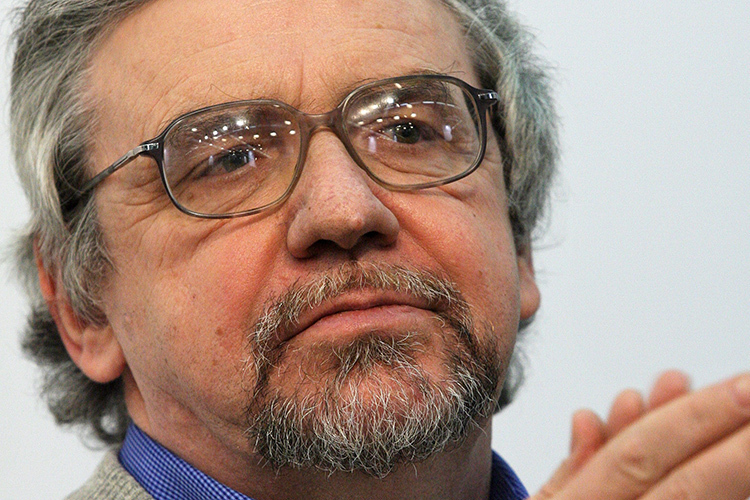
Mikhail Yampolsky: "He was one of the few knew how to think a culture globally"
Borya Dubin left. It is impossible to put up with this; First of all, because he was a wonderful friend, unique person “without flaws”, absolutely reliable, one hundred percent non -junk, modest, sensitive and open. But the loss of it is also non -executed for Russian culture. Now it seems to me that with the departure of Bori, the whole stage of our culture, measured by the openness range, has ended. She seemed to have become collapsed, narrowed, became a corridor in a communal apartment. This collapse was felt for me by the milestones of loss - Prigov, Vitya Zhivov, Grisha Dashevsky and here is the last - Borya.
I met him at the first Tynyanov readings in 1982. Marietta Chudakova, who organized this philological meeting, brought with her two young sociologists with whom she worked in Lenin, - Lev Gudkova and Borya Dubin. Philologists did not meet them particularly friendly. At that time, in fashion, there were searches for hidden quotes and comments. The sociology of literature seemed to many empty profanity, the level of analysis was too general, which neglected the intricacies of texts and contexts. The very problem of literature relations with the reader and society worried few. Borya, a wonderful subtle sociologist, remarkably knew world philosophical thought, had another hypostasis - he was a talented poet and translator of poetry. Now it seems to me that there is a much more significant connection between his sociology of culture and his translations than I previously believed.
Borya never thought of a translation as work on isolated text. The poem has always been to him the manifestation of the language (and he knew many languages and never worked with the tune), and his tongue always seemed to him the embodiment of culture. The poem fit into the integral work of the poet, who seemed to be a native speaker of a special configuration of the national language. Therefore, the translation has always meant the gravity of the general plasticity and the intonation of this poetic-cultural and linguistic total. Borya admired his teacher Anatoly Geleskul and repeated that Geleskul not only translated Lorca's texts, but invented only Lorca, created a frantic language continent, a cultural community, only based on which, you can translate the texts. In this sense, Borin's translation practice was based on a deep hermeneutical understanding of the ratio of text and culture as the relationship of the whole and part. And it is in this sense that the general -social approach to culture complemented his work of the translator. But in order to work like that, it was necessary to thoroughly know the “environment” that gave rise to texts. And in this knowledge, the bore was not equal. The conversation with him was amazing because he allowed the culture to discuss as a complex and unique layout of layers.
The translations made by him opened the zones of world culture in Russia. What is only his translation feat - many years of work on Borges. But the work of the translator is not only the discovery of unknown and universally recognized giants. Borya believed that the development of marginal cultures - Galician, Portuguese or Polish - is fundamentally for the development of Russian literature, which is too comfortably and comfortably inscribed in the continents of the French, English or German language system. His erudition was huge and unobtrusive, but it was precisely this ability to think globally, not abstractly and speculatively, namely at the level of the finest poetic intuition. In this sense, it always seemed to me that Borya is the author of excellent literary criticism and subtle philological analyzes-in some way an “anti-filologist”. Contexts and quotes did not occupy him at all. He was one of the few knew how to think a culture globally, as a changing form of consciousness, which is a way out in separate texts, as a dynamic configuration of hidden language layers. Russian poetry in his mind has always been part of the world.
That is why his death is a tragedy for all domestic literature, mired in provinciality, ignorance, anti -intellectualism and a sense of national self -sufficiency. The horror covers from the consciousness that Borya is absolutely no one to replace. Something ended irrevocably, it went away.
Sergey Kozlov. Three theses about Boris Dubin
Boris Dubin's departure is a catastrophic loss. The scale of this loss is recognized by many - so I hope that in the coming days a lot will be said about the club, and from different observation positions. I would like to note only three things.
Dubin belonged to a tiny number of people who perform a rare and at the same time extremely important cultural function of the “person-institute” in our country. This is a person whose activity unfolds in such different directions that contemporaries say: “It seemed that these were several people who had the same surname.” The other side of this rare cultural type is incredible performance and productivity; Contemporaries say: "It seemed that he alone replaces the work of an entire institute." That was Mikhail Leonovich Gasparov. Boris Dubin was a figure from the same row - although he would fiercely opposed any attempt to put himself next to Gasparov. But the fact is a fact: it was the same cultural role - if you like, a “cultural vacancy”. A number of people with different background and various fields of classes in one way or another played a similar role in the late Soviet and then post -Soviet culture. This prevalence of “Investigators” in Russian culture indicates only one thing: the weakness of the institutional framework of culture. A person in Russia is forced to replace missing or spoiled institutions. The vacancy of the “person-institute” appears and is in demand in the countries of culturally retarded: in the first half of the twentieth century, a similar role was taken, for example, Benedetto Kroche in Italy or Jose Ortega-i-Gasset in Spain. Italy and Spain of that period are typical countries of cultural periphery. And it is no accident that the literature of the peripheral countries was always the most interested in Boris Dubin.
But in the multi-stance of the club there was something that allocated him from a number of other “Investigators”. The distance between different areas of classes of the club was so great that it led to the inclusion in significantly different social networks. Gasparov, for example, was not like this: he, of course, was included in different groups of specialists, but all these groups belonged to the same and the same subculture of the humanitarians, graduates of the Faculty of Philology. Dubin, as well as accurately noted by his closest friend and ally, Lev Gudkov, "was connected by the most diverse environments: literary, scientific, public, cultural, where he represented different meanings of different aspects." I would like to say a little more about only one of the many aspects of this Tolmal role of the club. He made exclusively a lot to overcome the gap between Russian philologists and the language of sociology. When in the 80s the articles of Dubin and Gudkov began to appear in the first issues of “Tynanov’s collections” dedicated to the sociology of Russian literary consciousness, the philologists who read them simply could not understand what was written in them. 20 years have passed - and what seemed before the Tarabarshchina, for the same philologists, understandable texts, saturated with thought, became for the same philologists. This metamorphosis happened primarily thanks to the constant dialogue of the club with the philological environment, which took place since 1992 within the walls of the UFO Publishing House and on the pages of the journal "UFO". A huge role was also played by the seminar on the sociology of literature and culture, which was conducted by Dubin and Gudkov at the RSUS since the mid-90s. As a result, the young generation of Russian philologists absorbed the language of sociology even on a student bench.
In the case of a club, we are tireless work for the benefit of Russia and the Russian language, based on a sense of hopelessness.
A person-institute, an intermediary man, Dubin was a tireless enlightener. And here we approach a wonderful contradiction. This tireless educational work was in amazing dissonance with the hopelessness of the Dubinsky view of Russia as a country of failed modernization. This pessimism was imprinted in the mass of articles, reports and interviews of the club: in essence, this hopeless thought of Russia is the leitmotif of the texts of the club. We are accustomed to believe that cultural security is inextricably linked if not with faith in the future, then at least with hope for the future, with a bet on the future-in short, with cultural and historical optimism (albeit arbitrarily unnecessary). In the case of a club, we are tireless work for the benefit of Russia and the Russian language, based on a sense of hopelessness. Before us is hopelessness as an incentive motive for constructive social action. Is this possible? Yes. Here you can recall the famous Punin's famous saying to us by the memoirists: "The main thing is not to lose despair." You can recall Kirkegora and Camus. And you can recall the formula of the club: "Live impossible." So Dubin entitled his necrologist Vadim Kozovoy. Today I hear in this formula the motto of the whole life of Boris Dubin himself.