
Translated material
Forbidden voters
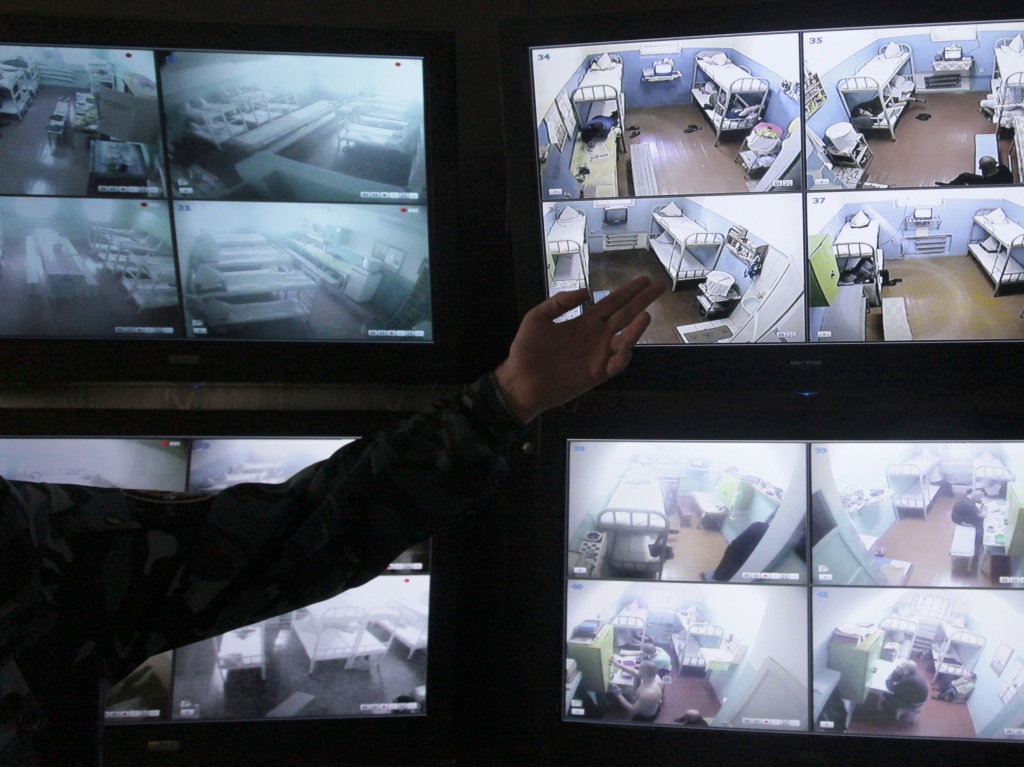
The Moscow pre -trial detention center, which contains more than 10 thousand people, counted only 100 voters for upcoming elections to the Moscow City Duma
Of the 10 thousand people, about 3 thousand are citizens of foreign states. The rest are our, mainly not yet convicted, that is, having the right to elect and be elected. Muscovites (with a residence permit) - about 2.5 thousand people. However, only 100 (STO) will be able to take part in the vote on September 14 (and this is a single voting day). If they want
Reuters/Ilya Naymushin
Here is the alignment of voting prisons:
Pre -trial detention center No. 1 - 7 people, No. 2 - 17 people, No. 3 - 13 people, No. 4 - 25 people, No. 5 - 21 people, No. 6 - 1 person, No. 7 - 16 people.
A year ago, in the elections of the mayor of Moscow, the FSIN recognized the right to vote in 2400 prisoners of Moscow prisons. Why did it happen in a year? But because. Because the contradictions in the laws, because reluctance to work, and the prisoners and their relatives still do not know their rights. Because not all prisoners have a Moscow residence permit. And the prisoner, for example, from the Lipetsk region, where on September 14 they will choose the governor, or from St. Petersburg, where the same thing, even if he really wants, will hardly achieve that he was sent to the Moscow prison, members of the election commission and observers - from Lipetsk and St. Petersburg, respectively. Far, expensive and nobody needs.
But why are there so few Moscow voters? What are they - less plant? Yes, nothing like that. It's just that the election is arranged for us. It is arranged that, for example, the indigenous Muscovite, lawyer Evgeny Chaika, the trial of whom he still did not think to be appointed, contained in pre -trial detention center No. 5 (Voikovskaya) and registered in Ochakovo, with all the desire, will not be able to vote. As Alexander Margolin, Muscovite (sits in Butyrka) cannot do this, although his sentence clearly does not have time to enter into legal force by September 14. There are thousands of such “deprivation” only in Moscow. Tens of thousands of the country. The law allows them to vote.
Here is a certificate prepared by lawyers by electoral law and experienced observers at the request of the public movement “Rus Sitting”:
---
On the exercise of the electoral rights of citizens in custody
The Moscow Electoral Code provides active suffrage only in the election district where the place of residence of the citizen is located. Thus, only those citizens who live in the territory of the same constituency to which the pre -trial detention center belongs to the place of temporary residence can be included (at the place of temporary stay).
The law admits for persons detained, the organization of voting outside the voting room, however, it is almost impossible to implement such a process on a Moscow scale (even if it is assumed that the district commissions have the opportunity to arrive in a pre -trial detention center for voting among their own voters, still large pre -trial detention centers will not be able to accept so many away groups from different sections).
Another option is the delivery of persons detained to polling stations at their place of residence on a single voting day. However, such a procedure also seems to be poorly re -relevant, since the number of plots that will need to deliver citizens may be very significant.
An alternative may be the provision of citizens in custody to vote during early voting. Such a procedure can be carried out within 11 days (from September 3 to 13), and the number of voting places is significantly less compared to the main voting day (since early voting is carried out in Moscow exclusively in territorial commissions).
This means what an interesting thing. Those who wish to vote prisoners should notify the leadership of the pre -trial detention center. Territorial election commissions in the districts should be notified of such desire (they are notified by the head of the pre -trial detention center, or the prisoner himself through the head of the pre -trial detention center, or lawyers or relatives of the prisoner). And in this case, the voter must arrive vote ahead of schedule under the escort, equipped with the necessary documents. It will vote - and back. Yes, troublesome. The convoy is there. Well, nothing, this can be done on the weekend when the courts do not work and when there are no traffic jams in Moscow. After all, suffrage is more important than frogs of the convoy and prison employees? Of course, it is more important what to argue here.
I expressed this simple thought at the city hall on a round table, which took place on August 20, and where we were all-all. Thanks to Alexei Venediktov, the chief editor of the Echo of Moscow, as well as part -time head of the capital’s OP for the development of civil society - called and gave a word. Suddenly, this idea was seriously supported by Nikolai Gonchar, a prominent member of United Russia, the secretary of the Moscow Regional Department, by the way. What FSIN answered, even conveying inconveniently, honestly. “Could or cannot vote, not the FSIN, but the investigator, decides,” Valery Avedov, deputy chief of the Federal Penitentiary Service of Russia for Moscow, told a high assembly. And this is in the presence of the entire Mosgorisbirkom and personally his head, Mr. Gorbunov. Oh, how uncomfortable it turned out.
But the strangest thing - no one objected to the FSINOV colonel.
In general, so. In order for the prisoner to fully realize his suffrage, which neither the investigator nor the colonel can take away from him, he is not bad, now, to write such a statement (of course, it concerns not only voters in Moscow prisons, but in all the others):
To the boss
(names of the institution - places of detention of suspects and accused)
(initials, surname)
from (name, patronymic, surname of the person in custody, as well as other information that is customary to indicate in statements in the name of the administration)
Statement
On September 14, 2014, the city of Moscow will be held in Moscow of the Moscow City Duma of the sixth convocation. In accordance with Part 6 of Art. 4 of the Electoral Code of the city of Moscow, voters have active suffrage, whose place of residence is located in the territory of the corresponding constituency. I am registered at the place of residence in the area of ____________ of the city of Moscow, which belongs to the single -mandate constituency No. ___. Thus, I cannot be included in the list of voters at the place of stay at the place of detention.
To exercise my right to participate in the vote, I ask me to provide me with the opportunity to vote either on the voting day on 09/14/2014 in the premises of the polling station at the place of residence, or on early voting, organized in accordance with Article 69.1 of the City of Moscow in the period from September 3 to 13, 2014 in the premises of the territorial election commission of the district _________________.
The story of the vote of persons under house arrest is no less curious. The conditions of such an arrest are determined by the court. Therefore, Evgenia Vasilieva can go for walks, to hairdressers and shops, but Alexei Navalny and Konstantin Yankauskas. However, costume can be visited, but Navalny - no. At the same time, Navalny was arrested at the place of registration, and Yankauskas was arrested at the place of registration and residence of his grandmother. And, by the way, the list of people who are now contained under house arrest (the measure is becoming quite popular), these three surnames are far from exhausted.
Here is a joint certificate of experienced observers and “Rus of sitting”:
On the exercise of the electoral rights of citizens under house arrest
Problems of the implementation of active suffrage also exist in persons under house arrest. The list of grounds for voting outside the voting room, provided for by law, does not include house arrest, and judicial practice in different ways interprets the question of whether this list is comprehensive. In addition, in some cases, citizens contained under house arrest imposed restrictions on communication with third parties. In some cases, the place of house arrest differs from the registration address at the place of residence, which is also an obstacle to voting outside the premises.
Thus, to ensure the possibility of voting for this category of citizens, it is necessary:
- To solve the issue of whether household arrest is the basis for voting outside the voting room;
- if there are restrictions on communication with third parties - to obtain decisions that allow us to cancel these restrictions in the amount necessary for the exercise of electoral rights;
- If necessary, to ensure accompanying persons under house arrest to the place of voting.
Here's what the colonel of the internal service of the Avedov answered this:
“Aleksey Navalny and Konstantin Yankauskas, which are under house arrest, have legal right to a walk, they can use this opportunity to vote in the elections in the Moscow City Duma on September 14.
Their sentences say that they have the right to walk with the permission of law enforcement agencies, for this Navalny and Yankauskas must first submit an application. ” And the Chairman of the Moscow City City Crimea Valentin Gorbunov emphasized that in such cases, the organization of voting is under the jurisdiction of law enforcement agencies, and not his departments.
Until now, law enforcement agencies have not made it possible to walk either Navalny or Yankauskas.
Now let's see what international law tells us about this. The ban on participating in the election of state authorities of citizens contained in places of imprisonment violates the right to free elections, has been telling us international law since 2013, and the European Court of Human Rights calls for Russia to return the right to vote in the elections to the concluded. Moreover, all prisoners - and convicts too.
The decision of the European Court of Human Rights in the case “Anychugov and Gladkov against Russia” (Anchugov and Gladkov v. Russia, complaints NN 11157/04 and 15162/05) were unanimously adopted. The judge from Russia Dmitry Dedov also voted for the adoption of the decision.
Sergey Anychugov and Vladimir Gladkov in the second half of the 1990s were sentenced to imprisonment, and their active and passive electoral rights were limited in accordance with part 3 of Art. 32 of the Constitution of the Russian Federation. According to the applicants, the ban on the participation of prisoners in the vote is contrary to the international obligations of Russia. In addition, prisoners, by law, have access to information and therefore are able to make a conscious choice. All courts in Russia, up to the supreme and constitutional, refused to satisfy their complaints about the ban.
The resolution of the ECHR says that in the 21st century the right to elect a privilege is no longer, so such a restriction of active suffrage is disproportionate, especially when you take into account more than 700,000 people. The ECHR admitted that there was an ongoing violation of applicants' rights to elect, determined in Art. 3 protocol No. 1 to the Convention (right to free elections). Having taken into account the difficulties associated with the change in the Constitution of the Russian Federation, the ECHR provided the Russian authorities independently choose a way to eliminate the violation.
So they chose. Eliminating everyone. There are no voters - there are no violations.