
Translated material
Who got the Libyan oil
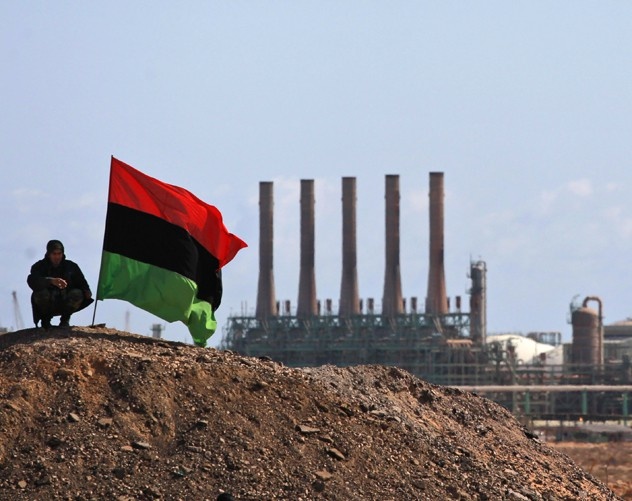
Oil is a favorite substance of conspiracyologists, it has a universal answer to all questions. Whatever happens in the world, the details are not important, because in the end the root cause will still turn out to be oil. Saddam overthrew-because of oil, graters with Venezuela or Iran-because of oil, Ukraine, however, occurred due to shale gas, but it is the same oil. Let oil in Afghanistan only saw oil on the only TV in the Lenin room-it doesn’t matter if not because of the oil itself, it means that because of oil pipelines, to build them there or, conversely, not allow to build them.
Of course, the revolution in Libya also could not do without oil. The country is included in the first ten in reconnaissance oil reserves, in Africa - this is generally in the first place. Here, there is nothing to think - it is clear that Patriot Gaddafi prevented the West from plundering the Libyan bowels, and for which they overthrew him. In this version, it is not very clear why the West for forty -two years Gaddafi suffered, and then suddenly it became unbearable, but, let's say, they were waiting for favorable circumstances. In 2011, the West waited for these favorable circumstances, overthrew the colonel and now, three years later, in theory, should swim in Libyan oil. But in reality, things are exactly the opposite.
Third for happiness
If you try to name any one side that got the most oil thanks to the fall of the Gaddafi regime, then the future generations of the Libyans will be. Just because now most of Libyan oil does not get anyone - it is calm in the ground, waiting for better times. On August 18, the Libyan authorities joyfully announced that they managed to regain control of several oil fields that were previously blocked by militants, and now Libya will be able to increase oil production to 550 thousand barrels per day.
That is, now in Libya, as a great achievement, the level of oil production is presented, which is three times less than it was under the last months before the revolution. Then Libya stably mined 1.65 million barrels per day: 300 thousand of them went to internal needs, and everything else (more than 1.3 million barrels) - for export, which allowed Libya to be one of the world's largest oil exporters, speaking on equal terms with Kuwait, Qatar or Mexican.
How many barrels per day are exported now, it is quite pointless to count, because deliveries are too unstable. For example, at the beginning of this week, after an annual break in the largest oil terminal in the ESS, it was possible to pour something into the Italian tanker, which sailed to Trithus by order of the Austrian OMV, and it’s already good. And tomorrow, perhaps, again, it will not be possible to sell anything, because someone will capture the terminal. Or because there will be nothing to sell: over the past three years, there have been periods in Libya when oil production has fallen up to 200 and even 100 thousand barrels per day, and this is less of its own needs.
This is all due to the fact that in Libya, in fact, there was no state left. There, of course, there are people who call themselves prime ministers, government members, speakers of parliaments, deputies, but this is more likely for decency for foreign correspondents to know who to take interviews. And in practice, these characters have a very weak influence on the harsh Libyan reality. The prime minister can at any time abduct and take it away unknown where or simply not to let it go to the airport, so as not to be asked. Deputies elected in June are forced to hold parliamentary meetings for provincial hotels and not in full force, because parliamentary factions will boycott each other. In the largest cities - Tripoli and Benghazi - fights are continuously. Most of the foreign embassies have long been evacuated. This week it came to the point that Tripoli bombed unidentified aircraft. Some unknown people got somewhere bombers and bombs to them and now they are lying around the capital.
Capture - money - valve
Now the country is divided between dozens of warring armed groups among themselves, which are formed according to the regional, relative, ideological, religious and other principles. It is difficult to call these people anti -government rebels, because many of them are quite government. Among the leaders of these groups in the abundance of generals, deputies, former ministers who consider their resignation illegal.
Or, for example, when the next gang of militants captured a large oil field, the Libyan authorities responded to this by increasing salaries by border guards by 20 percent. Logic suggests that this was done so that the border guards motivated by higher salaries would go and disperse illegal invaders. But no, logic is not suitable for Libya. In fact, these are the invaders themselves were border guards, and the authorities thus tried to pay off them.
Naturally, Libyan gangs do not set themselves the goal of destroying the domestic oil industry. Just the capture of wells and port terminals is the only way for them to get money from the central authorities. They would gladly support oil production if they could sell oil themselves, but oil is not drugs, not precious metals and cigarettes, you won’t earn a lot of money with it, you need appropriate logistics and serious customers. And they are not, because so far everyone understands that the money paid by the Libyan militants for the oil tanker can easily return back in the form of bombs in public transport.
Although Libyan gangs are actively working in this direction. For example, the largest oil terminals of Eastern Libya were standing for almost a year, from August 2013 to the end of this spring, because they were captured by the detachments of one of the local leaders, who was part-time in the leadership of government oil infrastructure protection. Under the slogans about the greater autonomy and fair separation of oilollars, these people even created something like local self-government bodies and tried to find at least someone who would buy oil from them.
In March, the militants managed to find a tanker floating under the North Korean flag to load it with oil for several tens of millions of dollars and send it to unknown customers. But in the area of Cyprus, the ship was intercepted by the American troops that returned him to Tripoli by force, and the team was arrested. After this failure, the militants reconciled and agreed to a deal with the government: they unlocked the terminals in exchange for ransom in the form of salaries for port guards (that is, for them) and a common amnesty. Actually, now this is the basic principle, according to which the oil exports of Libya are organized: a group of armed people captures a piece of oil infrastructure and blocks it, the government gives them money, and they open the valve in return, the government exports oil for some time, then the money from the militants end, they again capture something oil, and so in a circle.
We will dig up the colonel
Caddafi Brother leader was not the most treated person, but it became very difficult to work in Libya in the current conditions. It is best to cope with difficulties now, as before the revolution, it is obtained by the Italian ENI. A significant part of her production is located on a shelf, where it is not so easy for militants to get. In addition, Italians have been working in Libya for about a hundred years and know the best of all how and with which of the locals you need to negotiate in order to minimize the losses for business. Although even the Italians have not yet managed to bring their volumes of production to those that they had in the blessed times of Gaddafi.
The rest of the things go much worse. The first major international company, which had to stop his work in Libya due to constant attacks, was Royal Dutch Shell. She signed the agreements with Gaddafi back in 2004-2005 with the unofficial support of the British government - this was part of the fee for forgiven Colonel Lokerbi. The plans had exploration, the production of liquefied gas, investments of $ 650 million. But at first the work had to be temporarily interrupted due to the civil war in 2011, and in the spring of 2012, Royal Dutch Shell completely stopped its activities in Libya, and not having time to export anything from there.
A similar story happened with BP. First, in 2007, even under Gaddafi, they announced joint projects with the Libyans by $ 900 million, after the revolution the amount increased to $ 2 billion. But at the beginning of this year, the BP had to freeze all ground exploration work for an indefinite period - for security reasons. And in June, the company announced that not everything is calm at the Libyan shelf, so there the start of work is postponed at least until 2015.
France was the most active supporter of the West to take part in the overthrow of Gaddafi. But the French Total did not get anything from this. In May, the company had to take almost all its employees from Libya, and now its activity in the country is limited to small work on the shelf. One of the largest oil companies in Libya, the American Conocophillips, the production volumes of production in the beginning of this year fell more than 20 times compared to last year-all due to the same safety problems and permanent gangster blockade. Another American company, Marathon Oil, has been trying to sell its Libyan assets for almost a year.
So there is no question of any fabulous benefits that Western oil corporations from a change in the regime in Libya. On the contrary, there are only losses. What can be benefits when mining regularly falls three to five times compared to pre-revolutionary times, and even the most generous consumption expenses do not help, but give the opposite effect-the same guards will capture you, having bought weapons for your money.