
Translated material
The CPSU case
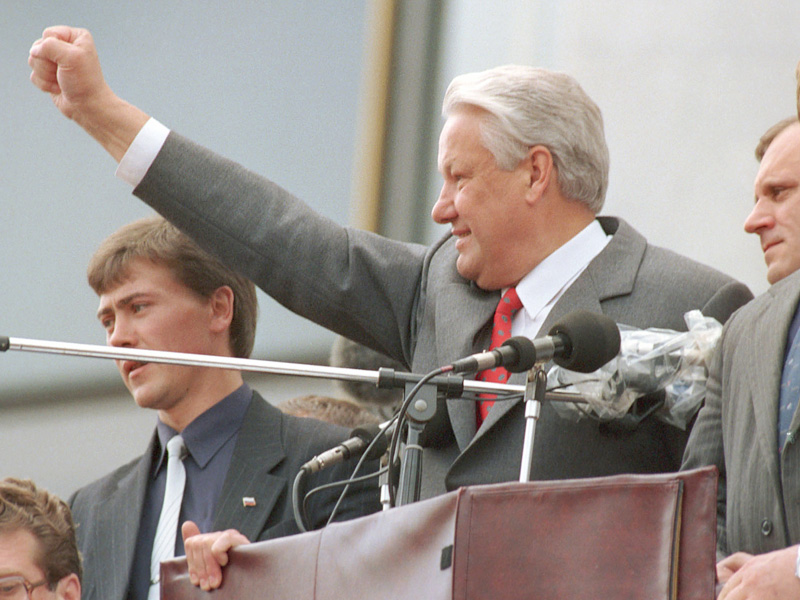
After the August putsch of 1991, the court began in the CPSU case, which did not become the new Nuremberg. Why?
Immediately after the August Putch, on August 23, 1991, Russian President Boris Yeltsin signs the first of three decrees on the CPSU: "On the suspension of the activities of the Communist Party of the RSFSR." A group of people's deputies decided to verify the constitutionality of President Yeltsin’s decrees by contacting the Constitutional Court. “New Nuremberg”, frankly, did not.
Was the chance to officially condemn the totalitarian regime in the country? Or was there just no such chance?

After the August putsch of 1991, the court began in the CPSU case, which did not become the new Nuremberg. Why?
The text of the copyWidth PX Height PX
The url has been copied to your clipboard
No Media Source Currently Available
0:00 0:23:45 Download the media fileThe program “Man has the right” participates: historians Roy Medvedev and Nikita Petrov (author of an expert opinion in the case of crimes of the CPSU), witness to the CPSU, Soviet Dissant Vladimir Bukovsky and representative of President Yeltsin in court Mikhail Fedotov.
Leading Christina Gorelik .
Kristina Gorelik: Today, the human rights calendar is dedicated to one significant event - the so -called "CPSU case". How many hopes and anxieties were associated with this event, how many victims were brought, how many efforts of many people preceded this action. And the result ... On the one hand, all participants agree that the process was historical, but its role in history is not completely clear, incomprehensible, many now. The point is not set, the CPSU is not named by the criminal organization, in the Nuremberg process, frankly, this case has not turned.
Since the history of subjunctive moods does not like, we will talk about the results today. Positive and negative. What this process led to.
Was the chance to officially condemn the totalitarian regime in the country?
Next to me in the studio is one of the authors of an expert opinion on this case for the court, historian Nikita Petrov. What did you count on then, and do you consider your hopes naive now?
Nikita Petrov: In part, of course, today from the height of the past years we can say that the hopes were not that naive, but somewhat high expectations. Hopes could be slightly, I would say romantic. Nevertheless, when my colleagues Arseniy Roginsky, Nikita Okhotin and Sergey Mironenko, then the head of one of the archives on the Old Square, we had such an assignment from the Constitutional Court, from the Judge-Rosaver Anatoly Kononov, who in this trial just reported the material for the Constitutional Court. I must say that the first court session took place at the end of May and was given time to finalize our expert opinion, collecting materials. And at this first court hearing, a counterclaim was put forward. I will remind you briefly where it all started. The Communist Party began to dispute the presidential decree, which simply banned it. When they were pressed, they remembered the rule of law. 70 years of the reign of the Communists in the Soviet Union, they did not remember any legality when it became hot, they remembered this legality and said that the Communist Party cannot be prohibited by the presidential decree, for this it is certainly necessary to decision with any court. They filed a lawsuit to challenge the constitutionality of the decree. The party of the president was not in debt and a lawsuit was immediately filed about the unconstitutionality of the CPSU itself as such. And then the first meeting took place at the end of May, and after this preparatory period on July 7, as Mikhail Sergeyevich Gorbachev liked to say, the process went, you know.
Christina Gorelik: But what did he come to? The historian Roy Medvedev is in touch with us. I would like to ask you this question: how do you evaluate the results of this process now?
Roy Medvedev: The process ended in the fact that the Communist Party was legalized. It was recognized that the leadership of the Central Committee of the CPSU, the leadership of the Soviet state is obedient in the crimes of Stalinism, but this does not concern ordinary party organizations, this does not apply to primary party organizations that did not participate in these crimes and this does not apply to the Communist Party of the Russian Federation, which was created only in 1990. And therefore, on the basis of the decision of the Constitutional Court of the CPSU, the CPSU was finally liquidated, the CPSU was prohibited as the All -Union Party, but it no longer existed by that time, and the Russian Communist Party of the Communist Party, on the contrary, had held its restorative congress and was constitutional as the Russian Communist Party, it still exists. That is, the decision of the Constitutional Court was favorable for the Communist Party of the Russian Federation.
Kristina Gorelik: So you think that the Communists won this process?
Roy Medvedev: The Communists won to a large extent this process, not completely, but in any case, the process allowed them to legalize the Communist Party in a different appearance, in a different form, but at least as they restored it.
Kristina Gorelik: Nikita, because it was true that almost immediately the Communists held their congress and began to restore influence in the country.
Nikita Petrov: In principle, it is customary to talk about the half decisions of the Constitutional Court. The half -heartedness of the decisions of the Constitutional Court was that, of course, on the one hand it was recognized that the Communist Party of the Soviet Union, the CPSU - this is not a political party, this is a special mechanism of power and therefore to close it with the president’s decree quite correctly and correctly. It was also recognized that for a long time in the Soviet Union, this is in the decision of the Constitutional Court of November 30, 1992, terror reigned, in fact, the authorities from the names of the CPSU acted, exclusively relying on violence and the mechanism of this power, the Politburo of the Central Committee, and so on. This is all very important. But, of course, the fact that the primarys were taken out of the decisions of the Constitutional Court, and the fact that in general the Communist Party was not recognized as an unconstitutional organization is very bad. Because it really could be a chance not only to desevetization or decommunization, but also to the country's teninization. This chance was missed. But this was such a position, I would say, carefully, maybe with a certain submission of the highest management, carefully protective.
Kristina Gorelik: That is, they were afraid that unrest would arise in the country, worse than they were already in the 90s?
Nikita Petrov: They counted on the fact that one could not exacerbate the situation, but somehow go through, as they say, between the droplets, as the once in a famous joke about Mikoyan, not to aggravate the situation, realizing that nevertheless the communist idea has quite a lot of supporters, but real adherents that temporarily lurked. After all, when we were preparing an expert opinion, we showed precisely the crime and anti -constitutionality of the Communist Party . She was branded both for ideology and for criminal practice, she was branded for this inextricable connection between ideology and criminal practice. Criminal practice is not individual crimes of Stalin-these are crimes arising from the essence of the regime, crimes arising from the essence of the doctrine of Marxist-Leninsky. So here in this case we had a sequence. But I want to ask: who are you, Dr. Zorkin? Zorkin led the process so that these are all the Kumran manuscripts, let's disassemble the last years of the existence of the CPSU. In recent years, what have they specifically violated? They did, step by step, retreating before the democratic public on the eve of the August Revolution of 1991. And in this sense, I think that the chance was missed.
Kristina Gorelik: I believe that we need to give the word Roy Medvedev, who will not agree with you in many ways.
Roy Medvedev: I agreed with the decision of the Constitutional Court, because it was half -hearted and it was just the compromise that was needed. That is, the communist idea as such was not convicted, the communist ideology as such was not convicted, that is, it was not recognized as criminal, only the political practice of the Central Committee of the CPSU and Stalinism was condemned. That is, communism and Stalinism were nevertheless divided. If the Stalinist practice was convicted, then the communist ideology was not convicted, it entered as an integral part into the ideology of the Communist Party of the Russian Federation. For such a communist party, there was a political base in the country. And the Constitutional Court did not lead to an exacerbation of the internal situation, nevertheless, the Communist Party of the Russian Federation arose and still exists and constitutes an integral part of the political space of our country. All kinds of prohibitions play a negative role. That is, a democratic solution to the issue was ensured.
Nikita Petrov: I can’t agree for one simple reason that the matter here is not in compliance with any democratic norms, which, of course, must be observed, the essential issue is here. After all, these crimes, which Roy Alexandrovich spoke of, the crimes of Stalinism, the crimes of the communist regime, are also flowing from ideology, they are not on their own. To separate the ideology and say that the ideology is good, bad people, somehow incorrectly realize in our country and the practice was like that. Many will then write off on circumstances, say: well, how, military confrontation, proximity of war. So you can justify anything. The CPSU was supposed to be prohibited in the same way as once in 1945 in Germany of the NSDAP. It was about the declaration, and it was not about the punishment of the specific. By the way, those criminals who committed crimes could still be punished, those who judged the dissidents, those who persecuted the same Roy Aleksandrovich Medvedev contrary to the Soviet legislation of even Brezhnev time. These were all persecutions against Medvedev, they were, but all these people who were repressions against him were to be punished. Yes, he was not imprisoned, but he was going to put him in jail, the KGB has written such membranes of the KGB in the CPSU Central Committee. Do these people should feel their right after all? Therefore, we turn out today a complete, as they say, coup in consciousness. Some believe that in one city there may be avenue of Sakharov and Andropov Avenue - absurdity, persecuted and persecutor. Today's Communist Party, which Roy Aleksandrovich Medvedev is talking about, is not an organization with a communist lining or on the basis of a communist ideology, about which Roy Alexandrovich says that it is one of the components of the current Communist Party of the Communist Party. The Zyuganov Party is actually a National Socialist Party, there is an alloy of not just socialist ideas, but National Socialist ideas with pan-Slavic and pro-Soviet myths-this is what this party is.
Kristina Gorelik: If we look from the other side, the requirements of the universal lustration, was it possible to judge all these people then? The Nuremberg process is when the winners of the vanquished are judged. In this situation, I see neither winners nor defeated, because there was no such obvious war. Secondly, it was impossible to judge the conditional third Reich by the laws of the Third Reich. In 1992, the Constitutional Court judged the party under Soviet laws, moreover, the judges themselves were members of this party. Maybe then there was no chance to condemn the totalitarian regime in principle?
Nikita Petrov: This is, as it were, the seeming nonsense, they say how the Soviet leadership according to Soviet laws can be judged, and that is what the Soviet leadership did not fulfill Soviet laws. There were constitutional norms and there were constant violations of the Constitution. As for lustration, of course, many laughed and said: how will you do it, interesting, lustration, if your country is led by a former candidate for members of the Politburo? Theoretically, of course, everyone said: we will not make an exception for him, drive the Communists, and drive everyone with all floors. And in this there really was a weak moment of the new victorious Russian democracy. Because in power, those formers who quickly rebuilt quite quickly. You know, as Gorbachev said: "We all need to quickly rebuild." They quickly rebuilt because the instinct of power, but not the instinct of a change of beliefs. From here we have today's ideas. Here is the restoration, then the constant return, all this crackling about Soviet values - all this returned, because this problem remained unfinished, it was necessary to put forward new people, it was necessary to look and change the personnel of the leading elite.
Kristina Gorelik: Roy Medvedev says that the Communists won this process, and Mikhail Fedotov, who is now headed by the Presidential Council of Human Rights, and then he was also one of the active participants in these events, from the Yeltsin team, so he does not believe that their process was lost.
Mikhail Fedotov: The process turned out. If you look at the text of the decision of the Constitutional Court, then there is probably an account of 7: 3 in favor of the president. And the main task of this process was to justify and protect the constitutionality of the Yeltsin decrees on the ban on the CPSU and on the nationalization of the property of the CPSU. This goal was achieved completely. Moreover, if you look at the text of the decision of the Constitutional Court carefully, you can see that it contains a very important conclusion, this is just one paragraph, but this paragraph gives a characteristic of the regime that was in our country, which says that it was a dictatorship, that it was based on violence. This went on for many decades. This conclusion of the Constitutional Court remains relevant to this day. The Communist Party really soon arose after this and to raise the question of the ban on generally communist ideology at least would be illogical, in the conditions of a democratic state this would be wrong. The liquidation of a pseudo -social state structure that seized power was absolutely constitutionally, absolutely reasonable and correct. The thing is that the CPSU was part of the state, and the main part. The Constitution said that it is the leading and guiding force of the whole society and the state. By the way, this wording, which first appeared in our Constitution back in 1936, is a frank tracing -paper from the 1934 law - this is the law of the German Reich on ensuring the unity of the party and the state. So this German experience was quite used in this case in this case in the creation of the Stalin Constitution of 1936. This document, this law of the German Reich of December 1, 1934 can be found in the materials of the Nuremberg process.
Kristina Gorelik: As always, historical programs very often acquire a modern sound: as it became known, on Tuesday, July 8, the Ministry of Justice asked the Kiev court to ban the activities of the Communist Party. The press service of the Ministry confirmed this information to Ukrainian Pravda.
Roy Medvedev: My impressions about Ukrainian decisions are negative. Because, of course, there is now a campaign against the Communist Party of the Ukrainian State, the Communist Party of the Ukrainian state legally participated in all elections, representatives of this party occupy a certain place in the Verkhovna Rada of Ukraine, they are part of the political space of Ukraine. The ban on this party will lead to an increase in nationalism in Ukraine, which I consider to be a negative process.
Kristina Gorelik: Mikhail Alexandrovich does not believe that the process of Yeltsin’s supporters was lost, and you think that the Communists won.
Roy Medvedev: I do not think that Yeltsin lost the process, the decision was compromised. And it really could be 70% in favor of Yeltsin and other democratic forces, and 30% in favor of the Communist Party. I agreed with the decision of the Constitutional Court, because it left opportunities to continue the activities of the Communist Party and the Socialist Party, which I then represented in this court, which was created in 1991 and participated as one of the parties in the Constitutional Court. That is, we will say 70 to 30, or 60 to 40, or 50 to 50, who won, who lost, but in any case this decision was compromised and it left opportunities for people who were committed to communist beliefs, communist views or socialist beliefs, socialist views, and, in any case, did not have any punitive results of the Constitutional Court. That is, there was no what we call lustration, there was no persecution of former communists, there was no prohibition of the activities of those communists who worked in the new structures of power. That is, lustration was not carried out, and this was a positive result of the court. Because lustration was impossible, there was no political forces that could carry out this lustration. Indeed, Yeltsin was a candidate member of the Politburo and was the first secretary of the Sverdlovsk regional party committee. We can assume that he was involved in violations of the rule of law in the Sverdlovsk region. It is enough to say about the destruction of the house where the royal family was shot - this Yeltsin made all these decisions that came to him on secret directives from Moscow.
Kristina Gorelik: One of the former political and Soviet dissidents Vladimir Bukovsky is in touch with us. Do you agree with the historian Roam Medvedev?
Vladimir Bukovsky: No, I completely disagree with almost nothing. He rather looks at this question from the point of view of ideology. It was a court, that is, the legal process. From the point of view of the legal, the Yeltsin side won, the CPSU lost. The question was about whether Yeltsin legally or illegally introduced a ban on the existence of the CPSU. The Constitutional Court confirmed that this was legal. And the fact that the right to create a new party remains the right to create a general democratic position, people have the right to create any party according to their beliefs, since it does not call for violations of the law and the constitution. So this is not a victory and not 30% or even 1%. Legally speaking, the result of the court was unequivocal: Yeltsin, the presidential side won, the CPSU lost. Now Roy Alexandrovich says: what a blessing that they did not introduce lustration. I congratulate you, because they did not introduce lustration, Putin appeared and all this gable trash, which seized power by 2000. If there was lustration, they would not be close in power. Not only as members of the CPSU, especially as former KGB officers. Lustration, by the way, was more likely to apply to state security workers than just to party members. It’s just that the party members are not subject to the party in lustration in any country in Eastern Europe, only large functionaries who occupied leading posts, they were subjected to lustration, and state security. Here is the result of your joy, Roy Alexandrovich, that you received Putin, a terrible bloody regime that arranges provocations around the world and kills its citizens.
Kristina Gorelik: In your opinion, was it then that the chance was missed to officially condemn the totalitarian regime in the country or was there no such chance?
Vladimir Bukovsky: There was no chance, there was no political will. Roy Aleksandrovich mentions that Yeltsin was a candidate member of the Politburo - this was one of the reasons why he did not dare to court the CPSU. After all, what happened was not a trial of the CPSU, it was a process in the Constitutional Court. In the process, the judges were forbidden to call the CPSU by a criminal organization, explaining that the Constitutional Court is not entitled to resolve the issue of crime, he solves the issue of constitutionality. So in fact, there was no trial over the CPSU. And if it were, the lustrations would be inevitable, and we would have recovered from a very great trouble later in our history. The then power did not dare to hold a real court such as the Nuremberg over the CPSU, and this is what we then demanded from the Russian leadership, they did not go to this. Now, if we had achieved our own and conducted the Nuremberg type of the Tribunal over the communist system, I emphasize-the system, we never demanded the punishment of some individuals or persecution, we said that the system should be convicted, so lustrations would inevitably follow, and then no Putin would have come to power. But the authorities did not dare to do this, as we understand and as this was already mentioned, due to the fact that they themselves were flesh from the flesh and blood from the blood of the CPSU, this was their native mother. They did not go to this.
Kristina Gorelik: You see, there is no consensus in society even in the CPSU case, who won, who lost, what results. In my opinion, the only positive result was, we did not mention this, that there was at least some part of the archives.
Nikita Petrov: The result of the process, which was spilled out, as they say, in the light, reached the level of mass consciousness, a lot of documents that testified to the crimes of the CPSU. What do we have today? Today we have newly closing archives and that surge, that splash of documents turned out to be a single gulp. And today we have textbooks that do not include this formulation from the Constitutional Court. It should be included in history textbooks - it is not included.
It was necessary to get rid of not only the criminal methods and the criminal past, highlighting everything and opening the archives, having made natural lustration, it was necessary to get rid of the communist ideology. Alas, unfortunately, today we see a bad result of what has not been done.