
Translated material
Europe may abandon Russian missiles due to the loss of two Galileo satellites
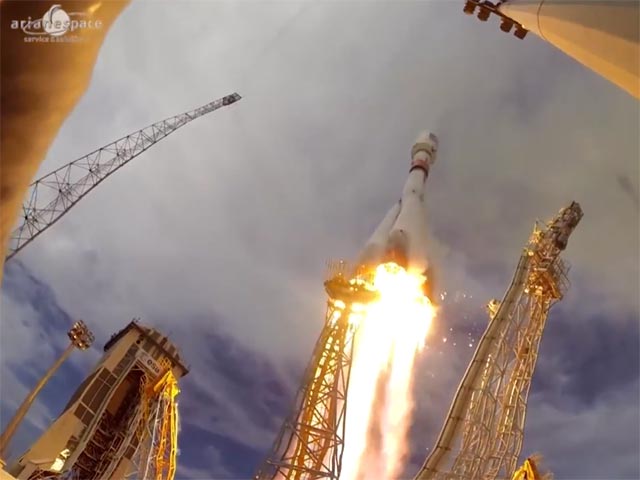
Russia can lose Europe as a client using Russian launch vehicles to launch its companions: the last straw was the unsuccessful launch of two satellites of the Galileo navigation system. The source in the missile and space industry spoke about the possible consequences of Interfax .
The Russian Soyuz-ST-B Conadier with the Frigat-MT acceleration unit and two European satellites started from the Guiana Space Center (French Guiana, South America) at 16:27 Moscow time. August 22. Initially, Russia announced a successful launch, and the European Commissioner for Industry and Entrepreneurship Ferdinando Nelly Ferochi with Paphos said: "The launch of these two devices marks the beginning of the full operating performance of the constellation Galileo.
As a result, however, it turned out that the Frigate Acupress Block worked out its part of the trajectory not to the end. The satellites did not reach the calculated orbit with a height of more than 23 thousand km, but to an elliptical with a variation in heights from 13 to 25 thousand kilometers. The Russian side admitted that it was the Frigate. According to sources, fuel on board the satellites is not enough to stabilize the orbit. The website of the European Space Agency is reported only about the “Anomaly” recorded when launching.
According to the source of Interfax in the rocket and space industry, spacecraft can be recognized as lost, since their use in the current orbit is impossible. However, a more serious consequence may be Europe’s refusal to use Russian Soyuz-ST missiles to remove Galileo navigation satellites. Satellites can launch the ARIAN-5 European missile, although the start is much more expensive.
Stefan Israel, Executive Director of the manufacturer of the Arian-5 Arianespace launch vehicle, said that on Monday the company "Together with the European Space Agency and the European Commission, an independent investigation began to find out the exact causes of problems and develop corrective actions that allow us to resume the launches In complete safety and as quickly as possible. " From this statement we can conclude that the launches of Russian Soyuz-ST launch vehicles from the European Cosmodrome Kuru in South America are suspended.
Earlier, Interfax in the NPO NPO Lavochkin, which developed and manufactured an accelerated unit, said that "there was an error when excreting the fragat overclocking unit.
Galileo is a European project of a satellite navigation system. The European system is designed to solve navigation problems for any mobile objects with an accuracy of less than one meter.
The Air Force recalls that before that Russia has successfully brought into orbit four European navigation satellites. The project of creating its own navigation system already cost Europe 6 billion euros. The program budget until 2020, when 30 satellites should be brought to orbit, is another 7 billion euros.
The Union project in the Guiana Space Center is carried out on the basis of an intergovernmental agreement between Russia and France, signed in November 2003.