
Translated material
University's future and university in the future
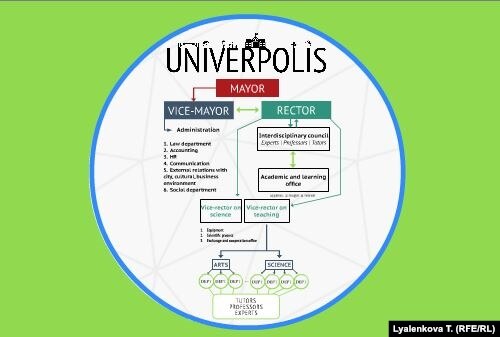
Six concepts of the University-2040 were invented by participants in the summer campus, which took place this summer in Tatarstan. In addition to students of the Russian Academy of National Economy and Public Service, which is the initiator and chief organizer of the project, the models for non-existent reality were constructed by students who came to the campus abroad.
The internationalization of education is one of the main current trends, said Evgeny Mironov, director of the Liberal ARTS program:
- 2400 participants came to the campus, they were from different countries, from all regions of Russia. This is a trend - we are already holding the third campus, and each time it is becoming more and more international. Moreover, in this
Start-up is always a victory according to the rules that you did not come up with
The year projects were protected in English. Each of the teams was supposed to prepare the University-2040 project, and I will emphasize that we set very framework conditions. The guys asked: what do you want? - And for me, as for the head of the tutor team, it was difficult not to answer this question, to withstand 8 days, while they themselves were looking for their method, how to think about it at all.
This is for us a fundamental difference from similar sites, which today are becoming more and more, where a student is invited to create a project start-up. And the guys have already learned to do this quite well, at least our participants. But the start-up is always a victory according to the rules that you did not come up with. We took the next step and invited the participants to think about what rules they would ask if it depended on them. Campus is not a curriculum, but an environment in which everything is possible, ” Evgeny Mironov explained the main idea of the project.
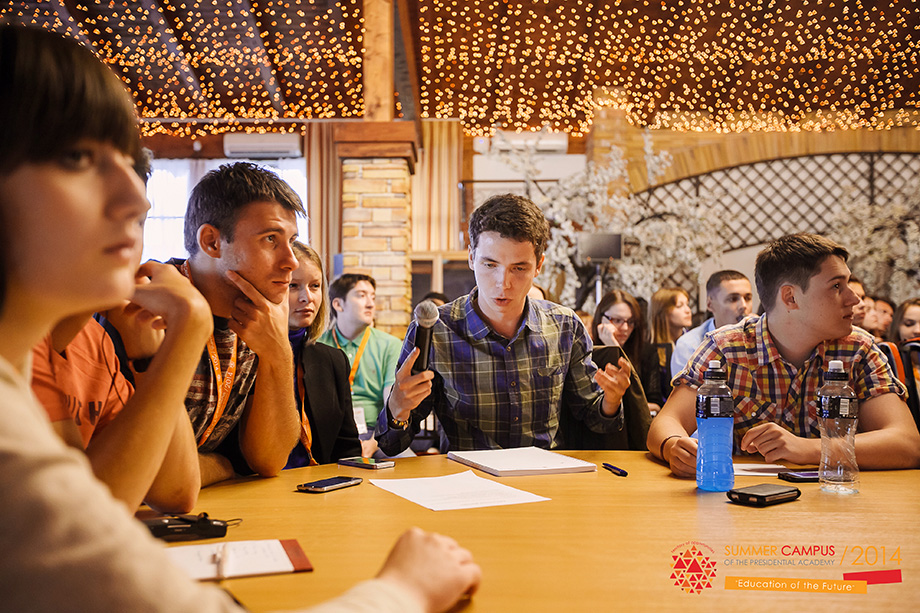
Students worked in teams of 40 people, regardless of the direction of training and the country of residence, talked in English. True, cultural and systemic, despite Russia's entry into the Bologna process, the differences still affected.
Izakov, student , student:
-On the 5-6th day, we noticed how the team gathering itself, is divided into working groups, and there is no longer a barrier between foreigners and Russian students. My team had representatives of Serbia, Croatia, Macedonia and other states. And after some time, even Russian students began to talk in English among themselves, although in the early days everyone was embarrassed and afraid.
It is curious that when the question was asked: how do you see education? - between Russian and foreign participants immediately arose
The Russians emphasized what the university will be equipped with, and foreigners completely went into the learning process
Disagreements. Russian students focused more on what this university will be equipped with, how it will look, moreover, my team even made a model plus 3D video. And foreigners completely went into the learning process, versed in the trends that are now, tried to understand what disciplines will be important in the future. Actually, some complemented others, in the end we combined our thoughts and turned out to be a very interesting university.
Anastasia Tokar , student:
- Of course, each person sees a picture of the future in his own way, but there are general cultural differences. These differences in characters became
Our guys come up with something, invent, and foreigners say: you know, we already have it
Sometimes a stumbling block in the discussion, because it was difficult to explain to foreign students some details that are simply not in their education. Or something that is not yet in our education system, and abroad is the norm. That is, our guys come up with something, invent, and foreigners say: you know, we already have it, it is not an innovation, it already is! - She shared her impressions of work in the international team Anastasia Tokar .
Nevertheless, the university of the future will become international, this belief united all six teams. There were other general principles that were present in almost all university models. It is also interesting that at a substantial level, as Evgeny Mironov noted, all projects complemented each other:
- What attracts the guys in education for their children, who in 2040 will probably already study at universities? First of all, it is obvious that modern higher education, at least on
Students proposed to completely build education according to the model and logic of the computer game
The level of undergraduate, should be wide and multifaceted. They felt that narrow professional training in well-known pluses was still a little trap. The rector of the Academy Vladimir Alexandrovich Mau also stated that modern education is largely returned to Liberal Arts models, when the guys get very diverse, universal training, and students themselves really like it.
The second important idea that was present in all projects, and in some it was even the main one is an element of the game in education. The guys even offered to completely build education according to the model and logic of the computer game, when you switch from level to level, gain glasses and so on. Of course, game elements are now being introduced, but the guys see this as an important line for themselves.
Another interesting thing - in all projects a lot said about the technical equipment of the university, about the virtualization of education, which should have many technologies. But all models suggested, I emphasize, direct communication with the teacher. Moreover, they all insisted that this communication should become more and more individual, less standardized, tutorial.
And two of the four projects, one of which won, offered a model for the complete integration of the metropolis and the university. When the very space of the big city becomes the space of training.
Izakov :
- In our team, the guys even built a mock-up city-university. The layout turned out to be very beautiful, in appearance it reminded Moscow City and was covered with a dome.
We focused on practice, and such a ratio arose: 40 percent - theory, 60 percent - practice. In our video presentation there is a fragment when the student enters a certain room, its walls are parted, and he falls into a practical space where he can try his skills. There was an idea that, moving around the metropolis, a person is studying something all the time. And the dome over the city is a kind of connection so that everyone immediately understands what is happening. We also came to the conclusion that since a person changes several professions during his life, sometimes even radically changes his life, one education is not enough.
Anastasia Tokar :
- Naturally, no one knows what the future will be, but one of the criteria has become the realism of the project. That is, not only is it necessary to develop the concept of the university, but it is also necessary to implement it into the future. And each team allocated for itself the factors by which it will determine the future. My team, through long discussions, identified three important things - medicine, information technology and the emergence of new alternative resources. And, already based on this, both the picture of the future and the university model changed.
That is, we took the trends that exist at present, and prolonged them until 2040, without inventing anything from the air.
They proceeded from the fact that medicine is now actively developing, and, taking into account new technologies, a person will live longer, up to 100 years. Of which about 80 years, he will be active, so he will have several quarries, which means several professions.
In addition, the idea of the University and the city are being fed. And in this case, the rector becomes the vice-mayor.
The guys also developed the concept of financing: the student pays 15 percent of the cost for education, the rest is paid by the employer, who is interested in learning something new, ” Anastasia Tokar finished the story about the winning project.