
Translated material
Peninsula for business
Small and medium -sized entrepreneurs of Crimea are in no hurry to go under Russian jurisdiction, and large companies are completely leaving the “risky agriculture” zone
Small and medium -sized entrepreneurs of Crimea are in no hurry to go under Russian jurisdiction, and large companies are completely leaving the zone of “risky agriculture” ...
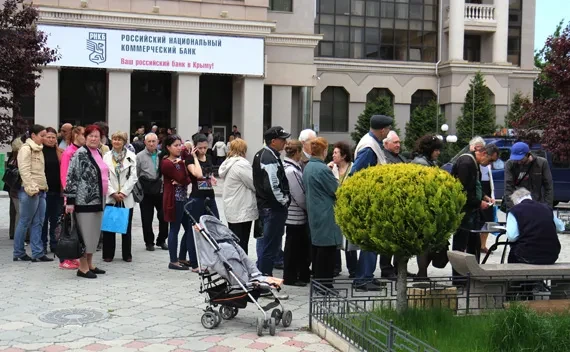
Photo: RIA Novosti
Crimea continues a comprehensive transition to Russian jurisdiction, but the local business is by no means in a hurry to change the legal plane. It is significant that the largest Russian players, both state and private: Sberbank, VTB, LUKOIL ... And they had nothing to do with them, from the peninsula. But McDonald's, which dared to close three of its restaurants on the peninsula, some time later fell under large -scale checks of activities throughout the country. Dobrolet became the first Russian company to completely turn off activities due to Western sanctions.
These are examples that are by hearing. “New” found out how medium and small companies feel on the peninsula that they would prefer: to become Russian Russian or self -destructive.
The process of re -registration of Ukrainian legal entities in the Federal Tax Service of Russia in the Republic of Crimea started from July 1. During this time, less than 400 enterprises were replaced by the legal field - the result that can hardly satisfy the Russian tax authorities.
Nevertheless, Crimean small and medium -sized businesses still have time to final transition to Russian legislation. Officially, it is ordered to register with the local Federal Tax Service by January 1, 2015, but even here certain reliefs are possible or, in extreme cases, registration as a branch of a foreign legal entity.
“There is enough time for now, the situation is not critical. In addition, now there is a summer season, and many entrepreneurs are on vacation, ”recalls the head of the Center for Expertise and Analysts of the Problems of Entrepreneurship“ Rossiy Russia ”Ivan Efremenkov. The expert expects a surge of registration activity in the fall, since by that time companies will either need to resume their activities on new conditions or to finally leave the market.
Nevertheless, it is obvious that the owners of the Crimean enterprises from re -registration holds not only the unwillingness to get out of a sun lounger in a sunny resort. The climate of the peninsula now more depends on the political situation in the world. Many entrepreneurs still do not understand what can be expected from the Russian authorities, and some of them still hope for the return of Crimea to Ukraine.
Among the possible economic ponon for the Crimean business, it is possible to especially note taxation. It can be assumed that the reluctance of Crimean entrepreneurs becomes Russian is associated with the differences between the tax systems of Ukraine and Russia, and is clearly not in our favor.
In the annual Doingbusiness rating, which is compiled by the World Bank and the International Financial Corporation (IFC), Russia occupies 56th place in terms of the degree of comfort of the tax system, Ukraine-164th. Despite the fact that the Tax Code of Ukraine is somewhat more liberal than Russian, the tax collection system in the Russian Federation is more effective. Its effectiveness is ensured primarily due to the principle of centralization of state bodies and the availability of “various tax regimes that simplify the tax system and provide the opportunity to apply it to a wide range of small businesses,” said Ivan Efremenkov.
Perhaps the reason is in an exorbitantly high tax burden, which interferes with the Russian small business to breathe deeply? Professor of the Department of Economics and Finance of the NIU HSE, Ivan Rodionov, denies this statement: “Yes, taxes in Russia are significant, but they are not a real obstacle to the development of small businesses in the region.” Most likely, Crimean entrepreneurs will have to come to terms with the existence of a single legislation in the Russian Federation and begin to adapt to it. “There can be no geographical exceptions from the law,” the expert is sure.
At the same time, the growth of the fiscal load on the new subject of the federation should be moderate. According to Ivan Efremenkov, Crimean firms take time to adapt to the Russian business climate: “It is necessary to reduce the tax burden during the transition period by providing small business preferences. However, the state should be neat: not all companies need benefits. ”
According to the Novice in the Government of the Republic of Crimea, one of these benefits had already entered into force: Crimean companies that did not have time to pay taxes before June 1, 2014, special conditions were provided, according to which, from March 20, 2014 to July 1, 2014, penalties and other financial sanctions for violation of payments.
Ivan Rodionov considers this a question of the principle: “Either entrepreneurs agree with the fact of the accession of Crimea, or not. All necessary benefits were provided earlier. The business had enough time for adaptation, so additional subsidies are unnecessary. ”
Entrepreneurs are caused by fears of difficulties that they may encounter directly in the process of re -registration of their companies. Ivan Efremenkov considers this procedure in the Russian Federation quite simple: “In Russia, the process of registration of firms is regulated at the level of federal legislation. An active work is underway to improve it. ”
In fact, by order of July 30, 2014, the Ministry of Economic Development of Russia on amendments to the “road map” “Optimization of the registration procedures of legal entities and individual entrepreneurs” reduced the deadlines for a number of actions key to optimizing registration procedures. Life of entrepreneurs is facilitated by the presence of the official website of the Federal Tax Service of Russia with full information about registration procedures, as well as a service that provides a round -the -clock opportunity to familiarize yourself with information from state registers. However, according to Ivan Rodionov, the state should still increase the headquarters of tax authorities in order to speed up the re -registration process.
“Contractors are not very willing to cooperate with Crimea, which leads to an increase in operating costs from local business. In such a situation, the Russian leadership should prove itself well, actively improving the conditions of doing business on the peninsula, ”Efremenkov notes.
At the moment, the main achievement of authorities in the field of regional economy is a significant increase in trade with mainland Russia. According to Ivan Efremenkov, the share of domestic goods in retail trade is now 60-70% of the entire market. “There are more and more new suppliers and retailers on the market, plus there is its own products in Crimea,” the expert “supports ...” notes.
Over the past few months, the laws “On the development of small and medium -sized enterprises in the Republic of Crimea”, “On the Commissioner for the Protection of Entrepreneurs in the Republic of Crimea”, as well as the state program “Development of small and medium -sized enterprises in the Republic of Crimea for 2014” have already been adopted.
The program, for which the government allocated 142.5 million rubles, provides for the creation of three funds, within the framework of which the entrepreneurs are most versatile, the representative of the Government of Crimea reports. “The first fund is mainly engaged in the issuance of preferential loans to enterprises, the second provides guarantees and guarantees in the implementation of projects significant for the republic, and the third specializes in various consultations and entrepreneurial courses.”
All these measures should in the near future significantly improve the economic situation on the peninsula, in particular, by attracting more than 1.5 billion rubles of investments and loans. Recall, however, that the Crimean market has already left a certain number of both Ukrainian and Russian companies. The banking system of the peninsula suffered the greatest damage, which, due to the departure of the largest players, will actually have to be rebuilt.
It is also noteworthy that in addition to the expected outflow of Ukrainian financial organizations (Oschadbank, Privatbank and about 30 banks), the subsidiaries of Russian banks turned their activities. Fear of sanctions tightly constrained large Russian banks; Not all organizations, even the Western blacklisted list, decide to come to the peninsula.
In Crimea, RNKB (Russian National Commercial Bank, 277 divisions in the republic), owned by the Government of the peninsula, as well as Genbank, Baikalbank, Krainvestbank, Fia-Bank and AB RNKB, which fell under sanctions, act quite successfully in Crimea. But still, they have not yet been able to fully solve the problems available on the market. “The difficult situation in the banking system seriously affects the state of business in the region: it becomes more difficult to carry out non -cash transfers, there is a difficulty in attracting financial resources and, as a result, the profitability of enterprises is reduced,” Efremenkov states.
It is sometimes difficult to find a working ATM on the peninsula (the number of which, however, has already reached 534 and is growing every day), and part of the population is still puzzled by the fate of their deposits in Ukrainian banks.
“A tremendous work was carried out - in five months, a banking system was created from scratch on the whole peninsula. At the moment, there are 28 banks with 484 branches here, ”commented on the situation in the Crimean government.
Of the Ukrainian financial organizations, two players still remained on the market: the Black Sea Bank for Development and Reconstruction and the Sevastopol Bank of Morn. “After the Crimea joined in Russia, the activities of Ukrainian banks in the region left the legal field. As a result, most Ukrainian commercial banks decided to freeze all operations, ”the government of the republic explained.
In the field of retail trade in food, noticeable business folding is not observed. The decision to leave Crimea in May adopted the leadership of the Ukrainian Fora network, but most enterprises still plans to stay in the market. However, here, as mentioned earlier, there is a different threat: the inability of Russian suppliers to quickly replace Ukrainian products, and state bodies - to control the increase in prices.
The departure of important telecommunication providers-“will” and Peoplenet, as well as the largest cellular operators of the peninsula-“MTS-Ukrainian” and “Kyivstara”, did not go unnoticed by the departure from the Crimea. True, all the equipment of the “will” is transferred to use to LLC Telecommunication Systems of the Russian Federation, and in early August the frequencies of “MTS-Ukrainian” began to use the first Russian mobile operator in the Crimea-“K-Telecom”, and all this seems to be with the consent of both sides. What clearly can not be said about the incident with the Crimean offices of Kyivstar, which, on the official statement, were captured by a group of unknown armed persons in early August.
In general, the experts surveyed give a positive forecast for the development of small businesses on the Crimean peninsula. Although at first the region requires significant support, Crimea, according to Efremenko, "has competitive advantages that can and should be used."
But it is still obvious that so far the question of the status of Crimea will not be settled with Ukraine and the world community, and these prospects are not even visible, the peninsula will remain in the zone of “risky agriculture” and large companies will not drive there either a whip or gingerbread.
Arnold Khachaturov,
Anastasia Kuvshinova