
Translated material
Gore Chakhal: "Damn is not Russian"
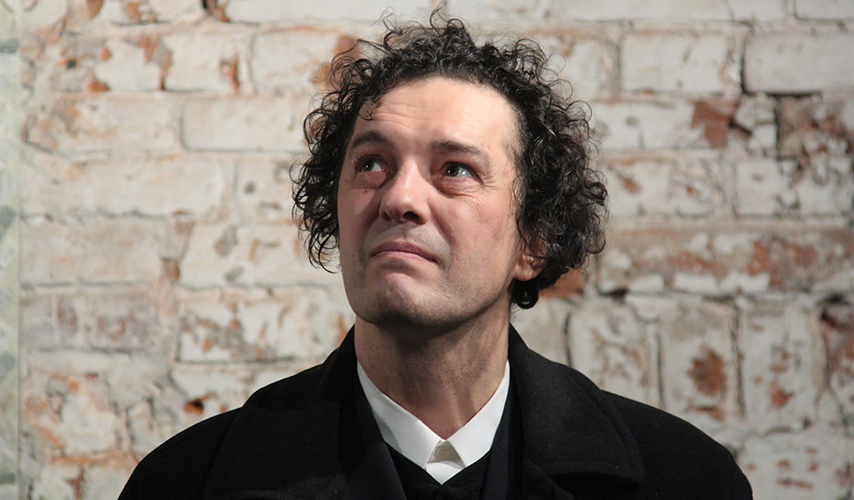
The artist of the Mountains Chakal has long been disagreed and even quarreled with other participants in the cultural life in Russia. First of all, with other artists and above all because of the attitude to religion. This is about this COLTA . RU decided to ask Mount Chahal himself.
- Some time ago you published a post on Facebook , in which they stated that "Russians are only church people, the rest are Soviet." That is, the Soviet genome, in general, excluding all religiosity, has not gone anywhere? Because the latter is not that more - they are a nation.
-Most of our people still remain in the space of Soviet culture, undoubtedly. Transforming, degrading, but in essence of the Soviet. This is especially true, by the way, intelligentsia. The least modified, in my opinion, part of society. Under the term “Soviet” I do not mean only an offensive “scoop”. Anti -Soviet, dissidents are also Soviet. Soviet science, Soviet music school, for example. They say she still remained. Although not the same that before, of course. I do not think that the “Soviet” will not go anywhere, but what will not go soon is a fact. Cultural transformations do not occur rapidly, as you know. The Bolsheviks, deliberately destroying the Russian culture for more than half a century, were faced with this.
- With the Soviet ones, it is clear, but who are the churching - who is this? Those who go to church on holidays hold candles, and in the rest of the days they take and rolls away, put people for six years in the “swamp business” and chases gays with nagikes?
- Under the churching, I understand the people of the church. Regularly visiting services, joining the sacraments living in the life of the parish. In Russia, there are 4-5% of such statistics. But this is not scary. The culture always creates a minority. In fact, the meaning of my statement was that during the 20th century, Russian culture was almost completely destroyed in Russia. First, the cultural elite, then the base, then the cultural memory and so on, was destroyed or ousted abroad. But they could not destroy to the end. Thanks to the church. After all, think: who went to church during the persecution of her from the time of the primary Christian? Obviously, the most uncompromising, incurious, unbending people, carriers of a thousand -year culture. Who did not break in the camps? Only believers, wrote Shalamov. They survived, went free and went to church. Therefore, I said: if somewhere we can meet the Russians, then in the church. Talk to the old priest and understand what Russian people are.
In my environment, I became almost an outcast.
- And, for example, Muslims living in Russia - are they also not Russians on a cultural phenotype? And Buddhists? And agnostics?
- I have nothing against the Muslims of Russia, Buddhists or agnostics. But the determining vector of cultural development in Russia has always been asked by Orthodoxy. I did not hear about the great Russian Buddhist writers, poets or artists. Even Russian agnostics and atheists turned to Christ in their God -fighting, and not to Allah, recognizing the significance of Christianity for Russian culture. Although Russian Muslim or Buddhist writers, of course, are, and this is wonderful. Our culture is polyphonic. Summing up these reasoning, I want to give a beautiful formal proof of this “the theorem of the chahal”, as the artist Nikita Alekseev called the statement discussed here . The proof from the contrary: the devil is not Russian. Q.E.D.
- You say in your reasoning that Russians are a superethnos, and Russia is a continent, who was pretending to be a country, but at the same time you do not consider yourself a nationalist. It looks contradictory. What then is Russian nationalism?
- The fact that Russia is civilization, not a nation, said not me, but Jose Manuel Barrosa, chairman of the European Commission. And the nationalist is not what I do not think, but I can’t be by definition. Well, think: how can a Russian nationalist with the name of the mountains have been a Russian nationalist? How do you imagine this? Andrei Monastyrsky, commenting on my statement, quite rightly remarked: “The apostle Paul in the message to the Kolossyans (chap. 3) speaks of the moral appearance of a true Christian, who should abandon the“ dilapidated person ”in himself, that is, from human vices (anger, anger, lies, misery, love, and spiritually renew (Article 10-11)) “In the image of creating him, where there is neither Elina, nor Judea, nor circumcision, nor impraise, barbarian, Scythian, slave, free, but all in everything is Christ.” That is why Russians are not an ethnic group, but a cultural phenotype, a superethnos. And Russian nationalism, based on the genotype, ethnic features, is always marginal. There, in the discussion, I noticed, by the way, that the Soviet ones were not an ethnic group. National, frankly, is of little interest to me. I am a half -breed by origin. Father - the Yerevan Armenian, mother - Russian from the Tambov province with an admixture of Polish blood, they say. I was born and raised in Moscow. But I do not consider myself a Moscow nationalist. In any of the great European cities in which he lived, always avoided Soviet emigrants, and talked with Aborigines and felt very comfortable. I am very close to the statement of the famous cultural historian Nikolai Wilmont: “The invasion of a foreign beginning usually only makes a large person a sovereign master of national culture. The first example of Pushkin, a descendant of “Arap Peter the Great” and the great-grandson of Christina von Sheberk (in Russian she said as follows: “Shorn Short makes me Shorni and gives them the hairpinsk name”) ... but Gogol will say about him: “Pushkin is an extraordinary phenomenon and, perhaps, the only phenomenon of the Russian spirit”. You did not notice, by the way, that there are practically no Russian ethnic diasporas anywhere? Unlike Chinese, Armenian, Jewish, even Ukrainian, for example? Why do you think?
There is a painful process of cultural transformation, recovery.
- Perhaps because the Russian is not characterized by the Russian, which Orthodox philosophers love to talk about so much? After all, even going on vacation abroad, we try to stay away from compatriots.
“But the collection is not an ethnic sign?” I respect collegiality, by the way, as a kind of direct democracy. We really feel bad with her. Together with the village community, she disappeared under the Soviets. But, I hope, with the revival of the church community can return. Has Khomyakov brought her out of there?
- Orthodoxy for Russians is Christianity or faith in the state and king? Sometimes it seems that the last.
- Orthodoxy for Russians is the faith in the first place, of course. There are few of them so far. But you can’t imagine which outwardly imperceptible work on the revival of the culture of the people is carried out by our monasteries. In general, in my opinion, just a regular visit to the Church, rituals, unloved intellectuals, rituals change the phenotype of a person. Let it involuntarily, subconsciously, but he joins the source of culture. I am convinced that this is not fast, but it affects. I can confirm on personal experience. So, I think, the revival of Russian culture, the Russian people. And, I must say, quite quickly, surprisingly.
I respect collegiality, by the way, as a kind of direct democracy.
- The country today, on the one hand, is more and more imminent in Soviet reality, on the other, it speaks louder about the spirituality and influence of the church on people's lives, in fact, the state and the Russian Orthodox Church are going on. Do you feel this contradiction?
- The fact that the country is more and more imminent in Soviet reality, I do not observe, I must admit. There is a painful process of cultural transformation, recovery, I would say. Not without complications, of course. But I clearly see positive dynamics. Especially recently. Take my professional activity. In the middle of the two thousandths, I could not put my work on Christian themes in Moscow. All cultural institutions shied away from me. The exhibition “Bread and Wine and Mother Syra-Earth” 2008 at the “Vincuration” caused a public scandal. In 2010, the polemic around the exhibition “Dvoestrovy/Dialogue” in the Tatian Church was excited by the public for a month. And a year later, “binary dialogue” was already given as an example of the possibility of dialogue of the church and contemporary art. A year later, the exhibition “Art and Religion in the space of modern culture” at the Academy of Arts was already without complications, and the exhibition “Gifts” last winter at the Museum of Architecture was held with great success with the public. Museum workers celebrated it as the most visited exhibition of contemporary art of recent years. Now the baton was picked up by the State Organization of Rosiso, organizing an annual tour of Russia for the exhibition “outside the canon”. On August 21, at the Nizhny Novgorod State Art Museum, the regional Minister of Culture opened it, write it, write it. Is this not progress?
Most of our people still remain in the space of Soviet culture.
- Maybe today your art coincided with the political agenda of the day?
- It would be nice, but each new step in this direction is still given with incredible labor. In my environment, I became almost an outcast. And the pressure only intensifies. So for now I feel that I'm going against the current. But the confrontation of traditionalists with modernists led only to the degradation of culture. I believe that initially the conflict is artificial. Traditional and modern cultures can organically complement each other. Only in this interaction I see the development vector.
- Speaking of development. How do you assess the new concept of state cultural policy proposed by Vladimir Medinsky?
- I do not want to evaluate the undercooked dish yet. I read that it was like a draft. I would like to hope, at least for this. So far, the project is very raw.
- Do you personally miss him?
- As I said, I am for a balance, for the dialogue of cultures, for polyphony. As a representative of modern, experimental art, I can notice: if the state does not support innovative art, prospects for both art and the state, in my opinion, will not. And if specifically, then I do not have enough centers of modern Christian art. Or x-centric, as I call it. Christocentric.