
Translated material
Kazakh poor
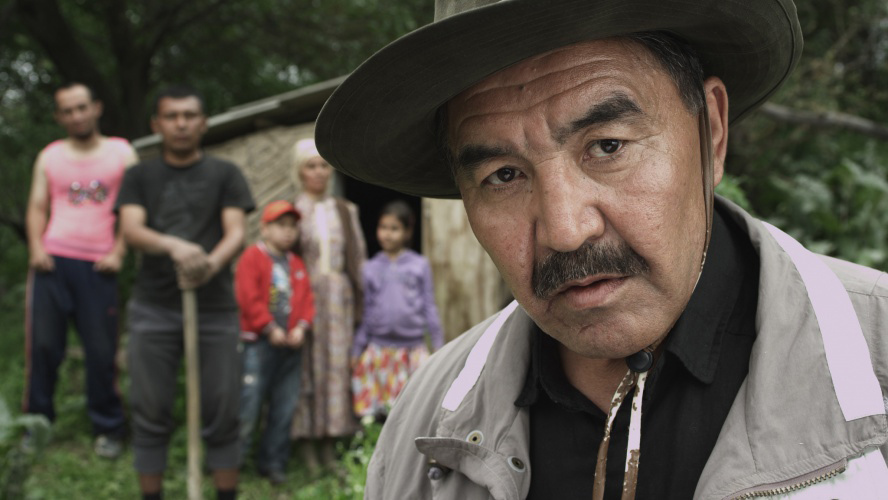
Kazakhstani cinema is an indispensable participant in the competitive program of the young Sakhalin Film Festival "End of the World". Last year, there were wonderful "harmony lessons." And in this-the picture of Adilkhan Yerzhanov “The Master”, the best that happened in the post-Soviet DIY-Kino after the “Shapito Show”.
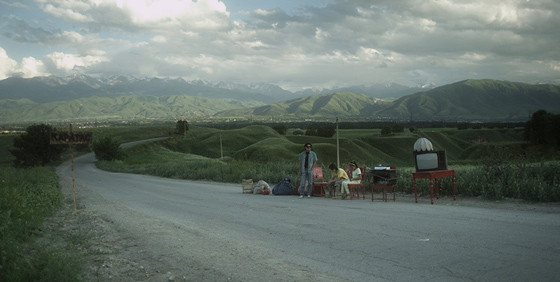
A young man, a teenager, a little girl, an antique set of firewood color and a Soviet TV vote on the sidelines of the Kazakhstan road, against the backdrop of hospitably green mountains and a deep gray sky. Cars are in horror pass by. Cut .
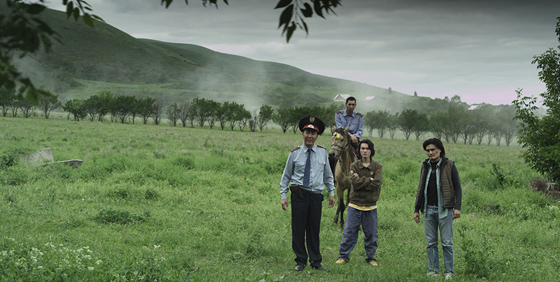
A teenager in a bomb from a second-hand enters the self-propelled house-the rural department of the police. "Quiet!" - shows with signs one district police officer. The other makes a prayer somewhere at an ugly office table, under the reproduction of Van Gogh. Shpping, another angle - the prayer actually opened in front of the portrait of Lenin. Cut .
 © Short Brothers LLC
The picturesque group of villagers beats the young man. A melancholy man in a suit and with a transistor receiver, resembling a strongly battered character in the film “The Needle” swaying a little to the side. At a distance, a couple of ragged children smiles amiably smiling. Sut .
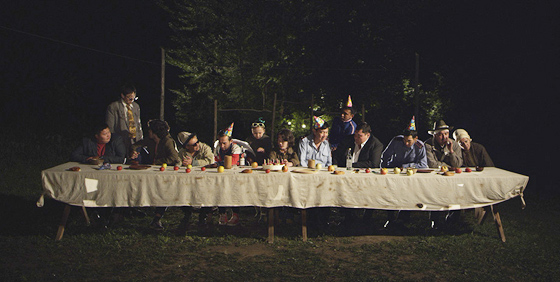
The old man with a mustache mustache, seeing a pistol directed at him, pronounces a short philosophical monologue about “We will all die, so let's have fun” and is accepted to shake in an incendiary under a rolling shak. Three shots sound - three bodies are lying into cabbage in order to get up in a second and finish the remaining twenty minutes of the film, full of death, love, blood from the chest, foam from the mouth and Vangogov yellow.
 © Short Brothers LLC
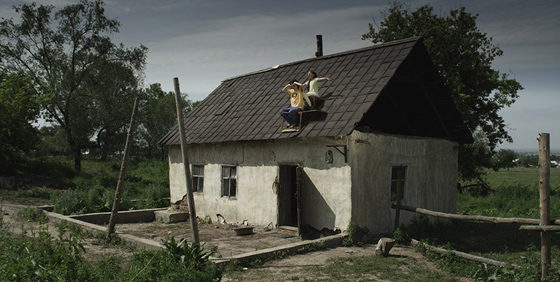
The film of the Kazakhstani director Adilkhan Yerzhanov “The Master” is all collected from such scenes, most of which, however, in principle, indescribable-as the numerous characters of the film are increasingly hiding in the war for the rickety hut in the Kazakhstani wilderness, the picture rises higher over the reality, taking off to us by the most wild samples of Asian cinema. Kitano, Tsai Minlyan, Matsumoto (minus sex) ... However, Yerzhanov’s cinema is much closer to Europe than Asia. Lubok is the most suitable word for the description of the "owners." Their director thinks with elements - a frame and a mounting joint, which glue one to another, forming an infinite, like a steppe, a mosaic canvas, where each scene is certainly shock. The consequence of such an atomic approach is the maximum expressiveness and eloquence of each frame, an obvious and slightly naive desire to “make beautifully”, accommodate the picture and scope of the Kazakh landscape, and the texture of the plastered wall, and the splendor of rhinestones on the pink T -shirt from the market, and the knowledge of the history of art, the circus, and the truth of life, and the truth of life, and folk wisdom. But this is not just a primitive: “low”, sensual, unreflected, unconscious Adilkhan Yerzhanov uses as a dynamite that explodes the jacket duties of a modern society of strong business executives who are ready to destroy a person for the living space (the basis of all this masqueshop ball is an ordinary household collision-a raider seizure of a wretched house in the village). Surrealism-and this is precisely he-Yerzhanova is not directed at any romantic depths of the subcortex: using the camera instead of a pistol, the director shoots into the crowd, draws the hare ears of the police, inheriting either Goder, or Van Gogh, floods the props with a bright yellow paint and forces the dead to dance. In the finale, unable to stop, he pulls and pulls a doused motive, forcing the heroes to die twice, three times, four times, not afraid to give all power over his picture of the imagination. And a strange, non -goods species of “owners” is the same form, which is their revolutionary, protest content. “X ** Voy is revolutionary, the rest of the bourgeois is bought” - this is just about Yerzhanov’s cinema.
 © Short Brothers LLC
At the same time, despite the viewing of the “owners”, a clear sensation of a clear, but debut, Adilkhan Yerzhanov, is actually an experienced director. He is the author of two more paintings-“builders” and “realtor” (the housing theme of the names here, however, is more likely a funny author’s touch than a through topic; “realtor”, for example, is a movie about the adventures of a realtor in a wild field, something like a parody of “the dust of the times”, shot exclusively on super-circular plans). All of them are made approximately the same creative group (Yerzhanov constantly works with relatives - for example, one of the main roles in the “owners” is played by his nephew Yerbolat). But it is the “owners” that make us reconsider all our ideas about the regional self -packing cinema and forget all the tricked condescending enthusiasm for the Yakut or Buryat wave. Because this, sorry for the pathos, is a movie with a capital letter, and I say this without any discounts on the budget, an ethnic flavor (usually hiding the illegibility of the statement and the naivety of the philosophy of the authors) or the everyday difficulties that the group experienced during the filming. It is also by no means a dumb fascinating to young Russian directors, always complaining that they have to fight not so much with the resistance of the material as with the yoke of producers and the budget deficit.
 © Short Brothers LLC
The history of the creation of “owners” is a generally indicative example of an artistic resistant: having received the money of Kazakhfilm to a similar but different script, Adilkhan shot his misanthropic cinema, equally disrespectful to the common people, police, prosecutor’s office and healthcare system (as a result, the film was prohibited for showing in Kazakhstan and now shown in South-Sakhalinsk).
At the same time, it cannot be called manicity: in this film there are no unambiguously negative characters, in it, as in the films of Kaurismaki, each hero carries a spark of humanity - but, as opposed to Kaurisma, this humanity does not fill the hero with dignity, but rather. This, in fact, is the Aristotelian meaning of the comedy: to portray people worse than they are. Although, on the other hand, there is nowhere worse.