
Translated material
Maxim Rousseau: Very lonely birds
One famous artist painted the picture “Very Lone Rooster”, where a small cock was drawn on a large clean piece of paper in the corner. In fact, there are a number of such “very lonely” birds that are known to ornithologists from only one copy or even from a single drawing.
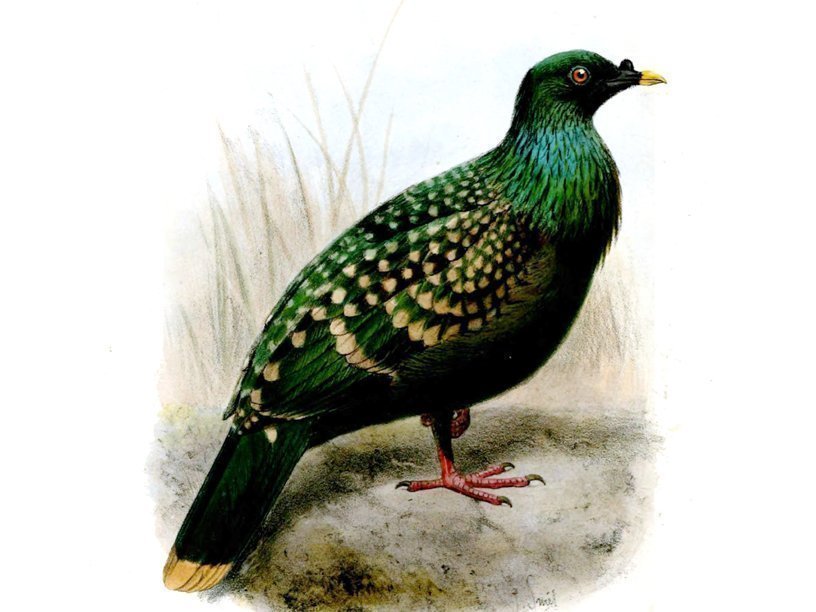
For example, the so -called Liverpool dove. He never flew over the Liverpool, and received the name only because his only scarecrow was stored in the Museum of the World in Liverpool. Another name for this bird is the green spotted pigeon ( Caloenas Maculata ). Previously, two copies were known, but the second scarecrow was lost. The Liverpool copy comes from the collection of Edward Smith-Enli . It was assumed that it was mined in the late XVIII - beginning of the 19th century in Polynesia. Ornitolg David Gibbs suggested that the spotted green dove was the mysterious bird Titi, the memory of which was preserved by the Aborigines of the Taiti Island. However, David Steidman found that in Polynesian languages the word “Titi” denoted other species of birds, representatives of the Burevestnikov family. Another hypothesis about the origin of the Liverpool dove, which was also expressed by John Latham , who published a description of the bird in 1783, connects him with the nicobar greenstic .
Green spotted ("Liverpool") pigeon (Caloenas maculata)
Recently, a genetic study was published in the journal Evolution Biology , which revealed the family ties of this species. Since due to the age of the stuffed DNA of green spotted pigeons, the researchers used three fragments of the genome, which are unique for most species of birds. Genetic analysis confirmed the kinship of a green spotted pigeon with a nicobar griva pigeon, as well as with the famous drant ( Raphus Cucullatus ) from the island of Mauritius and another extinct look- go-ahead ( Pezophaps solitaria ), which lived on Rodriguez Island. Different from the common ancestor, these birds settled on different islands of the Indian Ocean, and the separation of species occurred as a result of island isolation. Now, only a grivist dove has been preserved in nature.
Dront, a hermit, the Mauritian Dront and the Nicobar Grivisty pigeon are the closest relatives of the green spotted pigeon.
In 1840, the expedition of James Ross on the ships Erebus and Terror, which explored the southern polar waters, got an Aquarus (south of New Zealand) a copy of the bird. Now it is stored in the British Museum of Natural History. The bird is close to the hollow rzanka living in New Zealand ( Thinornis Novaeseelandiae ). It is called the hooding rye of the islands of Auckland or Rzanka Rossi ( Thinornis Rossi ). However, there is an assumption that this is still a New Zealand ryanka, just this copy has a slightly different coloring.
Rzhanka Rossa
“The mysterious bird from the island of Uletaa” ( Aplonis Ulietensis ) is known for one drawing and brief descriptions. In 1774, the second expedition of James Cook on the resolution ship visited the Pacific island of Uletaa (modern name Raiatea) open during the previous voyage. Among the participants in the expedition were scientific naturalists: Johann Forster and his son Georg . It was Georg that sketched a bird obtained there. A copy transferred to the collection of the President of the London Royal Society of Joseph Banks , later disappeared. Andrew Garrett , who visited the island of Raiatea in 1850, could not get such a bird there, apparently, by that time this species had already died out. It is suggested that this bird belonged to the genus of filter apflonis ( Aplonis ). In 2005, British writer Martin Davis published the novel by The Conjuror's Bird , dedicated to the search for the disappeared copy of this bird from the Banks collection. The book is translated into Russian under the name "Mysterious Bird."
Mysterious bird from the island of Uletaa, a drawing of George Forster
When Cook's expedition arrived at Tahiti, George Forster and managed to open and draw a new bird there. She is known under the names of the Thaytan Pogonysh ( Porzana Nigra ), or Miller's Perch. The latter name is given in honor of John Miller - a British artist specializing in the illustration of zoological and botanical works, who gave a forester on the basis of a drawing of Forster, he depicted this bird in the book “Cimelia Physica. Figures of rare and curious four -legged, birds, etc. Together with some of the most elegant plants ”(1796, Miller's drawings, the text of George Shaw ).
Thaytyan Pogonysh, Digor of George Forster
Johann and George Forestra on Tahiti. Picture of John F. Rigo. 1780.
One species of birds was discovered during the third expedition of Cook by naturalist William Andreson . On the island of Murea, not far from Tahiti, he got two waders. Locals called this bird “aunt”, in the literature it is known as Kulik Murea, or the white -winged Kulik ( Prosobonia Ellisi ). Both copies obtained were subsequently lost. Only sketches remained.
Kulik Murea
There are in the list of “very lonely birds” and those that were opened during the expeditions of Russian travelers. In 1826-1829, the first Russian round-the-world voyage was held on the Senyavin sloop led by Lieutenant Captain Fyodor Litke. Zoologist Friedrich Heinrich von Kittlits took part in it. When the expedition arrived on Kusaia Island - the eastern of the Caroline Islands, von Kittletsy opened two birds there. The first is the Kusai Pogonysh ( Porzana Monasa ), he is also a waist of Kittlitsa. Pogonsh lived on the sea coast and in the thickets of the Tarot plant. Two specimens obtained by Kittlits are stored at the Zoological Institute of the Russian Academy of Sciences, there are no other copies. It is still unclear whether this bird was able to fly. Based on the examination data in X -rays, scientists suggested that the Kusai Pinch was non -lethal. However, it is known that the local name of Pogonsh “Nai-Ta-May-Note” in the translation meant “the one who lands in the thickets of tarot”. Since the bird lands, we can conclude that it still knew how to fly.
Another bird discovered on the island of Kusaia is a Kusai star ( Aplonis Corvina ). She, like the “mysterious bird from the island of Uletaa,” belonged to the genus of the apflonis strokes. This is not such a “lonely bird” - five copies are collected.
Kusai Square (Aplonis Corvina)
When the German traveler Otto Finch visited Kusaia Island in 1880, he could no longer find a chasing or a starling there. The “Whitney expedition to the southern seas”, which visited the island of 1931, was not successful, although it was specially organized by the American Museum of Natural History with the aim of collecting birds. It should be assumed that both birds were destroyed by rats, which in abundance penetrated the island from whaling vessels that posed to its shores in the 19th century.
In 1909, a skin of a hummingbird was acquired in the Colombian capital of Bogota. Experts attributed him to the genus, which in Russian literature is called a hummingbird, and in the English-“Sunangels” ( Sunangels ). They suggested that this is a special species of this kind ( Heliangelus zusii ). But more representatives of this species did not come across to scientists. In 2013, genetics confirmed that the skin belongs to a special type of hummingbird.
Another type of hummingbird is known for the male, shot in 1877 in the Bahamas Lewis Brace. It is called the Emerald Hummingbird Brace ( Chlorostilbon Bracei ). For a long time, many ornithologists considered it a variety of Cuban emerald hummingbirds ( Chlorostilbon Ricordii ). Only in 1982, paleontologists in the Bagams discovered the remains of birds of this species living in the Pleistocene, which made it possible to confirm its independent status. It is believed that he died out by the end of the 19th century, when the forests where he lived was destroyed. It is interesting that one of the first to speak about the differences between Cuban and Bahamas was a prominent ornithologist James Bond , better known to the general public by giving his name and surname to agent 007.
Another type of hummingbird from this kind was described in 1860 by the English ornithologist John Gold. The scientist gave the bird the name Chlorostilbon Elegans , but it is often called the emerald hummingbird gulda. Alas, in addition, the instance by which the species was described, this hummingbird has never hit zoologists. It is not unclear where this bird is exactly brought from, most likely from the Jamaica or the Bahamas.
Emerald Hummingbird Gulda
The thorns of the watering of Letica ( Discosura Letitiae ) is known for two males obtained in Bolivia and fell into the hands of scientists in 1852. Perhaps this is a variety of rocket lace of hummingbirds ( Discosura Longicaudus ).
An obscure status has a duck of kues ( anas Strepera Couesi ), two copies of which were mined in 1874 on the island of Terain, owned by the Republic of Kiribati. This island is notable for the fact that in the center it lies not a salty lagoon, like many Pacific Atolls, but a fresh lake isolated from the ocean. There are also quite a few swamps, where these ducks were shot. Some authors consider it an independent look, others write that this is just a dwarf feat of a gray duck ( anas Strepera ), and others even believe that these are just young birds, which cannot even claim a separate subspecies to the status of a separate subspecies. In any case, at the end of the 19th century, the gray duck on the island of Terain died out.
Sprinkles on some unique specimens help genetic studies. In 1932, two young birds received in Madagascar were considered representatives of a special Vang Blucheli ( Hypositta Perdita ), but in 2013, genetics found out that this is the Belogorely fodetan ( Oxylabes Madagascariensis ), just these copies have a rare brown color version.
There are quite a lot of “single birds”, so we have to return to this topic next time. We will get acquainted with some birds of East Asia, with “single birds”, open recently, and also try to figure out why there were especially many among parrots and paradise birds.