
Translated material
Office VALSKOV
On cobblestones - blood,
Scarlet ace - on clothes.
On the heirs again
We are in hope.
A. Gorodnitsky. "Guards Valskos"
The famous "horse, horse, half a dwell on the horse!" The king pronounces an embarrassed tongue twister, giggling nervously and frantically looking around. Do not turn your head, sir, the horse will not enter here in any case. The king himself knows this. There is no salvation. The action of "Richard III" takes place in the office.
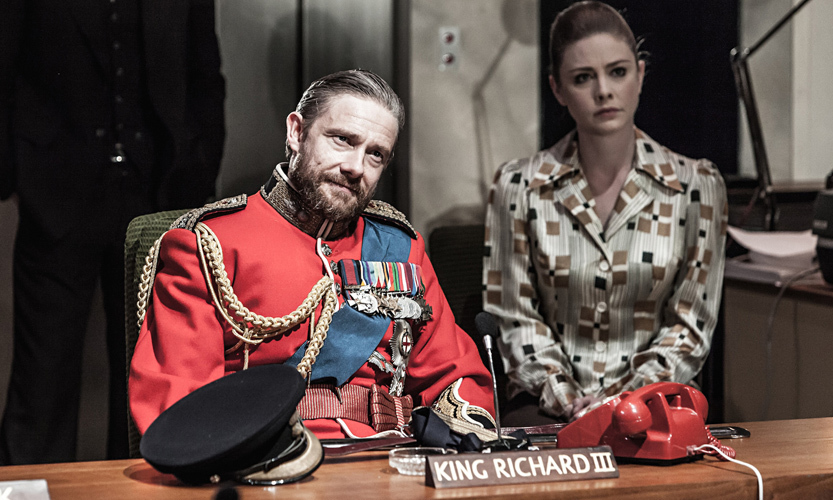
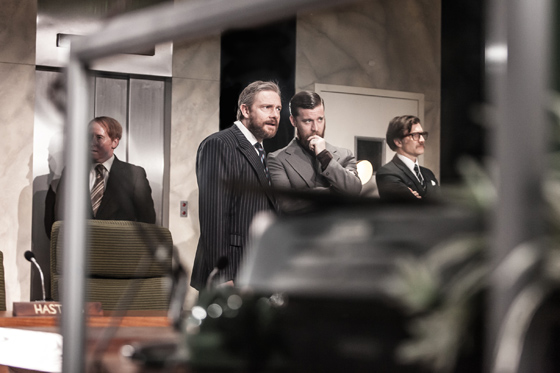
Nothing larger than the typewriter in the spaces of the play by Jamie Lloyd will no longer fit: it is already clogged with rough treasury furniture, standard lamps and other ergonomic rags (artist Gilmore Sutra). The saving horses, military camps, the field in the Bosworth, the battle, the army in bird helmets - all this is not. As there is no trace of a slowly strengthening trend, to shift the story of Richard III towards the tragedy (closer to Macbeta); There are no attempts to find the additional complexity of the historical character in the Shakespearean hero, indulging in the secret Ricardians (inspired by the recent fateful find of the remains of the last of the plantagents). But full of violence, blood, intrigue, and most importantly - cynicism. Richard III in this performance is primarily a cynic. And only then - a villain. It is cynicism, and not at all office entourage, that cancels the possibility of tragedy.
Jamie Lloyd, who had already set in the “trafalgar” of the bloody “youth” and deliberately “Scottish” McBet with James McEvo and Claire Foy, in his “Richard III” allowed a good joke, the annoying part of local criticism. “Winter of our internedists”, mentioned by Richard in the first monologue, appeared on the TV screen-documentary shots of British unrest of the late 70s, in the history of the Shakespearean quote. To get from the director what exactly he had in mind, what kind of episode of trade union battles reminded him of the war of roses, no one managed to. Lloyd, undoubtedly, was not interested in details, but the very presence of rhyme, an unexpected return of metaphor. The isolation of the historical circle is not the most anticipated topic for the young British, but it is it that is declared in the performance with a certainty.
Evil in this "Richard" is completely devoid of charm. It is just an irreversible part of office policy, in a sense - an element of corporate solidarity. By default, it is accepted that the main chair in this office is worth fighting for it. The imperious crisis finds the local “plankton” a little by surprise, but the mechanics of inner life are debugged for a long time and reliably, everyone simply moves to a step along the service ladder and continues to be everyday, with an ineffective helpful friendliness on physiognomies, fussing around the new bosses. The negotiators (like Gastings) - agree, PRA - PR (viewers fell on the last round of the election campaign and, heated by Buckingham spells, were ready to vote together for Richard. Stephen Moffat, who was sitting with Sue Verchi before us, was definitely behind us). The killers are equal employees, like a secretary, only salaries are higher. Clarence is a little chase around the tables, and then they put their heads into the aquarium - the fish will float in a blurry bloody spot.
In Richard III, Martin Freeman plays a hero who has achieved the devil greet his hand. First.
The daily flow of outgoing documents and fresh corpses is not interrupted: something-to print, something-on the signature, someone-take your feet forward. Only for moments in the office flashes a light bulb, and in a dim, dead light right in the tables, in the middle of writers and antediluvian phones, bloody ghosts appear. There are many of them, by the end of the performance - more and more. In contrast with the usual routine, this gives an irresistible effect that informs the action of the necessary scale.
Even before the start of the performance on the sidelines, sideways to the office, an elderly lady sits silently and indifferently. A spectator who did not get a place. In fact - Queen Margarita (in the brilliant performance of Maggie Styd). It is worth her to intervene in the action of how her curses are forced by the office of the office people to burn in the corners, amusingly running out of the elevator to the elevator. The defeated queen does not represent any real danger - horror lies in the very presence of a living witness, a person “from the former”. This is a direct violation of corporate ethics. When the “reduction in personnel”, arranged by Richard, will become an uncomfortable closest environment and the office war of the rose will enter the final phase, in the smoke of battles, in the midst of the fighting, Queen Margarita will indifferently sit in the middle of the office with a cup of tea. She knows how it all ends, and also knows that there is no end to this.
Only Richard is decided to object to the ice wrath of the prophecies of Margarita. Not because it’s so brave - it’s just completely devoid of imagination. The absence of a direct, immediate threat to him automatically means the lack of a threat as such. The "Birnamo Forest" will not go to the office. Duke Gloucester is a pragmatist. Martin Freeman plays Richard III at such nuances and such speeds that it is impossible not to marvel at the aesthetic deafness of the critics, who called the actor a “boy doing the work of a man” (they would try to do this in one of our academic “mosques”).
Of course, the hero of Freeman is terribly far from the image of an irresistible hunchback, a villainous seducing virtuous women with something like a mixture of indestructible vitality and devilish flattery. The actor’s “disadvantage of sexuality” has been pricked more than once, which unexpectedly discovers in solid London newspapers a tendency to touching errors characteristic of Russian innocent virgins. Meanwhile, Martin Freeman plays evil as an inevitable consequence of deep damage - not physical, of course. Gorb, lameness and a whipping hand, the dignity of the hero, distinctive features. His drawback is not that he is a freak (well, not this smart, smiling creature), but that he is mediocrity. A small clerk in the crowd of others is the same. Shakespeare's “Oryol has nowhere to sit, sparrows - expanse” - this is about himself. No titanic villainous torment, no ingenious efforts of infernal cunning: ambitious ordinary, small soul - necessary and sufficient conditions for the subsequent chain of murders. Freeman almost finished it in Fargo - but there his hero was destroyed shortly after the “coronation”. In Richard III, Martin Freeman plays a hero who has achieved the devil greet his hand. First.
 © Marc Brenner
The sparkling meanness of this Richard is how he pronounces the text. The magnificent scientific rhetoric of the false hump-chain is a lawsuit-this is in terms of Ien McCellen or Kevin Spacey. Freeman spaces the remarks dryly and agilely, as if crossing the knuckles in office accounts, he does not need to “revel” with Shakespearean sears - he cold -bloodedly rearranges the words with fascinating speed, pushing the opponent, only occasionally managing to be surprised when an excellent joke suddenly arises from a simple rearrangement. “Even the most fierce beast is able to regret! - I'm not capable. Therefore, I am not a beast. " The point is not the incomprehensible magnetism of the tyrant - but in the incomprehensible suppleness of his interlocutors. Richard Freiman every now and then with a cheerful, shameless curiosity glances at the hall: “How, and it will do? And will everyone be for? All 84 percent?! " (something like this). His career, one of those that could not be, seems to be fantastic to himself.
This Richard does not need to convince or seduce Anna - the lovely lady is virtually persisting, but gives up (naturally falling into a stupor for a moment), almost finds what to object. This is curious. Jamie Lloyd thoroughly reduced the text, but the structure of the play turned out to be more respectful than many others: the Shakespearean heroine (not only Lady Anna) ceases to struggle only when she ends the arguments. It was then that she has to get married.
And the Queen of Anna, already - literally - meek, Richard should not declare anything the patient (the heroine of the young Lauren O'Neill is terribly surprised at the heroine of the young Loren O'Neill immediately). For greater persuasiveness, the king will hastily put his palm on his wife’s forehead and shake his head in dismay: it’s bad, oh, the sovereign is bad, therefore, to the morgue. And he himself will send her back there - brutally strangling the queen on the office table with one hand.
In the play by Jamie Lloyd, everything happens almost lightning speed: a minute ago, Richard did not plan to kill the princes (simply did not have time), but now a smart little boy brought him to a fatal thought. And the curse of Queen Margarita comes true much more than one could assume: here, in a crowd of clerks, some young Richmond was seen. So he is torn to power and is already breaking through the door of the office. The night before the decisive battle is the phenomenon of ghosts in the office, where Richard and Richmond are sitting at neighboring tables. And the point is not that the dead judge the living, but that the dead can punish for the faulty evil, but cannot prevent the future. Requested with the villain Richard Richmond is exactly the same ambitious insignificance as his predecessor. Only he had a hump, and this beard. And the whole difference. (The further, the more willing to the Shakespearean finals refuse happy interchanges: Fortinbro and Malcolm in Macbeth, and the surviving heroes of Lira are increasingly turning out the successors of the villains, or even more terrible troubles. Apparently, the end of the Tyudor propaganda has come.)
Richmond smugly examines the coveted office. Gives a signal to the operator - and the victorious appeal of the Liberator to the grateful people is broadcast through the channels of national television. "Who is not a traitor - let's say" Amen "!" Amen - it is obvious that a somewhat underestimated play by Jamie Lloyd could be an excellent export option.