
Translated material
Fast response summit
The leaders of NATO countries will gather on September 4 in Cardiff (Wales) in an atmosphere as close as possible to the combat: the war in the southeast of the continent is gaining momentum and more and more concerns not only Russia and Ukraine-it is time to do something. But what?
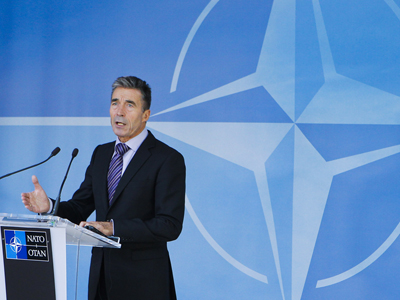
NATO Secretary General Anders Fogg Rasmussen at a press conference in Brussels. August 29, 2014 /Photo: ITAR-TASS
“Do not be deceived, this is an ordinary tactical maneuver; He (Putin) does not celebrate the option with the invasion if necessary, ”-this is how NATO Secretary General Anders Fog Fog Rasmussen answered the question of one of the journalists about the background of Vladimir Putin’s background about the redress of the 20,000th grouping of Russian troops-from the border with Ukraine deep into the territory of the country. “Putin leads a double game,” Secretary General developed his thought.
It was July 9th. Rasmussen just talked in Washington with President Barack Obama and informed him: work on the new “Readance Action Plan), in the context of the changed geopolitical situation, is in full swing. Obama asked if Rasmussen would have time to coordinate the details of the plan with all member countries before the autumn meeting at the top in Wales. Rasmussen replied: "Yes." And he explained: "Poland and the Baltic countries would like to strengthen patrol flying groups ... I think this issue is practically resolved."
Replicas for history
Rasmussen’s words about Putin’s “double game” can be interpreted so that, they say, he, the Secretary General of NATO, also managed to look into the soul of the Russian president and make out something there. Yes, such a characteristic - sounds like a diagnosis of Putin, and Russia - as a partner who can be believed and trusted. Rasmussen was quite frank and at that moment he thought more about his mother-historia. Indeed, then, in July 2014, all forms of practical cooperation with Russia (with the exception of perhaps the formally functioning logistics base in Ulyanovsk) were already rolled up (the decision of the Alliance countries was made in April on this score), and by October, he, Rasmussen, will have to hand over all matters of NATO, the ex-premiere of Norway Yenses Stoltenberg: “Lame Duck” can afford to say everything he thinks. And in general, they have mutually with Putin: nevertheless, they remember how the owner of the Kremlin during the spring “straight line” publicly stuck about the moral qualities of Rasmussen, who, at the beginning of the zero years without warning, wrote down their conversation on the recorder (they say, for the same mother-historia), and then gave it to the journalists.
“When we heard this story from Putin, we immediately realized why they and Rasmussen, unlike Robertson and de Joop Scheffer, were not imbued with mutual trust from the very beginning,” the diplomat of one of the NATO countries, working in Moscow, noted in a conversation with The New Times. “The Russian president never forgets anything.”
The format of presence
Putin was not defiantly invited to the NATO summit in Cardiff, but just as defiantly as the only leader of the alliance member country, they invited Petro Poroshenko: NATO-on the side of Ukraine-and is ready to provide her political, material, technical and financial support (in Cardiff will be announced about the creation of four special trusts). However, the alliance will make key decisions in Cardiff based on the security of member countries, and if you take it wider, throughout Europe. And this turned out to be the most difficult. One hundred percent - and unanimously - so far only the issue of signing an agreement on military assistance with Finland and Sweden has been resolved, which, like Baltic with Poland, are also Russian neighbors. The rest of the agenda, as one European diplomat noted in a conversation with the magazine, is completely dependent on the further military situation in Ukraine: “The exit of the pro-Russian militia to the Mariupol-Odessa corridor will predetermine the outcome of the entire campaign in favor of Putin. The negotiation positions of Ukraine and the West are sharply narrowed. ”
On August 26, 9 days before the summit in Cardiff, the Secretary General of Rasmussen in a short interview with a number of leading European newspapers (hereinafter - quotes on the British The Guardian) said: the Alliance is considering the deployment of new military bases in the territory of the Baltic countries with the corresponding military presence and infrastructure. "Will they be there on an ongoing basis?" - “If in short, then yes. But to avoid misunderstanding, I use the expression "exactly as much time as it will be necessary."
"
Angel Merkel: “We have not only the charter of the alliance, but also the act of Russia-NATO, which I currently do not want to cross”
"
“Our eastern allies will be satisfied with our plan for a quick response to the current situation,” Rasmussen expressed confidence. And he added that the rapid response forces can be deployed within a few hours.
A source in NATO in a conversation with The Guardian explained: “The summit in Cardiff should approve the format of the presence for patrol units deployed according to the principle of rotation - so that this will not be base in the classical sense of the word, and there is no talk of placing units on an ongoing basis.”
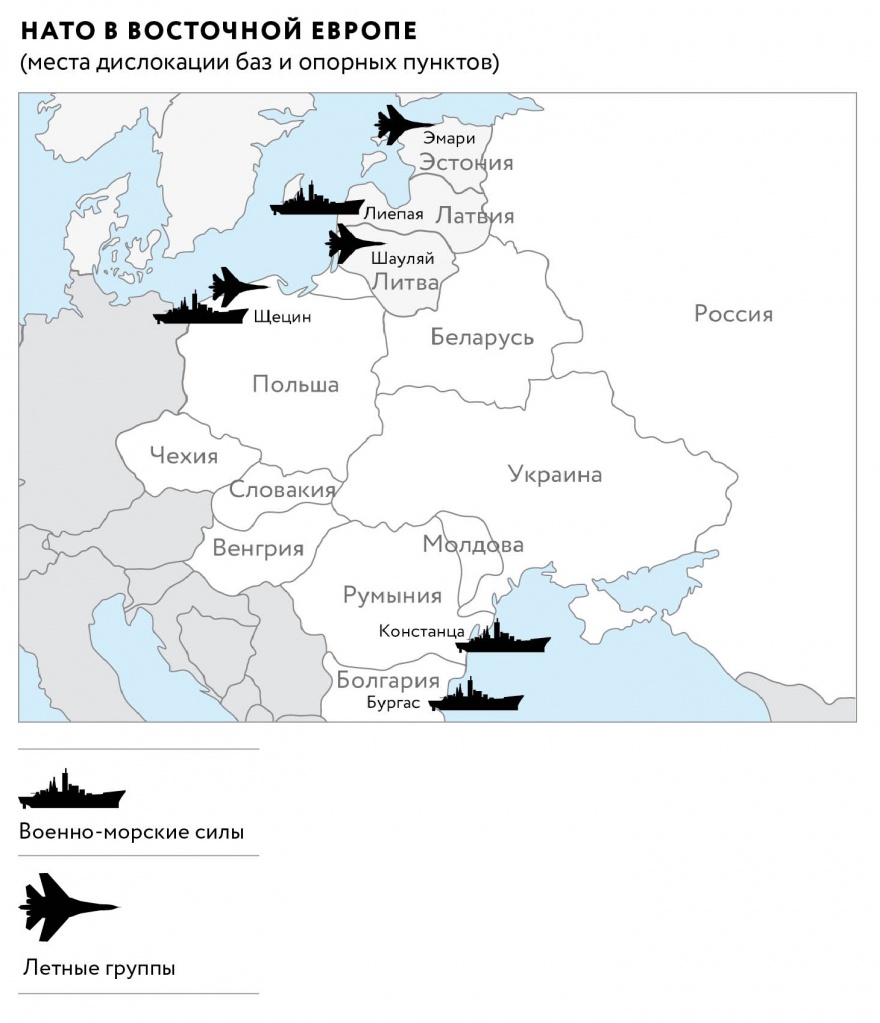
The transshipment point of the new NATO mobile patrol system on the eastern borders, according to the sources of The Guardian, will be the Polish Schezin, the port in the Baltic. The plan for the deployment of the forces of the Navy and the Air Force in Schezin has already been approved, it remains only to agree on the ground forces of the Alliance.
The sources of The Guardian are still forced to admit: opinions about the new plan have been divided. The United States and the United Kingdom fully support the request of Poland and the Baltic to the “tough presence of NATO forces in the region”, Italy, France and Spain against, and Germany “does not yet know whose position to take, fearing how not to provoke Russia.”
However, the sources of The New Times in Berlin considered it necessary to clarify: unwillingness to provoke a dissolution - this is a position, and Germany still hopes to influence Putin. But in the case of further offensive actions of the pro-Russian militia, the diplomatic source of the magazine in Berlin explained, the Alliance will return to the “Plan of the Defense of Poland and the Baltic” developed after the Russian-Georgian War since 2008, according to which 9 NATO divisions are allocated in the event of a crisis situation: the USA, Great Britain, Germany and Poland, as well as the Russian Navy and Poland.
German "but"
On August 18, Angel Merkel met in Riga with the Prime Minister of Latvia Laimdota Strayuma and warned her: Germany had a special position on the expansion of NATO infrastructure in the Baltic countries. “We have not only the charter of the alliance, but also the act of Russia-NATO, which I do not want to cross at the moment,” the Chancellor said. And she made it clear: Germany is against the constant presence of NATO troops in the Baltic.
Now the sky over Baltia is patrolling about two dozen fighters six times a week six times a week. The NATO air group serves only the airfield in Shaulya (Lithuania). Now we are talking about expanding infrastructure at the expense of the airfield in Emari (Estonia) and Liepai port (Latvia). In addition, the Alliance wants to strengthen the Patrol Group of the Air Force by six Eurofighter fighters, which are in service with the Luftwaffe.
The problem, however, is that the local airfields-both by the ability to take aircraft in difficult weather conditions, and the quality of the runways-still do not reach NATO standards. To reach - you need considerable additional funds. Considering that most of the European NATO members just three or four years ago, due to the crisis, defense budgets were sequent, and the Americans were tired of forking up for everyone, the financial cargo obviously falls on Germany.
Merkel understands this. Including for this reason in Riga, she reminded of agreements in Russia - not to increase flight groups at strongholds.
“You can, of course, quickly increase the number of military bases, but this will greatly increase the alliance budget and will mean the actual consent of the member countries to build a new“ iron curtain ”in Europe,” said the Deputy Director of the Institute of World Problems and Security Policy in Hamburg (IFSH) of the NONENEC CHITC in a conversation with The New Times. In response to the creation of new strongholds of the NATO Air Force in the Baltic, Russia will build new airfields on its borders - and so endlessly, the interlocutor of the magazine is sure
"You can quickly increase the number of military bases, but this will greatly rise in the cost of the alliance budget"
"
Another painful question is about overcoming the Pro on Russia system, as Poland and the Baltic countries proposed a week ago. A little earlier, Denmark announced her intention to join the European pro. But on August 28, several sources at the NATO headquarters were informed news agencies: there will be no reloading missiles to Russia, and the topic of the pro, if it is discussed in Wales, then at a minimum, taking into account only the Danish application. According to the sources of the magazine, the Germans managed to convince the majority of member countries in no way to tie the topic of the about crisis because of Ukraine.
“Technologically, this system is still not worked out, its expected effectiveness is generally highly overestimated,” says Getz Neuinek. And he adds: “If Russia at one time did not argue that the Pro system is directed exclusively against Tehran, then it is easy to imagine what its reaction will be now, when Iran, who agreed with the West about the moratorium on the nuclear program, has become less dangerous - the answer of Moscow is unpredictable.” Unfweling the topic of about in the current conditions is the shortest way to renew the strategic weapons race, a German expert is sure, and this is not necessary either to Moscow or the West.
NATO is softer?
Of course, if at the summit, most countries vote for strengthening the military presence of NATO in Poland and the Baltic, then the Alliance will be forced to make the corresponding decision. “The Poles and the Baltic states have already provided a quantitative advantage,” the informed source in European diplomatic circles told the magazine, “the“ action plan ”will be accepted taking into account their wishes.” The only question is that this will mean in practice.
Getz Neuinek believes that NATO strengthening in the East will not occur at the expense of military personnel. “The tactical advantage is achieved in our time not by the number of troops, but the possibility of their operational relocation. Therefore, NATO, most likely, will decide to expand its own infrastructure - primarily transport, supply and communications. But there will be no massive movements of the NATO brigades to the east, with the exception of the “small strengthening of the contingent in Poland”, according to the expert, will not be.
Photo: ar