
Translated material
There are many plans in the area
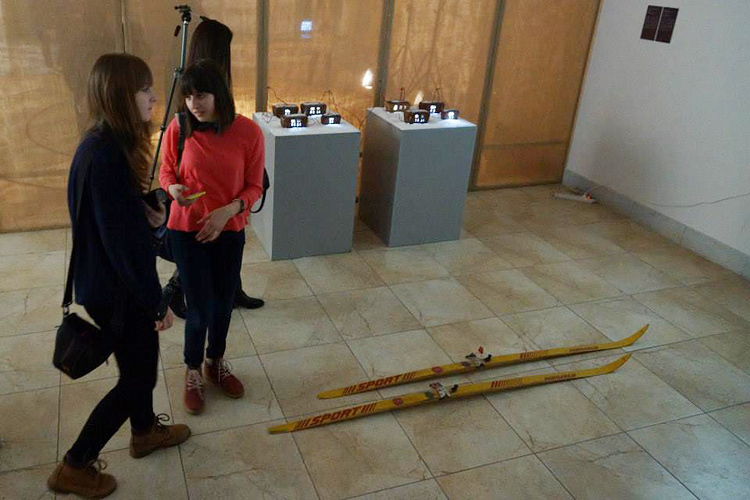
A year ago, there were no regional galleries specializing in except at exhibitions of honey - in their place the association of the “ Exhibition Halls of Moscow ” appeared.
The modernity overtook Moscow district galleries, most of which until recently suffered greatly from cultural anemia, suddenly. A year ago, the Moscow Department of Culture undertook to reform them and created the association of the “Exhibition Halls of Moscow” , which was headed by Elizabeth Fokina, the Executive Director of the Association of Culture Managers . There are 18 of them in total, but five are still in the process of joining.
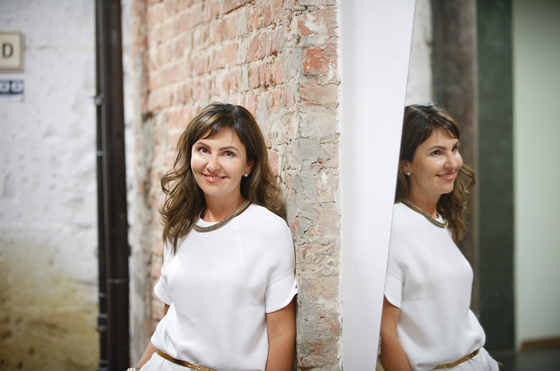 © Cult.mos.ru Elizaveta Fokina
Here, it seems, everything is clear: the town is still in trend. The Polish urbanist and teacher of the Strelka Kuba Stopyk ( “Belyaevo forever: preservation of the unremarkable” ) writes about the “cultural injection” for sleeping areas, and the head of the Moscow Department of Culture Sergei Kapkov repeats about decentralization . The cultural life of Moscow is finally scattered into many islands scattered around the city. Alexander Brodsky and Eric Bulatov are exposed outside the garden ring.
Over time, as it is supposed to grow around the institution a full-blooded cultural infrastructure-with bookshopes, lectures, exhibitions, replaced once every two weeks, children's creative camps, residences and calling from time to time art star as a bait for the press. “A good curator should be able to make a budget,” says Elizabeth Fokina.
The association has eight curators, including Alexey Shulgin and Aristarchus Chernyshev, Katya Bochavar, Vitaly Patsyukov and Larisa Greenberg. They make up the curatorial council, eagerly trying to master the alien type of thinking of the middle resident of the sleeping area. “Not only the creative offers of curators were important to us, but also their communicative abilities - the ability to work with people not their generation and not their paradigm of thinking,” says Fokina.
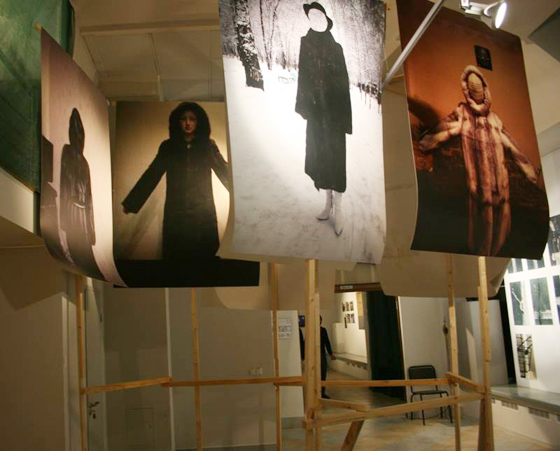 © Exhibition Halls of Moscow “The Beauty of Unbelcy. The art of contextual direction "in the" Gallery "Belyaevo"
The halls have already been invited by art critic Andrei Erofeev, convicted in 2007 for the exhibition “Forbidden Art” and dismissed from the Tretyakov Gallery in 2008, to make the “Beauty of INTIVITY” project in two galleries-“Belyaevo” and “On Kashirka”. They participated in the Moscow Youth Biennale and city promotions like "Nights in the Museum." They made partner projects with the conservatory, the Open Scene Theater and the State Center for Contemporary Art.
However, while the main morphological feature of the exhibition halls is the absence of the present.
Repeated galleries exposing the Francisco Infande and Seeds Faybisovich already exist, and their visitor has not yet matured. Hipster with Vincavod or from Gorky Park to sleeping areas is reluctant to go. The local public does not immediately respond to the call for cultivation. “The exhibition halls have not yet felt for the tools: they do not know how to adapt the complex language of contemporary art for the new audience,” admits Larisa Greenberg, who oversees the unification of three halls - Zamoskvorechye, Peresvetova Lane and the Nagornaya Gallery.
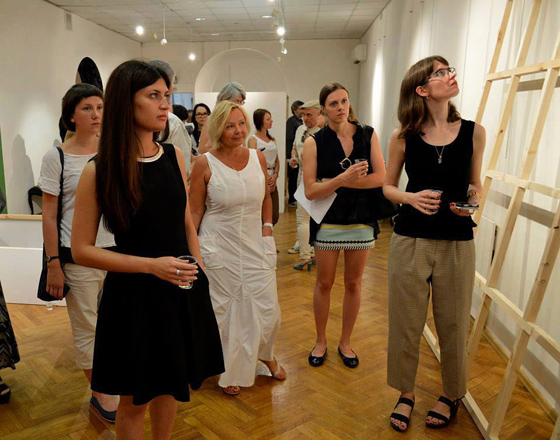 © Exhibition Halls of Moscow "Methodology of exhibition space" in the Gallery "Nagornaya"
The reformation of the former district galleries took place, according to tradition, by emasculation of old cultural codes, part of personnel and meanings. “Almost all Gallery directors were unhappy,” says Greenberg. “For 25 years, they used the advantages of permissiveness and feudal housekeeping.”
One of the employees was frightened by contemporary art. Someone was afraid of the return of the genre of state order and the imposition of a “single cultural code”-especially in the context of the “foundations of state cultural policy” . The conflict of interests could not do without dismissal.
“In the gallery“ on the sandstone ”, people quit gradually, in“ Izmailovo ”the entire composition left overnight,” says Elizaveta Fokina. -Someone left for ideological reasons, someone did not want to engage in contemporary art (although only the association of “Khodynka” and “on sandstone” and “electric museum” in Rostokin gravitate to it). We parted with some people, because there were no exhibition policy in the galleries at all: there were empty exhibitions, people who were far over 70 worked in the halls. ”
The conflict in fact turned out to be more stylistic than ideological. Even successfully functioning galleries before reorganization typologically remained a “scoop”. In some places, preschoolers taught English, in some places the adults danced Capoeira and arranged the gatherings of the UFO club. All this held the halls from ruin and fed the Soviet system of circles and clubs. “Of the 18 galleries, only five fully functioned as exhibition spaces,” says Fokina. “Some of them reported on attendance only by groups of Sotosopeki organs: schoolchildren, orphanages.”
Today, the institution is still in the process of formation and is a compilation of heterogeneous curatorial projects - a collection that has not fully realized its boundaries.
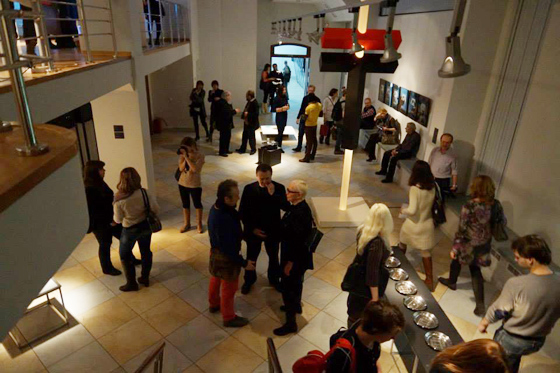 © Exhibition Halls of Moscow "Space Lucida"
The Mediaart is now engaged in the Electromuse , which is supervised by Aristarchus Chernyshev and Alexei Shulgin, artists of the duet Electroboutique . Network projects spreading through several halls (as “ Lucida space” - a common project “ZV”) is developing Larisa Greenberg. The halls of Warsaw and Phoenix are gradually turning into art residence -the focus of artists who will settle here for three to four months and eliminate cultural deficit in sleeping areas. The Solntsevo Hall transforms into the Center for Contemporary Art and Design for Children, and the Ark Gallery continues to rhyme the old one with the new one - now the direction that its former director, and now one of the two curators Sergey Safonov, is called "traditional art in the modern context."
At first glance, it seems that the halls are not going to surprise the halls. They think themselves as a social environment, the cultural landscape is a cross between Gorky Park and the Winery. But now it is obvious that they are able to work not only to create a safe-leisure cultural background for the sluggish district regulars.
A slightly utopian idea of the People’s University, for example, was seduced by a combination of two halls - “Khodynka” and “on sandstone” - a gran (state district artistic university of independent talents) . The curator Katya Bochavar and producer Julia Bychkova pushed professionals here with everyone. Together, they form something like a living archive with a documentary basis - everything will be recorded on the video and eventually turn into an “Archive of modern culture”.
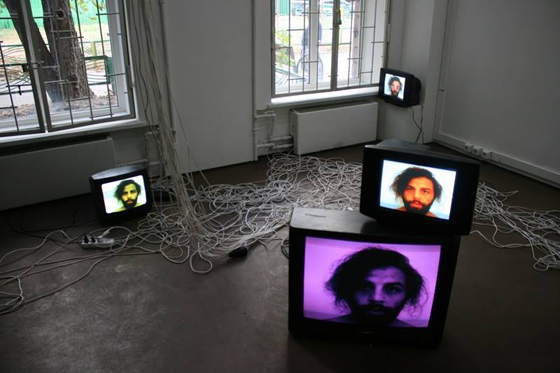 © Exhibition Halls of Moscow "Quarantine. Media Extractor "in the workshop-gallery" Graund Khodynka "
Relations with the past, however, are actively building only the Zamoskvorechye gallery. “Now we want to hold a number of historical and local history exhibitions,” says Larisa Greenberg, “after the repair, we open the exhibition“ Constructivism on Shabolovka ”-about the architectural monuments of the district and then the project examining the mythology of the place. Previously, the Zamoskvorechye Gallery never reflected on the topic in which it is located-the Shabolovsky housing estate, built in the 1920s. "
To meet people with the place in which they live, the Department of Culture allocates the halls of the exhibition budget of one million rubles with the condition that they will make up to 20 exhibitions per year. “Next year, this budget was promised to reduce this budget,” says Aristarchus Chernyshev, “therefore, in the“ Electromuseum ”, in the absence of exhibitions, we plan to show what does not require special costs: archival mediaart, some Electroboutique objects or, for example, installations of young artists who were shown once or twice, and now it is not clear where it is stored.”
In 2013, according to Elizabeth Fokina, the halls included in the association in the amount of 757 exhibitions. For comparison: “Cultural Alliance” Marat Helman makes 10 exhibitions a year. “If we talk about the producing of exhibitions, then I think one institution can make good projects four to five,” Helman believes. - At the same time, the halls that are counting on the local public, and not on the art environment, can change exhibitions. Although this is a strange practice. But still, the exhibition should go the minimum three weeks, because information about it reaches the public not instantly, and there will probably be no advertising budgets. ”
Talk about the adequacy of the application to the result, of course, so far early. Now the halls confidently turn into a scattered art-claster around the city, but they can still get into the corral of trade and entertainment foci of “culture and rest”.