
Translated material
Diamond in golden hands
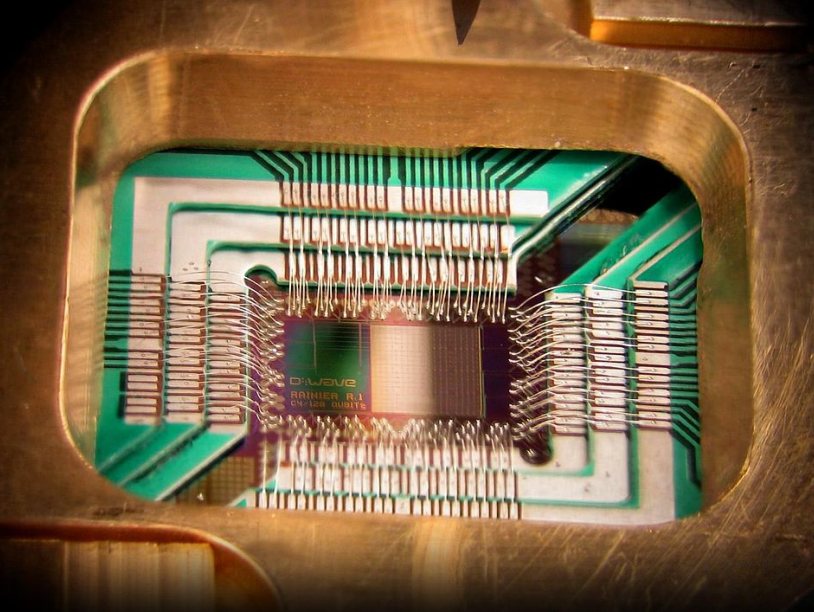
Since May, professional magazines have reported the development and sales of elements and fully collected quantum computers in the Netherlands and the USA, Canada and many other countries. Now no more than 15 such computers have been created in the world, and researchers around the world call them no less important discovery than an integral scheme. So far, only some examples of multiplication tables are available to them-Russian-physicists told about the potential and progress of calculations of such machines.
The development of a quantum computer was carried out earlier, and, despite the potential discussed by all, were much weaker than discrete analogues in connection with their rapid destruction in the environment, noise and insufficient power. The technological breakthrough of 2014 made it possible for specialists to apply the process of quantum calculations with greater efficiency, reducing the noise of the processor and data processing time at least ten times.
Calculations of a quantum computer are not similar to calculating classic computers and classical mechanics. Their work is associated with the section of theoretical physics - quantum mechanics, the effects of which are manifested on a microscopic scale. By their interpretation, they can contradict classical theories, and their action is comparable in size to the permanent bar. Simply put, on a quantum computer there are calculations that are not visible to us and not always understandable from the point of view of standard thinking.
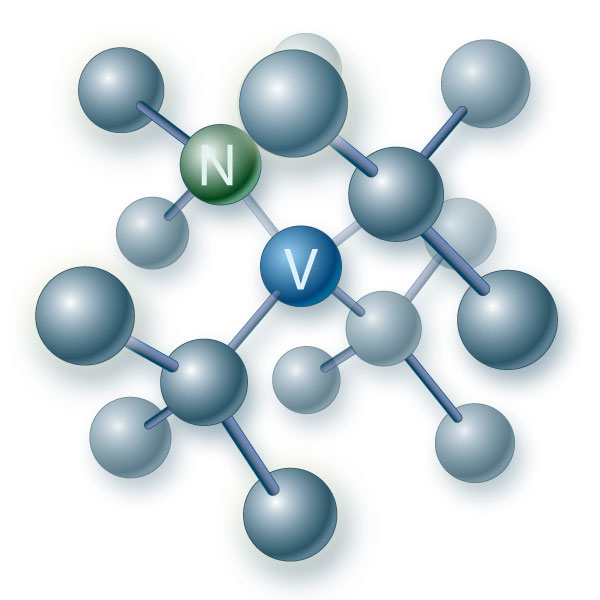 NV Center in Diamond, formed by the nitrogen atom (replacing carbon atom) and a nearby vacancy
In order to implement a full -scale quantum computer that surpasses any classic computer, in addition to internal characteristics, it is necessary to create a material for its shell that would allow it not to collapse in the environment. One of the most promising materials, according to scientists, was diamond - it began to be used for quantum calculations relatively recently. In diamonds, in addition to carbon atoms, there are usually also impurities atoms. The more impurities in stone, the less it is appreciated by jewelers, but more physicists and technologists. Cracks inside the precious stone - point defects - are the "wrong" nodes of the crystal lattice - vacancies. They arise when the carbon atom is removed from the grate node and are associated with nitrogen atoms. Such defects are also called nitricized vacancies or NV centers (from the English. Nitrogen-Vacancy). In these vacancies in diamond, it is possible to inlalate the mechanisms of a quantum computer - thereby isolating them from external exposure. The smallest units of computers in the mechanisms are called cubes - they are the back (the result of the pulse) of the nitrogen nucleus and the unbroken electron of each NV center.
This technology will allow in the future, by analogy with the current silicon chips, to create quantum chips from the diamond, and then superior to a classic quantum computer.
Typically, information is processed in the computer as groups of units and zeros, and cubes can simultaneously have two values: zero and unit. This property is called a superposition, and along with the ability of quantum states to “tunnel” through energy barriers, according to scientists, will allow quantum computers to perform calculations much faster than traditional computers.
The previous attempts to create a quantum computer was interfering with the impact of the external environment that distorting the calculations. It led to decoherence - a violation of the interaction of cubes and subsequent problems in the operation. Physicists found out that, synchronizing the rotation (the same spin) of the unbroken electron and nucleus of the nitrogen atom, you can achieve the protection of cubes. For the coordinated action of the cubes, experts used microwave impulses that force the electron to constantly change the direction of the back - as a result of the calculation, they were carried out faster.
The potential advantages of quantum computers are based on unusual laws of the quantum world. In order to solve the problem in a regular computer, several thousand transistors need. In a quantum computer, it can be solved on a smaller number of elements, each of which has a greater computational force. Researchers confirmed the quantum behavior of the device enclosed in the diamond, forcing him to perform a grover algorithm. This algorithm was invented in 1996 by Love Grover. It is used when searching in an unstructured catalog. If you need to find the name of a person in the phone book by his phone number. With a sufficiently large number of attempts, a person turns on an average of half the whole book for this purpose. If a regular computer will sequentially sort out various options and finds the desired answer, then the quantum computer, using the principle of superposition, will find the right answer at the very beginning of the bust, because it can be simultaneously in different conditions. Even an imperfect new computer in diamond issued the correct value the first time in 95% of cases. This turned out to be enough to prove his quantum behavior. Nevertheless, all these calculations are still in the future - the number of cubes in the existing computer is not enough, just as a guarantee of its long -term work in the diamond is not confirmed.
 Vasily Klimov
“The existing quantum computer is still a toy, but if its power is increased, say, to a thousand cubes, then using such a computer, one galaxy can be calculated. There will be new prospects for modeling the aerodynamics of new aircraft, new types of weapons, even for predicting weather for a longer period, ”says Vasily Klimov, deputy director for science of photon nano -metro technologies (FNMT). “Optical computers that are more popular today have similar computing power, but they are poorly programmed and therefore are used only for highly specialized calculations.”
According to Klimov, even one key element of a quantum computer - a single photon - has a very wide area of application. The FNMT company is engaged in the creation of a single photon generator based on color centers in nanoalmazes. A photon generator can be used for subtle management of chemical reactions, for creating chemicals that cannot be created in the usual way, for devices that measure absorption in very transparent media, to control life at the cell level and in many other areas. They also plan to consider spin effects in the cubit based on color centers in nano -almaz, but later, since even at this stage there are a lot of problems. In high technologies, everything should be of high quality: good diamond nanocrystals, in which there were at least one working NV center, the “golden” hands of technologists and scientists and good financing of investors. If the first two points are provided by the team of the company itself, then the financing of LLC FNMT is carried out as part of the grant of the Skolkovo Foundation.
 Alexander Fertman
“Quantum computing as a comprehensive solution is not tomorrow’s task, now only its individual elements are being created, photon generation processes are being worked out, the methods of transmitting, storing and processing information are not yet fully worked out,” explains Alexander Fertman's science, the Kolkovo nuclear technology cluster. - If the control of electric signals is a long -mastered technology, and the speed of information processing in classical computers is constantly growing, then the controlled generation of single photons is still an unresolved task. The first single -photon quantum generators are created, but the number of generated photons per second in them is small and, accordingly, the speed of information transmission is not comparable with the one that the modern computer provides. ”
The development of a signal source that Fertman is talking about is only one of the areas of the FNMT. There is also a management of photon generation and ensuring the directed signal transmission. According to the Skolkovo employee, the last two of these tasks are capitalized on the scientific equipment market: combining NV centamaters with metamathals can be implemented in information transmission schemes (so far not necessarily computer), as well as a directed transmission of the photon generator using nanoantennas, which will increase the flow of photons, and, accordingly, the volume of information transmitted per unit of the time is also quite realized product. “This is a fundamental topic, projects with such a depth of scientific research not only in our cluster, but in the whole fund, but the interest of business and scientific community in this topic is so great that commercialization occurs at earlier stages than in industrial technology,” is convinced by Alexander Fertman.