
Translated material
Anchored?
On September 3, French President Francois Hollande announced the absence of “sufficient conditions” for the supply of the first helicopter carrier of the Mistral class to Russia. Many immediately decided: Paris bent, the famous Russian-French contract was torn under the pressure of Paris Paris partners.
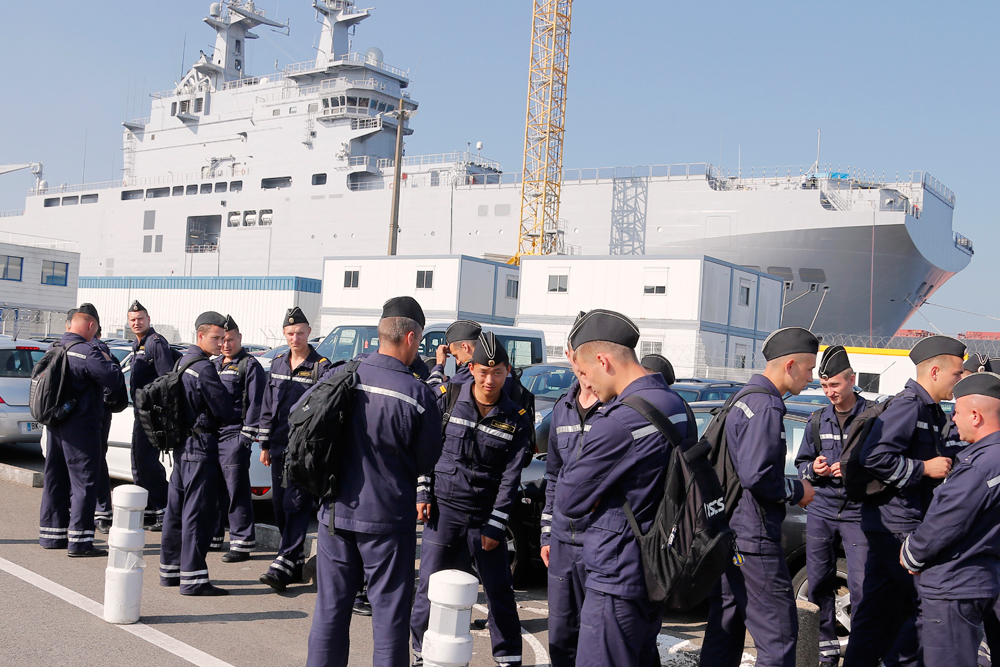
Russian sailors in the port of Saint-Naser against the background of a ship of the Mistral type. France, September 5, 2014 /Photo: David Vincent /Ap Photo
Very impulsive grades began to sound in Russia immediately, including from the lips of senior officials: if so, let Paris not forget to return € 1.2 billion already paid under the contract, plus a penalty, and there we will run up in total, and for that money we ourselves will build what we ourselves need these “mistrals”, which may be useful only for more useful ones. In the southern seas ... They say there is nothing to worry about, the loss of contact with France is rather a plus than a minus.
True, the very next day, September 4, President Hollande made an important clarification: the contract was not broken, everything “depends on the events that will occur in the coming weeks” in the east of Europe - in Ukraine. And more specifically - on the Ukrainian front. And along the way, he made it clear that France is betting on a stable truce and hopes for the constructive role of Russia.
In fact, in a dossier called Mistral, nothing has changed at all. Yes, there was an unexpected statement by Hollande. But another statement was made a little earlier - much less known abroad, but no less significant: Foreign Minister Laurent Fabius at a meeting in Paris with the French ambassadors clearly stated: the Mistrals contract will be implemented.
The statement of the President of Hollande on the suspension of the supply of the first Mistral is explained, firstly, by tremendous pressure from the allies-not only the United States, but Great Britain and Germany. There have been no such pressure about twenty years - since the former President Jacques Shirak resumed nuclear trials. And secondly, Hollande could not help but react to rapid changes at the Ukrainian theater of military operations that occurred last week.
However, I repeat: there are no fundamental changes in this dossier. After all, last spring in France there was also fierce disputes about the supply of Mistrals against the backdrop of the growing external pressure on Paris. Official Paris then muffled the discussion: they say, we close the topic until October until the first ship is built, and then the decision will be made with an eye on the situation in Ukraine. On September 4, President Hollande said about the same thing. But France will now make the final decision on the Mistrals in November.
In the Champs Elysees, they hope that by October the fighting in Ukraine will be discontinued, therefore it is now the time to make an elegant diplomatic statement, bringing the necessary ambiguity to it. If the Poroshenko-Putin plan to stop fire in the Donbass will be implemented and the fighting will cease, the contract will be absolutely implemented.
In any case, the Russians, including the opponents of the current government, should understand: France cannot afford the termination of the contract. After all, the real price of the issue is not fines and penalties, but image losses, reputation risks. If France yields to pressure and refuses the supply of Mistrals, then they will look at it as an unreliable weapon supplier. And then we can lose profitable orders from India and other countries.