
Translated material
And eat a fish, and play in the double bass
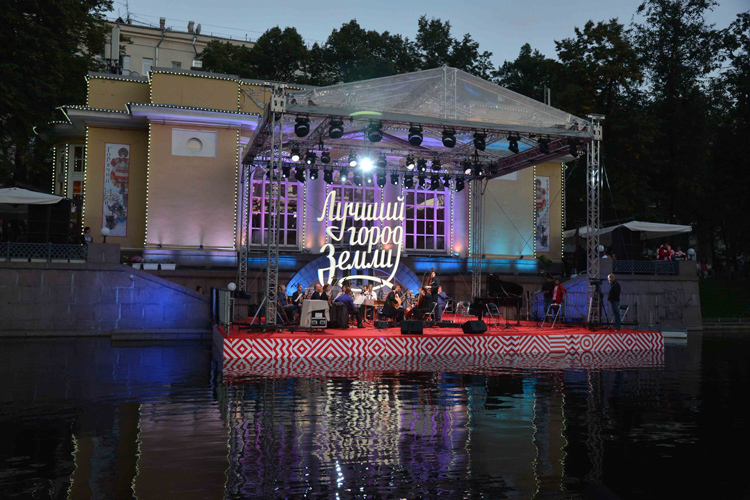
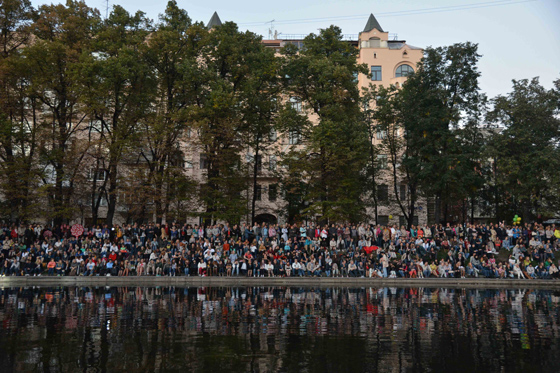
Among the mass events on the occasion of the birthday of Moscow, one thing was, let's say, mass-elitist. “Music on the water” is our answer to the Berlin Waldbun, the lake scene of the Bregen, the Arena Di Verona and all sorts of other overseas Openayers with classical music. Right on the surface of the patriarchal ponds, a pontoon stall was built, where a red carpet clogged with secular photographers led from the shore. The owners of tickets were recommended to dress in the evening, but to capture the stole-still damp from water. The shores were overwhelmed by people without VIP -inferences (according to approximate estimates, thousands of three boiled the entire one and a half hour concert, six thousand walked back and forth), some with children's strollers and pets. Particularly successful went to the balconies of their apartments around the pond.
The action itself, organized with the support of the Committee on Culture and the Bulgakov Museum, took place on the stage built under the restaurant Pavilion. It housed the ensemble of like -minded Persimfans under the leadership of Peter Aid. Violins and flutes, valtor and chandelier, piano and harpsichord at some point were supplemented by an electric stove and a hot frying pan, which supplied its spraying oil voice in one of the climaxes of the evening.
Among the musicians who increase the status of the event were the cellist Boris Adrianov and the pianist Andrei Gugnin, but the most memorable were Hibla Gerzmava and Grigory Krotenko. Gerzmava-as befits the Primadonna of the Stanislavsky and Nemirovich-Danchenko Theater-sang, the silk roules of her voice through speakers, they say, came already to the garden ring. For water procedures , she chose Lascia Ch'io Pianga and Gendel and Mozart Aria Laudate Dominum ” with a solo violin, which was played by the main hall of everything that was happening, the art director of“ music on the water ”Elena Revich (the first concert of the festival was held on the lake on August 9).
 © Kamilla Abushaeva
Krotenko - a double bassist, a gambist and even the author of Colta.ru - not forgetting about his main type of activity, in this case flashed in a new quality. During the Gendelev Passakal, he, having left the smuggling, took a picture of a cage with a stirring fish from the pond. During the Glukovskaya “melody”, he ate her even more picture, already fried, wiping his hands on the apron, spitting the bones in the pond and slightly reducing the pathos from the exciting meeting with the beautiful. Two large screens on the sides of the scene showed these delicious details of a starving coastal public, which could only applaud. The process of cooking itself came at the time of the performance of the very well -known composition of Pavel Karmanov “Vorel Quintet”, as well as the corresponding work of Schubert dedicated to a heavy fish.
Another opus of Karmanov - “Fireworker Music” - completed the program. This is a win -win option - the fireworks on the final chords (and by that time it was already completely dark on the Patriarchals) is included in the score.
Of course, modern rhythmic Minimalist authors (in addition to pocket music, the program was also an incendiary play “ Road Movies ” by his American colleague John Adams) is the most harmonious participants in this kind of stories. But the vulnerable baroque phrasing “Persimfans” was not afraid to connect with a democratic heart. Still, the composition that gave the name of the event is the “music on the water” of Handel, one of the first opuses for Openayers in the history of music. Numerous numbers from it glorified the entire program, informing it with a manor-free sound, and in the intervals Ilya Kukharenko told the whole quarter about a barcam with musicians, who was sailing in the tops in 1717 and playing a Suite that was composed by Handel, which was so much liked by George I that he wished to listen to her three times another day.