
Translated material
Carroted and carrot in front of the nose
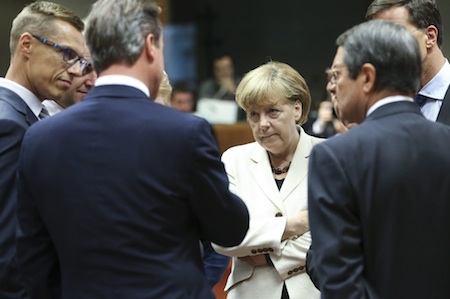
The EU countries finally agreed on the expansion of sanctions against the Russian state and defense sectors of the economy. However, their official entry into force can be postponed for several days. According to the chairman of the European Council, Herman van Rompey, “their entry into force after publication in the EU official journal will take place in the coming days. This will give time to evaluate the implementation of actions to stop fire in Ukraine and a peaceful plan. Depending on the situation, the EU is ready to revise the agreed sanctions in whole or in part. ”
The process of coordinating new European sanctions was closely monitored in Moscow. Medvedev gave an interview to the newspaper Vedomosti, in which he threatened with an “asymmetric response” in the event of new restrictions on the Russian economy. Among other things, we can talk about the closure of the Russian airspace for Western airlines. Hardly responded to the coordination of sanctions and the Russian Foreign Ministry, accusing the European Union of the direct support of the "Party of War" in Kyiv.
According to media reports, the cause of the delay was the position of the Prime Minister of Finland Alex Stubba. According to The Wall Street Journal, Stubb believes that now is not the best time to introduce a new package of sanctions. In addition, Finland is concerned about "possible response from Russia." Russian experts immediately regarded this by a manifestation of weakness from Europe and evidence of a split among its leaders. The media immediately appeared that Europeans themselves are not interested in strengthening the trade confrontation with Russia, but are forced to introduce new restrictions exclusively under the pressure of overseas hawks.
Let us leave these speculations on the conscience of those who are engaged in them. In strengthening the trade war with Russia, Europe is certainly not interested. And to deny the negative impact on the European economy of both sanctions and “antisanctions” will never occur to anyone. This does not at all abolish the EU determination to stop Putin, which poses a much greater threat than possible economic losses associated with certain trade and financial restrictions. And in this strategic issue, the EU and the USA demonstrate complete unity.
The only question is, which tactics better contribute to this strategic task. The United States insists on building economic pressure to the final withdrawal of Russian "vacationers" and regular troops from the territory of Ukraine and stop supporting the so -called militias.
However, in this particular case, the European position in the relationship with Putin looks more effective. The sanctions whip is entered, and in this position it is a much more effective restraining factor than a simple introduction of new restrictions. They are ready and agreed. The slightest reason by the Kremlin or "militias", and the sanctions will be introduced automatically. Meanwhile, formally in the east of Ukraine there is a ceasefire. And whether this fragile, constantly violated by both sides, a truce into something more stable and long-term, is not least dependent on Putin. And in order for him to have an additional incentive to peaceful political settlement, juicy carrots loomed in front of his nose. Sanctions may not be imposed at all. Another root crop was suspended by the German Chancellor Angela Merkel, who stated that mutually beneficial partnerships with Russia can be resumed at any time if Moscow stops violating the sovereignty and territorial integrity of Ukraine.
Such tactics have been successfully used by the best trainers for many centuries and gives amazing results even in relation to the most cunning and evil creatures. You act well and right - get the sugar. You act badly - inevitable punishment. The use of only a whip can only angry and burn the ward even more.
The EU understands that Putin has to deal with Putin for a long time. Therefore, it is necessary to leave him, and most importantly - his environment, the possibility of choosing less dangerous for himself and surrounding behavior.
And this may work, since Putin has already fulfilled his strategic task within Russia with the help of the Ukrainian crisis. The recession in the economy can be safely dumped on anti -Russian sanctions, so a deterioration in living standards does not lead to anti -government protests (the level of protest activity has decreased to almost the lowest values since 2001). Further binding into the sanctions war and additional economic damage already pose a threat to Putin himself by much more radical than him, supporters of the “Russian world”. As for the notorious New Russia, the Donbass also does not smile at him to feed, the Crimea is enough for his eyes.