
Translated material
Source of growth within yourself
You noticed that the smarter a person, the less he is fussing? Although the present time is just very disposed to succumb to all sorts of bustle - to run, rush, collect suitcases, to unpack them again ... You can succumb to - why not? Suspicious weakness. But it is very important, as never before, it is probably important to think, understand what is happening (well, or at least try to understand) and do your own business. In general, the ability to think is a real gift. Nothing harmonizes the world as sound thoughts, even if these thoughts are gloomy.
Here is a lecture club “Conversations about the economy and not only”, continuing to work in Kazakhstan, just gathering those who want to understand what is happening, who is ready to think, before acting. It is noteworthy that the lecture club was created with the support of the National Bank of the Republic of Kazakhstan and the Faculty of Economics of Moscow State University. Lomonosov is good when theorists and practices are united, but for some reason in life this happens quite rarely. The first meeting of the club took place in May, and the lecture cycle was opened with a joint performance by Kairat Kelimbetov, the chairman of the NB of the Republic of Kazakhstan, and Alexander Auzan, Dean of the EF of the Moscow State University, who spoke of the main world challenges in the economy.
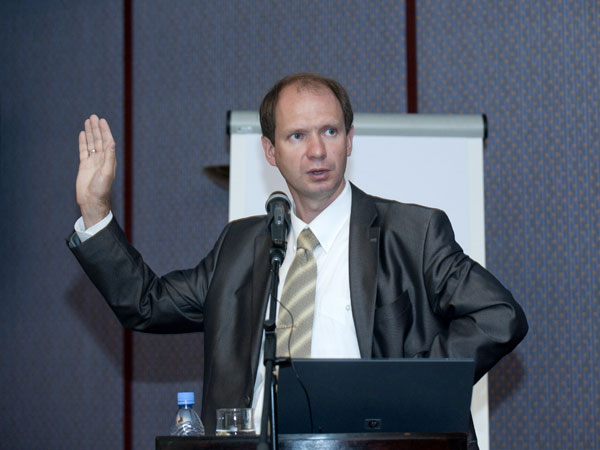
The guest and the main participant of the second “conversations” in Almaty became Sergey Afonkov, Doctor of Economics, Professor MGIMO, co-director of the Scientific and Educational Center of IMEMO RAS and Moscow State University, adviser to the round table of industrialists in Russia and the EU. Partly continuing the topic of the first meeting, he told Kazakhstani colleagues and all interested in new trends in the world economy. The lecture turned out to be very symbolic: both the topic and the moderator itself are none other than the chairman of the National Bank, and the day on which the meeting was held-August 30, the Day of the Constitution of Kazakhstan-everything was somehow greatly crushed.
In the hall - the absolute predominance of young faces, people up to thirty or a little over thirty. And the lecturer himself is a young man, but already known as one of the main specialists in the world economy in Russia. Naturally, everything that Sergei Afontsev said about the world economy as a whole, those present mentally attached to private specific realities - Russian and Kazakhstani.
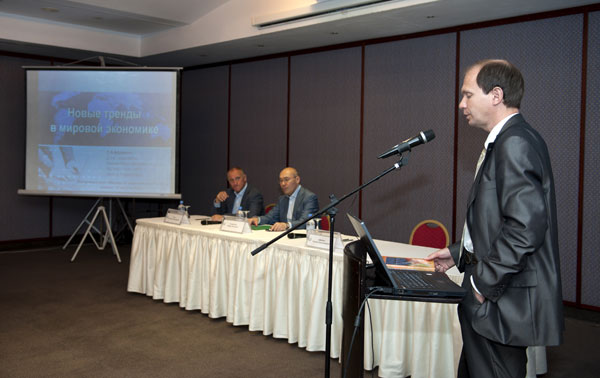
Afonians talked about how the world economy will develop in the next 5-10 years, how growth models will develop, after the global crisis (someday!) It will be over, and what factors will be important for building these models.
The moderator, Kairat Kelimbetov joked at the beginning of the lecture: "We used to live from a crisis to a crisis, but now we get used to living in a permanent crisis." But Sergey Afontsev assured the audience in the fact that the exit from the crisis is not far off. “General diagnosis” is this-the growth rate of the world economy in 2010-2013. They exceed 3%, and this indicates its exit from the crisis, despite the fact that you and I and our neighbors in Kazakhstan still feel in a difficult situation. Those. There is no global crisis already. But in certain countries they still feel it acutely. There is no systemic "trouble", which means there is no, but the countries like ours have problems. Developed countries, such as the USA and Japan, and some developing, like China, have already overcome crisis trends, but only due to anti -crisis incentives that will cease to act sooner or later.
But, since we know that it has never been so that there was no way, you need to look forward and think about the future. For example, the growth rate of the world economy - they will be like before a crisis or? ..
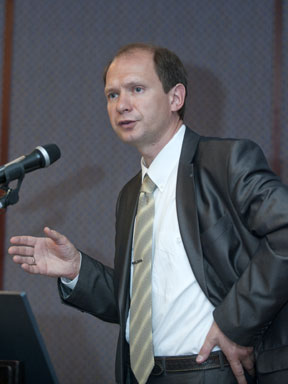
Afoners drew attention to the lecture on how experts analyzed the economic growth models in recent decades, what factors the researchers paid special attention to. And the researchers identified several factors: resources and technologies, economy geography, sociocultural, institutional and political economic factors.
As it turned out, some of these factors have ceased to be decisive-for example, in recent decades any country can correct any adverse economic and geographical factor-due to technology and correct actions-there would be a desire. Take at least the notorious cold climate of Russia. Dear, they say! The peak of electricity consumption - in winter, which means that Russians need special benefits. And in Israel, for comparison, the peak of the consumption of the same electricity-in the summer, because it is hot there, everyone has air conditioners, again, watering-the country is flowering, agrarian, albeit in the desert ... and Israel does not complain about the climate. And you can also eradicate tropical diseases, create artificial islands, drain swamps, build “smart” energy -saving houses ... If you have money and ingenuity, you can correct everything. Those. The economic and georallafic factor does not affect anything, practically.
And the rest of the factors, according to Sergei Afonsev, are also not so important. He is even sure that the economy (both world and our countries) will not fall when oil prices fall, because The law of replacing prices works: if something is getting more expensive in the world, something is getting cheaper-and vice versa.
In a word, what we can probably be sure of is that the coming model of economic growth will depend on some completely different factors. For example, there will be no way to do without analyzing the institutions of the political market. And in general, the institutional factor will become more and more significant.
The lecturer drew attention to modern challenges for economic development, those that Auzan and Kelimbetov already spoke about in their joint performance. Two main challenges, according to Afontsev, are: a demographic situation that led to the aging of the population in developed countries and a reduction in the influx of cheap labor to the markets of developing countries; The growth of competition for raw materials, which leads to the search for alternative sources and types of raw materials, as well as all kinds of energy conservation and development of new technologies (resource -saving, etc.)
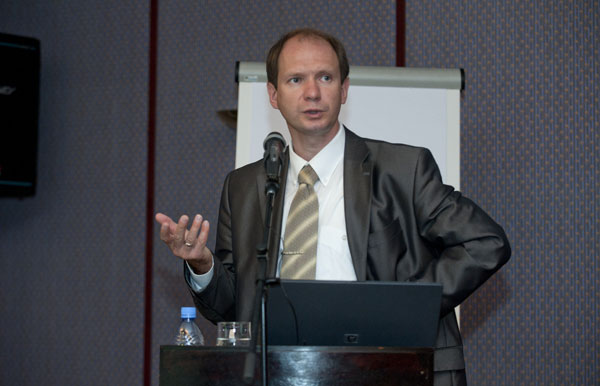
Especially sunk into the soul what economists say - in the coming decades, the role of cheap labor will radically decrease. Those. China, for example, will lose one of its main advantages, and it will not have two -digit numbers that indicate economic growth in percent. And other developing countries will not be able to, roughly speaking, “take the quantity”, because Again, in the world, “replacement of labor with capital” is planned (one well-trained worker with expensive equipment is better than many, not trained with conditional hoes).
And yet, how can a global economy grow, despite modern challenges?
The lecturer called three important conditions:
1. Improving the quality of investment. That is, again, you need to take it not by number, but in quality - accurately choose an object for investment, do it technologically, etc.
2. Return (resouring) investments of industrial companies in developed countries. So cheap shale gas appeared in the USA, and labor in China and Southeast Asia went up - and the money began to return “home” - it became profitable.
3. "Green Economics", which, incidentally, are entrusted with considerable hopes by experts from the UN. It is assumed that resource -saving technologies, a decrease in environmental pollution, and in general, a decrease in the anthropogenic load on nature should lead to amazing results (for example, an increase in real GDP by 16% and a reduction in energy consumption by 48%).
But the main factor for building a favorable scenario for the future, Sergei Afontsev still considers the institutional factor. We will improve the institutions (economic, social, legal, political), and we will, as they say, will be happiness. Moreover, institutional changes should be global in nature, and not limited to the framework of individual states or national economies. And the markets must be regulated not only with the help of the state, but also with the help of non -state entities. And the state cannot already “steer” due to the scale only (the size of the state or the size of the public sector) - no, the quality of the state as an institution and the quality of the functions performed by it come first.
In general, it so happened that each state should, first of all, find a source of growth within itself-in the modern world there is everything that is needed for this. Actually, with an individual, it seems - the same.
Such a conversation took place about world trends in our alarming time, in the glorious city of Almaty. One of the listeners and participants in the discussion agreed with the visiting professor, someone argued, and someone just thought. So it’s good-for that they are conversations to argue, think, and only then begin to do something. Without fuss and in smart.