
Translated material
Special status for individual territories
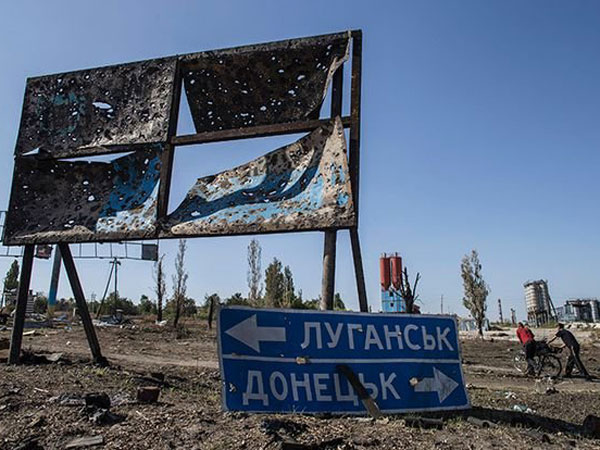
On September 5, in Minsk there were negotiations of the contact group in Ukraine, on which they signed a protocol on the ceasefire in the Donbass. There were two main points in the contract - to stop hostilities and agree on a “ special status ” in the framework of the decentralization of power in Ukraine. On September 16 , she voted for the special status of the Lugansk and Donetsk regions and, at the same time, for amnesty.
277 deputies voted for the project on a special status, 287 - 287. That is, there were no complete solidarity of the fractions - the Freedy faction, Freedom, A. Gritsenko and two more from his “civil position”, as well as O. Lyashko, were. A. Shevchenko from the "Fatherland" explained that his faction is against, because the law provides for an amnesty of terrorists. After voting, Shevchenko had already stated on Twitter that the vote was in violation of the procedure and, therefore, was illegal. But this is a quite ordinary routine there.
Now it will be about the law, but first you need to imagine the frame of the problem. Here, some territory seemed to rebel, it is shouting - fighting, and then agreeing on the ceasefire. What to do next - not only so that the fire does not resume, but also how to equip the current situation in life? Moreover, all this happens at all nearby, and the case promises to be very precedent. In fact, as here and now you can brill separatists?
Since the point on the "special status" was the main one, it raised the main issues. For example, there are different topics: “ Decentralization of power” is an old topic that had in mind the amendment to the Constitution of Ukraine, which would give more rights to areas. But this idea did not imply a " special status ", and even in the " individual areas " of Donetsk and Lugansk regions. The second question: how to isolate these areas? It is still clear that these are areas that the Separtists control, their border is determined by the presence of ATO troops. But the same cannot stand there forever? And, again, how can you draw something special for the "individual areas" of these areas? The law pretends to be answering these questions.
On the eve of the vote
On Monday, Poroshenko talked with the leadership of the factions, looking for their support. Here is how he glued the theme of decentralization of power with the special status of individual regions: " He recalled that the key elements of the peaceful plan with which he went to the presidential election, there are issues of special status of individual regions of the Donetsk and Lugansk regions ." They, according to him, " de facto are elements of decentralization with complete and unconditional observance of sovereignty, territorial integrity and independence of our state, with guaranteed to the state of all the main attributes, including external, safe, legal policy ."
That is, they are related to de facto. But not forever, " a special status has a clear definition in time - 3 years. During this time we will have the opportunity to introduce a question of deep decentralization, which should also be the subject of appropriate changes to the Constitution ."
And on the topic of amnesty, against which "Fatherland". In the execution of "Ukrainian Truth" this explanation looks heartbreaking beautifully:
" Speaking about the amnesty bill proposed by him, the president noted that criminals who committed a crime under the articles of the Criminal Code of Dentical Murder, Terrorism, an attempt on the life of a statesman, a law enforcement officer, judges, rape, muddy over the deceased, and the abuse of monuments, and the murderer. A number of other articles that must ensure the integrity of our state . "
Strongly: "bullying over monuments" threaten the integrity of the state to such an extent that there is no amnesty, such as mortal sin. This is not staring, but purely noting the level at which this document is written. In general, regarding other points of the document (except for the special status and amnesty), Poroshenko said: " The rest of the articles is an absolutely normal world practice - it is a tool that allows you to begin the political implementation of the program to introduce peace ." Type, it has always worked in such cases, one hundred percent result. But, the main thing is that in all these words of the fractions he generally convinced and the law was adopted.
The law as such
The full text is here . In an abbreviated translation - here . The preamble is already curious:
"According to this law, temporarily, for three years from the date of this law of action, the special procedure for local self -government is introduced in certain areas of the Donetsk and Lugansk regions, to which are the areas, cities, towns, villages located on the day of the action of this law within the region of the ATO, determined in accordance with the Law of Ukraine" On the Combat of Terrorism "(hereinafter - individual districts)."
Of course, the word "amnesty", which jumps out as a result of the law "on the fight against terrorism" and was supposed to cause a certain bewilderment in some fractions. But Poroshenko already explained this topic. Further: the state guarantees the right to use Russian or any other language " in public and private life ." " The powers of deputies of local councils and officials elected in the extraordinary elections appointed by the Verkhovna Rada of Ukraine cannot be terminated ahead of schedule ," but the law provides for the implementation in extraordinary local elections (probably on December 7, 2014).
A special procedure for the appointment of the heads of the prosecution and courts, which involves the participation of local authorities in resolving these issues, is introduced. The Cabinet of Ministers, other central executive bodies can sign an agreement with the relevant local authorities regarding the economic, social and cultural development of individual regions.
The law is supposed to sign an agreement regarding the economic, social and cultural development of individual regions. At the same time, Ukraine provides support for the socio-economic development of Donbass. Actually, this is a type of balance: “special status of individual territories” provides for their preservation in Ukraine, but Ukraine then restores these territories.
The document provides for the “ strengthening and deepening of good-neighborly relations between territorial communities, local authorities of certain regions with administrative-territorial units of the Russian Federation on the basis of agreements on border cooperation, which are drawn up by territorial communities, local governments, local executive bodies of Ukraine and territorial communities established by law .” Here it is not to understand: what does the discovery of the state border between the "individual districts" and the Russian Federation, which have a de facto ?
"On the territory of the ATO by a decision of the city, settlements, rural councils, detachments of the people's police are being created, their activities are carried out by the corresponding rural, settlement, city chapter." The detachments of the people's police are formed on a voluntary basis from among the citizens of Ukraine, which permanently reside in the appropriate settlements . "It is assumed here as if by default that the" people's police "acts within the framework of the Ukrainian jurisdictions, but what can such police officers know about jurisdiction?
Everything would be okay, which only at such moments people do not write and do not sign. It is incomprehensible with the economy. It must be assumed that - despite the special status - individual territories continue to be in the Ukrainian system of economic relations (taxes, etc.) but theory - theory, but how to imagine the situation of economic relations of enterprises located in the Donetsk region, some of which are also in “individual territories”? Again, someone should also be inaching up the territory?
Technical details
And yes, the speaker of the information and analytical center of the National Security and Defense Council A. Lysenko just said that " in fulfillment of the peaceful plan of the President of Ukraine to resolve the situation in the eastern regions of Ukraine, the State Border Service of Ukraine continues to reconnaissance (departure to the place of the future departure of the border service) departure departments in the security lane along the distinguishing line ."
In addition, " the preparation of operational-combat border commandants is completed before their nomination to the deployment areas. Material and technical support of these units are being taken ."
It is interesting here: de facto here, in fact, a large piece of border with Russia is given-which, by the time of suspension of the ATO, was controlled by separatists. Because well, how to put the Ukrainian border guards there? The topic of monitoring the OSCE on the border is also interesting-according to the protocol of September 5, they had to appear on this border and control the movement of Russian troops back and forth. This topic somehow disappeared.
But the main thing is that the State Border Service of Ukraine continues to reconnect the deployment regions of border units in the security strip along the demarcation line. It remains to understand that there are de facto build a new border (and inside Donetsk and Lugansk).
The other side
There was no reason to believe that the separatists would vote for this law, if they were suddenly deputies in the Rada. So it is: A. Purgin (calls himself the “first deputy prime minister of the DPR”, participated in the Minsk negotiation): “ This is a bill for Ukraine. For the Donetsk People’s Republic, the laws are creating our own parliament. Perhaps this will be a point of contact for future negotiations, but not more than that ”
I. Slotnitsky (participated in the Minsk negotiations from Lugansk) a little more delicate : " The law on the special status of Donbass mainly corresponds to our negotiation positions voiced on September 1. Therefore, although there are still many obscure ones, we can say that a peaceful settlement has a first chance ."
Of course, their words mean little, they are controlled - however, otherwise they completely stopped fighting - in the midst of their victorious offensive. They do not decide here. Perhaps a little closer to the places where the decisions are found, the next hero:
" V. Medvedchuk proposes to change the names of the Donetsk and Lugansk regions and establish new territorial formations ." This proposal of Medvedchuk and N. Shufrich was sent to the OSCE, from where he was leaked back to Ukraine, to the Mirror of the Week . The document is no longer about the temporary special status of the occupied part of Donbass, but it is proposed to fix a special status for the Donetsk and Lugansk regions by making changes to the Constitution of Ukraine.
In short, it is proposed to create the Donetsk and Lugansk Territory as part of Ukraine, " in order to ensure economic independence, national needs, solving humanitarian issues in the field of education, language and culture ." Of course, the powers above the roof, their parliament and the government, and representatives of the President of Ukraine will be there, but, in general, it is not even clear why.
According to the source of the "Mirror of the Week", the publication surrounded by Medvedchuk, " the stated proposals are offered by authors as a scheme of the final settlement of the conflict in the east of Ukraine ."
Everything that Medvedchuk produces is perceived in Kyiv unambiguously (as a product of "Kuma Putin"). But the nuances are also possible: who now knows exactly what in the amount of Kyiv’s attitude to D.I. L. to the regions? Maybe everyone, except for especially nationalist nationalists, is already ready to agree with the fact that well, these areas? But here it is all the same: this idea suggests that the separatists will be transferred not only to those territories where they are still standing, but also the entire region? And with what, in fact, joy?
But the theme of the region with special status, with parliament and the government for Ukraine are familiar: Crimea was like that.
But, in fact, the question is different: it is completely incomprehensible how they are generally going to regulate economic relations and in general-life. Even with all these laws and projects. Well, not the notorious leaders of the DPR and LPR will do this. Still simply: when they shoot, then it is clear that those who have weapons have power. But when they no longer shoot, it goes to someone who is able to organize life for the population. Starting with the very household. Neither who could do this in the data of individual territories with their special status?