
Translated material
Cemetery guard
The graves of the Pskov paratroopers who died in Ukraine are guarded by their former colleagues, according to investigators - from hooligan motives
The graves of the Pskov paratroopers who died in Ukraine are guarded by their former colleagues, according to investigators - from hooligan motives
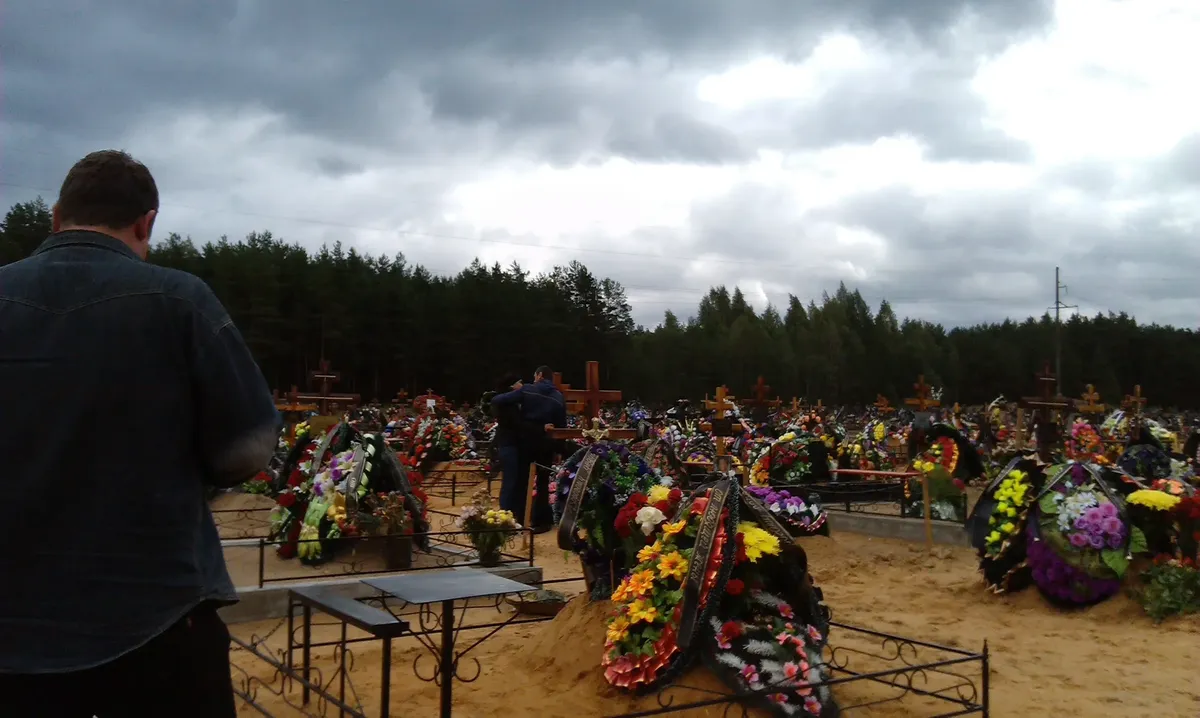
The Pskov police investigated one of the incidents with journalists in the cemetery, where several fighters of the 76th Pskov Airborne Forces were buried, who died in August in Ukraine. Investigators found out that they were on duty at the churchyard and violated the law, threatening journalists, divisions in civilian clothes. For other similar episodes of attacks on media representatives, law enforcement agencies have not yet been made decisions.
The incident with the employees of the Telegraph, Sergei Kovalchenko and Sergey Zorin, happened on the evening of August 26 at the village cemetery in the Baby (17 km from Pskov). Unknown people took the camera and documents from the journalists and threatened them with reprisals.
“New” told ( see No. 95 dated 08/27/2014 ) that it was in this cemetery in the Baby Baby on August 25 that the paratroopers of the 76th Airborne Forces-Leonid Kichatkin ( died 19.08.2014 ) and Alexander Osipov ( died 08/20/2014 ) were secretly buried. Correspondents of the "New" and St. Petersburg newspaper "Fontanka.ru" witnessed how the dead were escorted on the last journey. Hedly, quietly, secretly, in the absence of even close people, and even more so - prying eyes. On the outskirts of the village graveyard, three fighters under the control of the major buried the coffins of the dead comrades.
Why are the paratroopers buried secretly? And unwanted witnesses, especially journalists, drive away from the Pskov cemeteries? Are they attacking, threatening, intimidating? The reason is on the surface: so far the Pskov commanders, the leadership of the Airborne Forces, and the Ministry of Defense hide, under what circumstances and what losses the 76th Pskov Airborne Forces suffered.
The commander of the Airborne Forces, Colonel General Vladimir Shamanov on August 22 in Pskov, publicly stated: “In our airborne assault brigade, everyone is alive and healthy.” And the head of the Department of the press service and information of the Ministry of Defense of the Russian Federation, Major General Igor Konashenkov, called the Ukrainian media reports about "the capture of the Russian BMD in Ukraine and the deaths of military personnel". More - no comments from anyone.
Meanwhile, about the battle on August 19 near the village of Georgievka in the Lutuginsky district of the Lugansk region, the Ukrainian television channel Inter announced three weeks ago. The military correspondent Roman Bochkal described what had happened and posted several photos on the network.
“On the night of August 20, after the battle, my friends from the 24th brigade of the Lviv region sent me these photos,” said the “new” barrel. - According to them, there, near the village of Georgievka, a rather serious knead occurred. The special unit of the Ministry of Internal Affairs of Ukraine "Storm" participated. A lot died on both sides.
Later, other evidence appeared that the military personnel of the 76th Airborne Forces division participated in the hostilities in Ukraine, and among them there are wounded and killed.
A relative of Leonid Kicchatkin Daniil Kichatkin told the “new”: “They didn’t explain anything about his death. They simply said that he died near Lugansk in the performance of military duties. This is all that we know. ”
On August 29, the Pskov deputy and director of the Pskov Province Publishing house Lev Schlosberg received an audio recording of the conversations of two participants in the same battle near Lugansk. From them it follows that both the dead and the wounded fighters of the 76th Airborne Division are dozens. Over the past three weeks, the cargo 200 ( even according to our estimates - at least twelve, and we obviously know about everyone ) delivered to the Great Lukes, Vladimir, Tambov, Pskov, Leningrad, Voronezh, Chelyabinsk regions, the Republic of Komi ...
Most fresh graves are in the Pskov cemeteries. According to Schlosberg, the bodies of the dead paratroopers in Pskov are not brought immediately, but gradually, one or two, so as not to “blow up” public opinion.
“The division’s command is afraid of the effect of the sixth company,” the deputy believes. -In March 2000, in Chechnya, out of 90 military personnel of the 6th company, 84 were killed. Of these, 30 were Pskovichi. They were brought to Pskov and buried everyone at once. The whole city came to the funeral. It was scary. Most likely, conclusions were made from this, so now the bodies are brought in small batches, after a certain time. And they try to hide everything.
Attempts to hide the death of fighters in Ukraine Schlosberg explain the attacks on journalists in Pskov cemeteries. On the evening of August 26, at about the same time, two similar incidents occurred at the outskirts of Pskov at the outskirts of the “Krestovskoye” on the outskirts of the “Krestovskoye” on the outskirts of Pskov.
About 18 o’clock in the Krestovskoye cemetery were attacked by the correspondents of Novaya, Fontanka.ru, the Rain television channel and the Russian Planet portal. Two guys, strong physique, in dark jackets with hoods covering their faces, attacked the car on which the journalists arrived. They pierced two wheels, damaged the discs, pursued the car. At the nearest gas station, where surveillance cameras are installed, lagged behind. And correspondents called the police and wrote a statement on this fact.
At the same time, on the village graveyard in the Baby, other unknown young people “met” the employees of the Telegraph, Sergey Kovalchenko and Sergey Zorin.
“At the entrance to the cemetery, Nissan Quashqai,” says Sergey Kovalchenko. - When we left the cabin, the car overtook us already took a position near the graves of the paratroopers. As soon as the photographer Sergey Zorin took several pictures, two men came out of Nisan. In appearance - up to 30 years old, both are strong, one is shaven bald, very tanned, with a large head - the whole in black, the second with a short haircut in the blue hustle of Adidas and in sneakers. They behaved far from friendly. Demanded our documents. They demanded to give a camera. We gave. In a quiet rural cemetery, it would be a suicidal step. The guys began to call a certain Vyacheslav Alekseevich and asked him to quickly come with the “guys”. They explained to us that "now their" elders "will come here," we will all go to another place and figure out why you were rubbed at the graves. "
But the "elders" did not have time. The police officer arrived in the “telegraph” of the police arrived earlier. Kovalchenko also applied to law enforcement agencies.
On the morning of August 27, on the same graveyard in the Baby, unknown in the jeep blocked the path to the Reuters news agency Denis Pinchuk.
“Two well -built shaven -headed young people in sportswear jumped out of the jeep,” Pinchuk recalls. - One of them demanded: “Turn from here! Here is a forbidden zone, and you will not go there. Get out, otherwise we’ll call the elder and go with him. ”
The "senior" again failed to get ahead of the police, whom Reuters correspondent turned to. In this story, the Pskov Department of Internal Affairs is also being understood now.
Meanwhile, on September 15, Sergey Kovalchenko and Sergei Zorin came a response from the military investigation department of the RF IC of the Russian Federation for the Pskov garrison (it was there that the ATC was transmitted from the ATC on the fact of the incident with employees of the Telegraph - to make a decision).
“The Pskov police conducted operational events for the five with a plus,” Kovalchenko said to Novaya. - In my statement about the crime, it was not indicated who specifically kept us in the cemetery in the Baby. The operatives found that they are military personnel of the RF No. 07264 ( one of the units of the 76th division of the Airborne Forces - N.P. ) Zlobin S.I. and Kuzmin S.V. In addition, the police stated “the commission of unlawful actions that expressed in the obstruction of photographing the buried on the eve of the military and the removal of the already taken photographs, that is, in the obstruction of the legal activity of the journalist.” This is Article 144 of the Criminal Code of the Russian Federation. But then military investigators who decided to hush up this business came into business, passing everything for “petty hooliganism”.
In the document, signed by the deputy head of the military investigative department of the IC of the Russian Federation for the Pskov garrison, Lieutenant Colonel of Justice M.V. Andreeva says:
“The study of these verification materials establishes that in the actions of Zlobin S.I. and Kuzmina S.V. Signs of an administrative offense under Part 1 of Art. 20.1 of the Administrative Code of the Russian Federation “Little Hooliganism” ... For these administrative offenses, military personnel are disciplinary liability ... Bringing to disciplinary responsibility of Zlobin S.I. and Kuzmina S. is included in the competence of the command of the RF No. 07264 ”.
“That is, according to investigators, either the military, on their own initiative, drove journalists in the cemetery, or they should now be punished by those who sent them there,” Kovalchenko argues. -I remind military investigators that Zlobin and Kuzmin, in the process of our joint stay in the Baby, constantly called someone, called this person by name and patronymic and promised that the elders would come and deal with us.
By the decision of military investigators, the employees of the Telegraph and the Telegraph remained unhappy and will appeal it. Reuters correspondent received no answer from Pskov. The journalists of Fontanka.ru, Rain, Russian Planet and New "did not yet wait for him:
“On the fact of the attack on the Krestovsky cemetery, a pre -investigation check is now being conducted,” said Vasily Malyut, head of the information and public relations department of the Internal Affairs Directorate in the Pskov Region, “according to the law, it can last up to 30 days. The decision to initiate a criminal case or refusal will be made on September 25, at the end of the audit.