
Translated material
Day of Polish "Siberians"
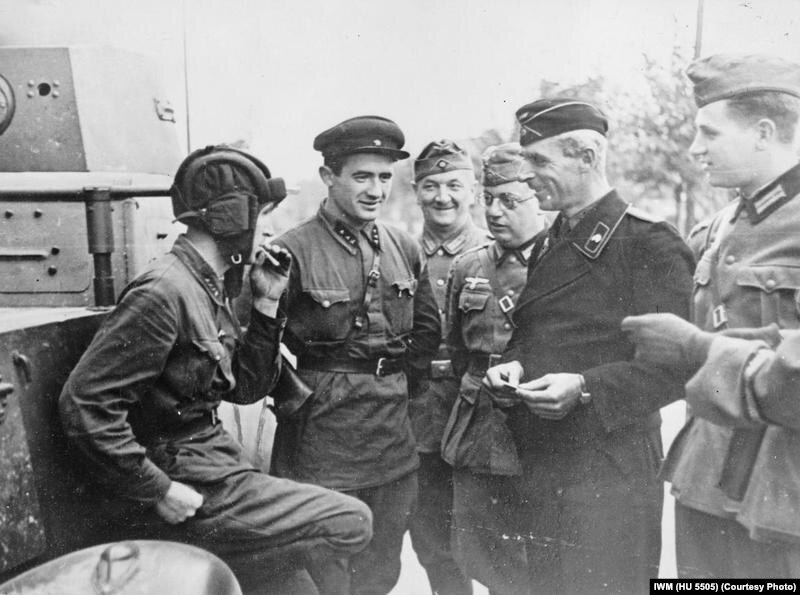
75 years ago, the Red Army invaded Poland
In Poland, on September 17 - the day when Soviet troops entered the eastern regions of the then Polish state (now it is Western Ukraine and Western Belarus), - it is noted primarily as the day of memory of those who died in Soviet capacity. This year, from the moment when the USSR actually hit the back of Poland, who fought with Nazi Germany, 75 years have passed.
The Polish section between the Third Reich and the Soviet Union took place on the basis of a secret protocol to the agreement on non -aggression between Moscow and Berlin, more known as Molotov’s Pact - Ribbentrop . Now the late Polish historian, Professor Pavel Vechorkevich believed that since the signing of this agreement, the fate of Poland was a foregone conclusion:
- How did it happen that the non -aggression pact was signed by two states that were not neighbors at that time? What could be aggression between countries that do not border on each other? This pact portended that the USSR and Germany would soon have a common border. It was not necessary to be a sage to guess that there was some secret protocol to this agreement ... As is now known, it was about the division of Poland and, as a whole of Central and Eastern Europe, into the German and Soviet spheres of influence.
It was about the division of Poland and, in general, Central and Eastern Europe on the German and Soviet spheres of influence
Nevertheless, the Poles did not expect an attack from the east, especially in the midst of battles with a Nazi aggressor who attacked them from the west on September 1, 1939 . Then the citizens of Poland for the most part were confident in the relics of their army. Indeed, in numerically, the Polish army was then inferior to the armies of Germany and the USSR, it was a significant combat force - 950 thousand soldiers and officers. The Poles, however, lacked modern weapons: about 600 tanks and 400 aircraft were in service with the Polish army - several times less than the eastern and western neighbors.
By September 17, when the Red Army crossed the eastern border of Poland, the position of the Polish troops was very complicated, although the command was counting on a protracted war with the Germans in the conditions of rainy and slushy autumn just in the eastern regions of the country, in anticipation, while the allies of Poland, France and the United Kingdom will proceed to active actions against Germany in the west of Europe. Therefore, the attack of the USSR meant for Poland the collapse of all hopes and the final defeat.
Soviet propaganda described the actions of the Red Army as a "liberation campaign", which brought freedom to the Ukrainian and Belarusian population of territories occupied by Soviet troops. Here is a fragment of the sound path to the Soviet newsreel of those years: “The valiant troops of the Red Army with honor and glory fulfilled their liberation task. The end of the border that separated the fraternal peoples. The Pan Eagle - a symbol of oppression and infancy will never appear over these lands that have now become free. In cities and villages, scarlet banners will rise. The Polish army is defeated. Her regiments and divisions surrendered to the prisoners - former soldiers of the former Polish army will let you go home.
Home, as you know, not everyone was released. At a time when the winners took part in Brest, in which the Nazi and Soviet troops took part, the Chekists were in full swing for the mass export of the “enemies of the people” into the depths of the USSR, as well as for executions, including in Katyn , which became the symbols of Soviet terror for the Poles.
Last year, the Polish parliament ruled that on September 17, the country will celebrate the Day of Memory of Siberians
Last year, the Polish parliament ruled that on September 17, the country will celebrate the Day of Memory of Siberians. This word in Poland has a completely different meaning than in Russia, and means tens of thousands of Poles exiled to Siberia and other remote regions of the USSR both after the Poland section in 1939, and later, after the end of World War II, during a new wave of repression.
Says a deputy of the Polish Sejm Peter Babinets :
- We want to worthlessly honor the memory of our compatriots - the "Siberians", which so many were sacrificed so that Poland was independent. I will quote the poet’s words: “Will we die in battle, or we will rot in the Siberian taiga, but Poland will rise in our torment and work in order to live.”
On September 17, people gather at the monuments to the Siberians and the graves of the dead in those years to honor their memory.