
Translated material
Goodbye, speech!

The end of August 1949. Steppe in the east of Kazakhstan. Wood in the steppe. Near the tree is the house. Father and daughter, father is a former pilot. World map and a portrait of Nekrasov on the wall. On the table, the book is Vladimir Mayakovsky. In the steppe is a young Kazakh and his horse. On the outskirts-a visiting guy-photographer. Somewhere far away-military trucks and people with a Geiger counter. In the West - death. On the screen is the film by Alexander Cotta "Test".
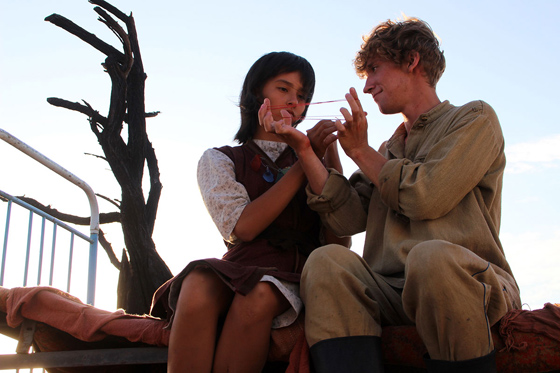
It would seem that with the “test” everything is clear - it is too seductive to declare the author the heir to Soviet poetic cinema. There is everything that is needed for this: fresco -shaped static personnel, bright colors, mythological simplicity of the plot and somewhat deliberate sacredness of action. Nemota - and this is a film in which not a single hero will say a word - only emphasizes the importance of what is happening. After depriving his characters to speak, Alexander Cott raises the narrative to a new level. Now it is no longer a father and daughter, but a father and daughter, now not a love triangle - but a cornerstone plot, simple and ancient, like a world.
After the retreat of the ordinary, the main symbol of which is speech, the plot of “testing” rises in full mythological growth, dissolving the realities of a particular time and turning the types of the era into archetypes. To contemplate this film is about the same as looking at the steppe, or the sea, or mountains. Our consciousness persistently tries to find in what kind of thoughtful substrate what is seen. And, as if playing along with the viewer, the cottage fills his film with images: here the father swallows the sun, here is the shirt of the photograph and the daughter’s dress weaved in a whimsical embrace on the linen rope. Even the breath of the sleeping father in the first scene seems to be something important that lurks something else.
 © Our cinema
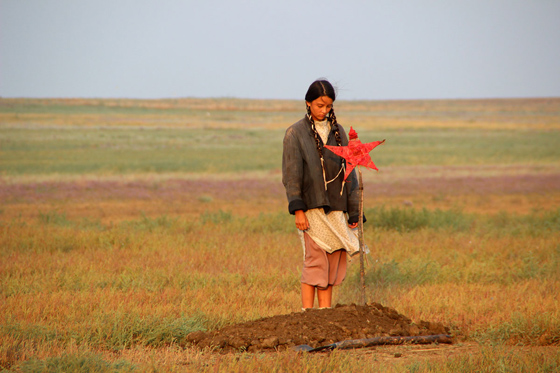
It would seem that everything is so, but writing this film in the heirs of poetic cinema is still too simple. There is something wrong in the poetry of this picture, something broken down. First of all, this is the weak of her heroes. It would be incorrect to call the “test” of a silent film - the picture of Kotta is full of sounds. This is the singing of birds living under the roof of the house, and howling winds, and the noise of the propeller. Yes, and the heroes of Cotta can laugh, cry or scream. Finally, the world of “test” also knows human speech: in one of the initial scenes, the heroine is fascinated by the Italian aria, which is transmitted on the radio at that time.
Only the characters of the film are deprived of the voices, and something artificial is felt in this technique. To understand this artificiality, it is enough to compare the “test” with the “naked island” of Kaneto Sindo or “Bo Ba” Ali Khamraev - vivid examples of a dumb movie. The silence of Sindo is due to the being of his characters, he creates a world in which words simply are not needed, communication in it is different. Khamraev, on the other hand, builds his picture on the impossibility of communication, bringing out representatives of different cultures into the frame who are not capable of (and do not want) to find a common language among themselves.
 © Our cinema
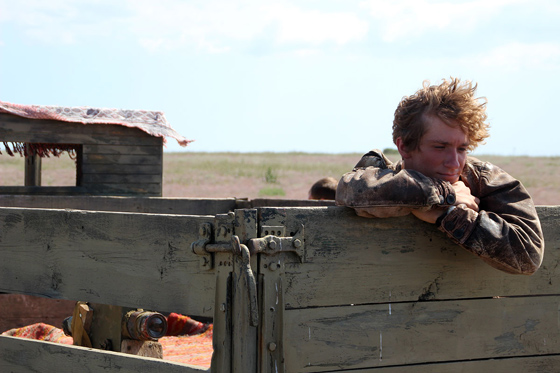
Cotta acts differently. His rejection of speech is a conscious formal technique, since he encounters characters who simply must begin to speak with each other. Moreover, in a number of scenes, their silence seems simply unjustified. For example, in the scene, when the photographer approaches the house to ask for water, and begins to look out the window, he must hail the owners, however, obeying the author’s intention, he remains him.
I once had a chance to read poetry, the author of which consciously did not use verbs. The reception was also stylistic, quite conscious. The verses were very good. “Almost like real”-for some reason I wanted to add then. And this “almost” arose somehow by itself, without a desire to wound or offend the author. It seems good, but still a little wrong.
Thriterally recreating the conditions of the Soviet life of the late 40s, withstanding the picture in the color scheme of illustrations for the magazine "Soviet Art" for 1949, the cottage kills all possible credibility. Forcing his film to move out from the chopped rails of poetic cinema, he rushes him to an explosive final, which was simply impossible in poetic cinema. However, the final explosion was carefully prepared by the director, and the steel frame of the plot is still visible behind the air poetic beauty. The writer Sorokin, who took a classic form, did something similar in his early things, and then blew up it, filling it with a completely opposite, impossible content. Behind the triumph of form lies her death.
 © Our cinema
And by the time of the final event, which looks completely parody, even mockingly, it becomes clear why the cottage is the exhausting beauties of the Kazakh steppe, why he chooses this sleeping and meditative rhythm of the narrative, for which he so enhances the degree of poetry by the end-to sweetness, almost to vileness. The whole previous narrative resembles a huge plane without wings that cannot take off, but it does not need it. He should not fly, but to ram, sweep everything in his path, since the “test” is not a continuation of the tradition, but a statement of the impossibility of continuing it. Soviet poetic cinema died, as well as the country that gave rise to it. Showing the death of the ordered Soviet world with its portraits of school classics, dreams of the Kremlin, pilots (almost the most important Soviet symbol of a person’s victory over the elements) and Italian Arias in the Kazakh desert, the cottage suddenly speaks of something very important-about the death of modernism.
But as soon as modernism dies, the hope of the triumph of progress and faith in the linear development of history disappear with it. The omnipotent creators are replaced by weak and frightened people, and they are not waiting for them at the end of the Garden, but the scorched desert, filled with meaningless and dead fragments of the past.