
Translated material
Group of persons without a center
The name “#Sonneteskaspir” written in the form of a hashtag seems to be promising the actual theater on the material of classical poetry. In fact, the “grille”, which accompanies every subtitle indicating the number of the sonnet or the name of the musical composition that sounds at one time or another, is one of the very few signs of our time in the first premiere of the Nations Theater. Timofei Kulyabin begins his performance with long pauses, static mise-en-scenes and more or less monotonous recitation from Shakespeare: this is not a current course of time, and even more not the rhythm of the social network, to which the symbol made in the title appeal. Sonnets sound in the hermetic space of the abstract “high culture”, the director himself remains outside its limits, occasionally communicating with the audience in the modern network language.
Instead of a curtain, the scene around the perimeter is fenced off a frame from a striped warning tape. Two artists are on duty at the play under the guise of mounters, so that at the command of the souffler-operator to rearrange the props and decorations, in his free time, drinking a doshirak at the table at the left backstage: against the background of the sterile, abstract space of the stage, this is the household nature-like a sninking in the eye. The artist Oleg Golovko decides the space of the performance, starting from one of the most important motives of Shakespeare's sonnets - the loss of beauty. The way she looks in the “Sonetteshkispir” is probably an Ommage of the most refined theater artist of Moscow Alexander Borovsky (by the way, working on the interiors of the Theater of Nations): as modest as the expensive retro-maintenance-piano, soft benches with a lock-and monochrome black-gray Gamma with very rare flashes of color.
The Shakespearean performance of Kulyabina is an essay without any, semantic or formal center: not a poetic performance with plastic numbers and not a dance production with reading poems.
Golovko and Kulyabin emphasize the difference between everyday life and the magnificent theatrical “window”. The beauty on the stage is partly destroyed and meaningless by the invasion of pseudo-monitor, network symbols that prevent tape-rama. The souffler’s replicas sounding in the speakerphone initially reduce the pathos of the performance, but closer to the finale are perceived completely differently: the “wind” commands, “leaves” no longer interfere with the fake effects, and what seemed like an imitation of a beautiful picture is now perceived as a sign of a creative act carried out in front of the viewer - the enmity between the spaces of the “theater” gradually went out To nothing.
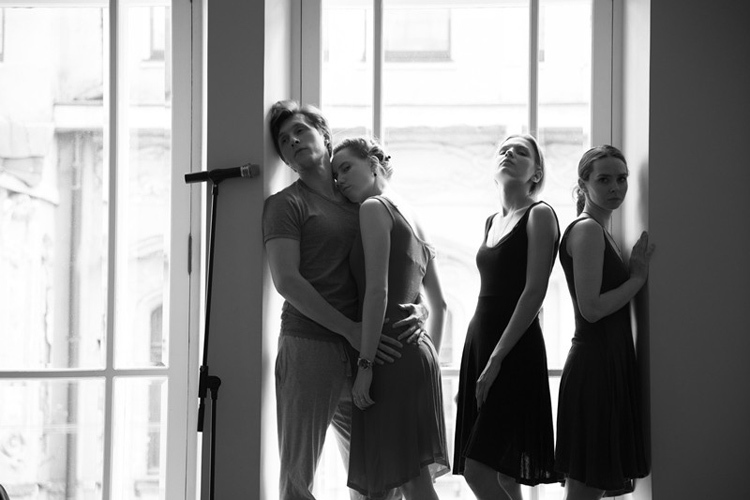
These “#Sonneteshkspir” in the recording could be watched without sound-and see something. In addition to the remarkable and in some way self-sufficiently substantial scenography, Oleg Golovko, the production of Kulyabin is remembered by choreography Ivan Estegneev and Evgeny Kulagin-the creators of the Kostroma company Dialogue Dance and the obvious leaders of the domestic Contemporary Dance . Their contribution to the whole performance is already tangible in the first sciences - quite seemingly static: the movements of the actors in them are a kind of microchoreography. Here the girl very slowly puts her head on the shoulder for a young man. Here he is just as slowly pulling her hands to her. Here she is being removed. After such an exchange, one of the sonnets finally sounds with smooth gestures.
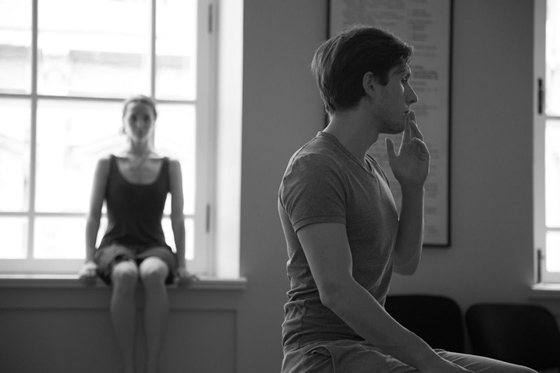 © Daria Nesterovskaya / Theater of Nations
Even from the photographs of the play, it is clear how the Kulagin and Esthegneans feel female sexuality - while working carefully, avoiding direct, vulgar use. However, none of the men are interested in the climax of the performance in it: two protagonists of the performance (Oleg Savtsov and Vitaliy Gudkov), who found themselves in the same space with five women, obviously entailing each other-mercilessly discarding their partners, they face the same text of the 73rd Snem about doomed love. Shakespeare's homosexuality is the main myth associated with his sonnets, many of which are devoted to a mysterious “friend”: a myth, it is worth noting, rather groundless, but nevertheless quite fixed in culture - and therefore capable of becoming relevant for the authors of the play.
In his second work on the stage of the Theater, Timofei Kulyabin develops a lot of topics and plots - however, not one of them becomes key, dominant in the play: they are all equal here and are often not connected with each other. The Electra left on the same site almost two years ago left behind much fewer questions - in that setting, everything was subordinated to one, rather transparent thought: crimes are committed in the name of God, religion is destructive and prevents society from developing.
The Shakespearean performance of the Kulyabin is the direct opposite of the Electrre: the essay without any, semantic or formal, the center is not a poetic performance with plastic numbers and not a dance production with reading poems. The “high culture”, which belongs to the lyrics of the Great Bard or sounding in the production of Persell with Rachmaninov, is shown simultaneously both living and as a museum, “taxiermic”. “SonnetteshkSpir” is the very case when the director’s task and the general solution of the performance cannot be brought to the common denominator even with all the desire: there are successful staging moves, but you are completely confused in relation to this work as a whole. Since confusion is one of those audience reactions that are the goal of modern directing, it can be assumed that Kulyabin achieved it intentionally - and in this case he won.