
Translated material
The same T.T.T.T.
A man in a boring business suit occurs at the door of the hotel. First, the silhouette grown on the threshold is completely unic. Then it is possible to make out a wary face under the fields of the hat-smoothly shaved, devoid of any individuality. The guest approaches the rack left unattended and tries to call the receptionist. In silence, a rattling sound of a call is spreading. No one answers. A boring person looks around intensely around. Nothing happens. All with the same incredulous mine, the guest sneaks along the corridor to a friendly open door.
Outside the door, a richly set table served for a good dozen guests is waiting for the door. If you read the right fairy tales in childhood, you can recall that there is no one’s in a strange house in someone else's house. Let the drooling flow from seductive treats, you will bite off only a piece - and that’s it, write: in the best case, you will remain forever in another world or turn into a pig. A boring person clearly did not read fairy tales (and was this character at all?). He eagerly echoes gift food for both cheeks. Finally comes a pleasant feeling of satiety. The hero's face for the first time blurred in a satisfied smile. She, however, immediately drives the grimace of the usual concern. But here is a new joy - the key to the number can be taken without a receptionist. After a hearty dinner, it's time for the side.
Grotesque “10 ways to get rid of her husband”, offering to strangle the faithful with a magnificent bust.
Further - awakening, tearing the insides pain, an animal fear rolls with a wave. A person rushes along the corridor, frantically looking for help, beats in the door of the rooms, like a perisive fly in the lamp. Everywhere the corpses of other people who also tasted treats in the dining room are insects, burned and fallen to the bottom of the plafon. In the last jerk, the unlucky guest falls out of the hotel, towards air, freedom, and dies. The hotel is no longer a building, but simply a trap the size of a matchbox, permitted in the corner of the kitchen. At the stove, the soup is a cook of giant sizes of a cockroach.
The Hotel, the first story from the graphic novel by Thomas Ott “Cinema Panopticum”, may seem uncomplicated by parables, but in fact it is not so simple. The already mentioned resemblance to magical fairy tales is complemented by the Kafkian image of a humanoid insect. The lifeless body in striped pajamas crouched near the trap, as if a prisoner, trying to escape from the gas chamber. Even the obvious reverseness of the story, in which a person and a cockroach change places, recalls manuscript marginals and paintings of old masters, where the usual plots turned inside out. Hares hunted dogs and fried people at the stake, the hunter turned into prey.
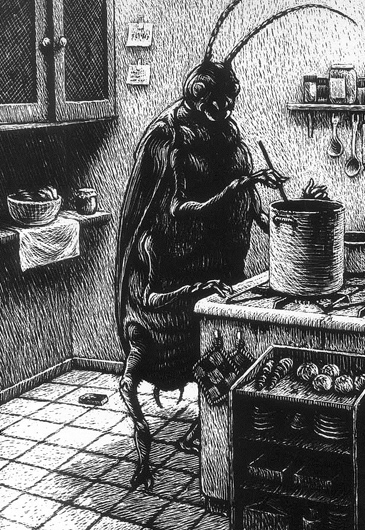 © Thomas OTT / Ediciones La Cupula "Hotel"
Thomas Ott builds his work to long-standing children's fantasies and nightmares and considers it a kind of art therapy, allowing you to get rid of dark thoughts for a while. It is not for nothing that on the website of the artist visitors meet an anatomical incision of the head full of worms, and the acronym “T.O.T.”, similar to the German designation of death. In any case, the drawn stories of Ott are inextricably linked with the centuries -old tradition of macabra, even if the artist himself does not realize this. On their pages are the baroque rows of grinning skulls and a grotesque operation, worthy of the extraction of stupidity in the Bosch painting, the divine all -seeing eye becomes an allegory of control over a person in a totalitarian society, skeletons in vignettes are gently hugged.
In this black and white world, classic stories like a stronger fight with death, unrecognized in his country of the prophet, treasures that kills its owners are successfully combined with the images of a modern mass club (UFO abducts, monstrous experiments, voodoo rites). Each story of Ott can successfully serve as an instructive story, an absurd morality or grotesque gallery of vices - whether it be the fate of an unlucky bodybuilder, instead of winning the hooligans, who received a bullet, or grotesque “10 ways to get rid of her husband”, offering to strangle the faithful with a magnificent bust.
Skeletons in vignettes are gently hugged.
The work of Ott does not come down to the drawn stories - he sang in the garage group The Playboys , periodically, getting tired of comics, is engaged in cinema and animation. But first of all, this native of Bern, who studied in Zurich, is certainly one of the most striking Swiss comixists, although to create the book “Hello from Hellville” he fled from a calm and serene Zurich to Paris. A fair effect on Ott was exerted by the French director and commander Mark Karo . Their work is similar to macabaric humor and black and white gamut, but in the technique of execution, comics of Ott are strikingly different from angular, hard in contour, deliberately gross works of Karo. The Swiss artist works in the technique of grating, which he owns a masterly. Each centimeter of its drawings is filled with a thin grid of strokes, creating a visual effect of volume, fullness of space with air and light and contrasting with impenetrable blackness of shadows.
Another specific feature of comics Ott - as a rule, there is practically no direct speech of the characters in them. Therefore, these graphic stories are often compared with dumb cinema, although such a comparison is not quite appropriate - the text was often used in the silent cinema. In the case of comics Ott, the expulsion of speech from a drawn story does not make it “dumb”, but rather helps to fully evaluate the expressive language of the drawing, not being distracted by reading replicas. In addition, drawn stories become universal, saving readers around the world from the difficulties of translation. The text, of course, is still preserved on the pages in the form of newspaper headings, inscriptions on signs and signs, but its role is deeply secondary.
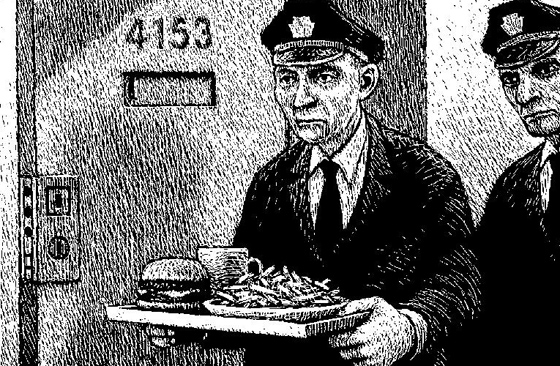 © Thomas OTT / Edition Moderne AG "Number 73304-23-4153-6-96-8"
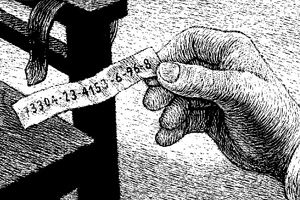
In one of the main works of Ott, the graphic novel “Number 73304-23-4153-6-96-8”, the text even determines the plot-but we are not talking about letters, but about numbers. The number on a piece of a prisoner from the Bible, who was sentenced to death, is everywhere haunted by his executioner. The numbers seem to him everywhere - on the clock, the calendar, the football player T -shirt, maps, playing bones, roulette wheel, in the phone number, address. They add up to the necessary combinations, first promise good luck and winnings, then they deceive and put a revolver in the hero’s hand. In a word, "three, seven, ace." From the killer within the framework of the law, normally existing in society, the executioner becomes an outside the law and ends the pursuit of numbers on an electric chair. The circle closes, the story returns to its beginning, the number is waiting for the next executioner again.
The lack of text makes the drawn stories of Thomas Ott with especially fertile material for audiovisual performances, where there is nothing superfluous, only images and music. Ott comics attract different musicians - for example, LE group Skeleton Band turned to the graphic story of Sinema Panopticum, and the Swiss group Bash was attracted by the comic book “Number 73304-23-4153-6-96-8”. Judging by the trailers, the music does without words - they are not necessary here, just as a text in the unusual stories of Thomas Ott.
The Thomas Ott exhibition will open on September 25 in St. Petersburg as part of the international festival of drawn stories "Boomfest". The concert of the Quartet Bash and the performance “The Number” according to the comic book Thomas Ott will be held on September 25 at 22:00 in Union Bar (Foundry Prospect, 55).