
Translated material
About freaks? About people?
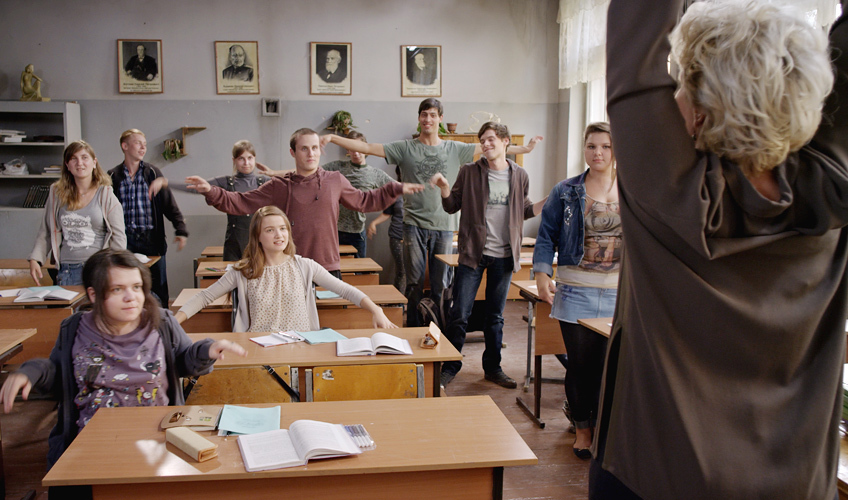
The “Correction class”, the full -length gaming debut of Ivan I. Tverdovsky, is released. The picture received a prize for the best debut at Kinotavra and was contradictory criticism: the spectrum of ideas about the “Correction Class” varies from rejection of the director’s rigid sentimentality to enthusiastic gratitude to him for the acute -social cinema about the problems of excluded categories of the population. On c olta . Ru Olga Shakin and Maria Kuvshinova enter the polemic about the film.
Olga Shakina: "Everything is conditional, as in a folklore"
“Class class” would be nice to judge by laws established not that the author, but his entire creative biography. Ivan I. Tverdovsky is the most crafty pseudo -domesticist who knows our new movie. Until a full -length debut, he removed the mockier, and a few restaurants: if the Western colleagues, falsifying the film document, are more often trying to scare or make fun of the audience, Tverdovsky provokes crying, ideally sobbing. The effect of its best shorts - like a chanson in a spine -long taxi driver. “As if waiting for a bus” - about lonely provincial schoolgirls who console themselves with amateur prostitution. “Dog Kaif”-about a kid who almost hanged himself because of unhappy love and, apparently, will continue to hang a little daily. “Snow” is about the mother that she protects her daughter, buying her drugs from the former son -in -law, who planted her on them.
Tverdovsky made an unpopular decision - without wasting time to search for real girls, boys and drug addicts, to remove their short, acute -social sketches here and now with not the most unconscious actors. Coming to ourselves that you will have a sampling our audience more likely a grunt in strings than a terrible whisper. Honestly, with the help of a list of roles and performers in the final credits, signing that it takes off the exploids, and thus relieves any possible accusations of operating a hard topic. Show me other domestic directors who, with an undoubted ability to manipulate, are honestly recognized as a tendency to manipulatory. Especially those who are twenty -six. Yes, Tverdovsky is sweeping, like a multiple laureate in the world from his film "Pianism", plays on the audience nerves. But our society, it seems, is vital for someone on its nerves to play qualifiedly-without long, without h/b, without a lonely cigarette in the cold. With passions, screams and hysterical laughter.
“Class class” is a brilliant inflation, a story that was not told, but a beggar in the subway drowned in the voice. Everything there is conditional, as in a folklore cry: from the heroes of the disabilities-the truly Disabled here is only the main character-to the soundtrack: where Germanicus would have cut the marginal domestic nightmare-pop, Tverdovsky cuts the parody of him performed by the Golt asphalt game VIA (“pain, pain, but we will find a password with you, it’s hard to live without branders, it is hard to live without brands. Without bad obsessive dreams ”). The irony is also amplified by the fact that Philip Avdeev and Nikita Kukushkin, refined artists of the Gogol Center, played in the “Correction class”, play the main roles in the Asphalt.
The train deafeningly signals a train about the condensed tear of what is happening, under which, in search of a thrill, students of the class for inferior ones lie down. The episode is removed so that the viewer involuntarily bends: how to not recall the first episode of cinema napulations in the history of mankind. “I love Trier, I sobbed on the“ dancing in the dark, ”the author yells almost to MegaFon. “Do not look for realism and psychologism, turn off your head.”
And then in the night, a wheelchair spat on a bully from jealousy burns. And then the mourning portrait of the deceased is fed with liquid oatmeal. And then the virgin, suffering from muscle atrophy, puts on lace stockings. “Class of Correction” - Korean cinema, where people with strange plastic fights bonds of oysters and beef bones, are explained in love with syringes and fishing hooks. A sketch from the life of aliens, which is a lot of our nursing. In order to remove this, you need to have well-developed abstract thinking, striving for the level of Vvedensky and Platonov, humanly speaking-a good shift for the whole head. A smart eccentric capable of translating the images that arise in his shifted head into a universal language of direct emotional perception, in our cinema is no less rare than an engineer in a stroller - in a district school with dirty linoleum. “She is exotic. Well, as if he had traveled to Lada all his life and suddenly sat on Lamborghini once, ”one of the heroes of the fellow practitioners clearly explains one of the heroes in the stroller.
According to the apt remark of one of the heroes of the “New Russian Wave”, the domestic director in the context of the world cinema is in the position of the racer, who arrived at Formula 1 on the “Lada”: wound up-already well. Tverdovsky entered the world cinema context on a limousine with a hinged top (but wheels from a wheelchair) and confidently rushes forward under the whistle and the delay of others. I do not want the driver, crossing the car more solid, to begin to shoot the “Kursk arcs” in 3 d . I would like to throw the roof even stronger at his car.
Maria Kuvshinova: “Solidovsky reproduces not reality, but a generally accepted idea of cinematic belonging”
How to explain the sucker, what is a fake? Probably not: who believes that the young talented author takes the range from provocation to a miracle, that reality is naked, the dialogues are accurate, the actors are organic, and in the village of Uglniki, the boys took off the Virgin on the mobile phone , which rebelled from the water of the Bystritsa-Nadvirnyanskaya River, let him believe.
Russian critical thought offers two diametrically opposite interpretations of the “class of correction” (which in itself cannot but alarm). The first: this is the flagship of the “new new wave” , a masterpiece of realism (all in life!), The sob of teenage despair and the “scarecrow” of the 21st century . The second: this is an elegant postmodern trick, grotesque, his own universe, a flaming giraffe and the output of a young talented provocateur into the territory of Balabanov and von Trier .
Both are a big advance.
The first version is folk, this movie will be watched, and it is worth talking about it in more detail, a little lower. The second is more sophisticated, and in connection with it there is one fundamental remark: for provocation in this picture there is a little provocateur. In each film of Balabanov there are Balabanov, and in every film Trier there is trier - his self -love, self -flagellation, self -denial, exhibitionism, disgust to oneself and rapture of oneself; The author is, therefore, the author, which is most often already in the debut. In the "Correction class" Ivan I. Tverdovsky is not, we do not see it. Probably because he is still difficult to arrange, and his heroes are schematical and deprived of halftones: a bitch-pipe, bitch-bitch, creature-classmate, beast-classmate, “Bespalov died”, “I am young! I understand you? " The only controversial act in the picture - the rejection of the relationship of the boy, who seems to be in love with the main character in a wheelchair - happens suddenly and is not motivated (just don’t have to talk about “looked into my eyes yesterday” - it was better to remember how slowly, as if in a swamp, was plunged into the betrayal of catfish from the “Scarecrow”). In a similar way in the zero in Russian militants showed fights, not being able to put them and shoot them: there is a barn, a noise is heard, a person flies out of the window; Not an event, but an index. Tverdovsky from the ignorance of the chosen object, from the misunderstanding of what provocation, brutality, betrayal, miracle is, but from the desire to show all this as if raising in front of the viewer the signs “Provocation!”, “Surrex!”, “Betrayal!”, “Miracle!”, And when it comes to the sign “Author!”, He demonstrates a fragment of his own short film “Dog Kaifa” in the TV And he puts a replica in one of the heroines: “Why take such a shoot, how do children strangle themselves?” So, for a few seconds, in the background, a flirty but shy creator reveals himself to the world.
Paradoxically, it was the absence of the author, the absence of his alter of the ego and personal experiences, does not allow the “correction class” to Russian cinema of the tenths, the timid dawn of which this year could be observed on the Kinotavra. New filmmakers (as in general, new people who are not burdened or less burdened with the experience of the post-Soviet-postmodern nineties) distinguishes not so much adherence to a certain aesthetics (“hyperrealism!”, “Trembling chamber!”), How much this is: the lack of fear of direct statement, before he is presented to the world, not in the form of winking, but with all and all with all. with my imperfections, stupid things and pain (I will not mean for a variety, not on my own stop -hundred articles on the “session” on the topic, but on the text of Larisa Malyukova with the same conclusions). The existence of this author’s utterance at this stage exists in symbiosis with a certain aesthetics that has been in many respects under the influence of the documentary school of Marina Razbuzhkina. And the indignation of those for whom the form coincides with the content is understandable, for whom peeping in the world in the camera means peeping first of all behind itself - from their point of view, Tverdovsky appropriated a stranger thing for himself in order to resell the exurge under the guise of provocation.
It is the aesthetics that is the cause of confusion in the interpretations, and it is precisely because of it that the “Correction Class” takes (and will take) for a pure coin. Of course, Tverdovsky does not reproduce reality, but precisely the current generally accepted idea of cinematic belonging, mainly formed by the television series Germanics: the trembling camera does not keep up with the heroes; school corridor, through the screen, smelling of a wet rag; adults-boys and children are drunk; Everyone will die, and I will stay (with pressure on "die"). At the time of the “school”, this caused a shock among the mass viewer, four years later, the “second welding” receives not only the debut prize at the Kinotavr, but also the award from the pans as a potential commercial hit. Only twenty years have passed since the Dogma manifesto, fifteen-from the triumph of the Dardensky Rosetta, thirteen-from the attack in New York, the shots of the burning towers of the approved new standards of reliability, and now the Russian people on both sides of the cameras ceased to be afraid of the trembling picture.
It’s commendable, but late - the aesthetic pendulum in world cinema has already swung back, from hyperrealism to visual redundancy and thorough extension of the frame (this does not mean that the directors in pursuit of recognition instead of a trembling chamber begin to use static - this means that the authors working in a certain, for various reasons, which are in demand specifically today, aesthetics).
Boris Khlebnikov once said that at first he did not accept the accusations in Chernukha, and then guessed: Chernukha is the slurred statement, and in this sense, “Class of Correction”, of course, is the chernukha in the spirit of the early zero, albeit packed in the aesthetics of the early tenths: either rain, or snow, or not.
And here's something else. A conversation about aesthetics in new Russian cinema, which seemed so important at the beginning of the year, as well as a stubborn twenty-year-old struggle of the Russian director for the credibility of the recipes “Dogma-95” are rapidly obsolete, like the entire other pre-war agenda . In any case, the camera trembling in the school corridor will be swept along with glossy meat of necrophilic blockbusters. The time that comes will require another language, and the “class of correction” ... God with him and with all the reviews on him.