
Translated material
Memory. Dmitry Shostakovich
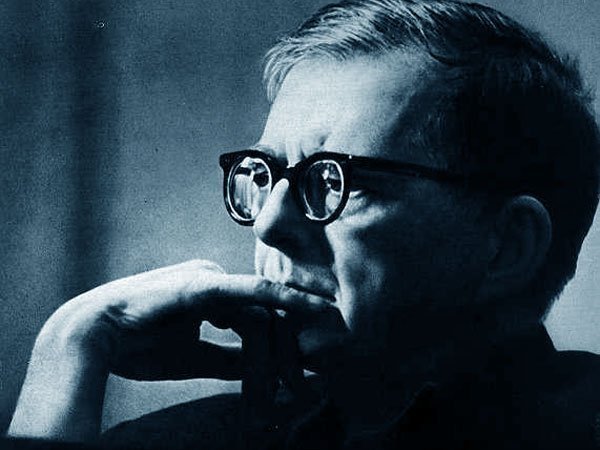
On September 25 (12), 1906, Dmitry Shostakovich, an outstanding composer and pianist was born.
Personal business
Dmitry Dmitrievich Shostakovich (1906 - 1975) was born in St. Petersburg. His father was a chemical engineer, worked in the main chamber of measures and scales, and his mother studied at the St. Petersburg Conservatory before marriage. She gave her son in the summer of 1915 the first lessons of the piano game. After a couple of months, Shostakovich entered the piano courses of Glasser, and the next year he already played complex works of Mozart and Haydn. In 1918, he began to study with Professor Alexandra Rozanova, then he entered the Petrograd Conservatory at two faculties at once - composer and piano. At the same time, he continued to study at school. In 1923, he passed the final exams in the piano class. By 1926, he managed to prepare an extensive repertoire and began to speak with an independent concert program, in which his own works were also included. Finishing the composer faculty, Shostakovich presented the first symphony as a graduation work.
In 1927, by the decade of the October Revolution, Shostakovich writes his second symphony “Dedication of October”. The next year, he graduated from the opera Nose on the story of Gogol. The premiere of “Nose” at the Leningrad Small Opera Theater took place in January 1930. Vsevolod Meyerhold had a noticeable influence on this work.
In 1929, Shostakovich composes the third “Pervomaisky Symphony” and the music for Mayakovsky’s play “Blop”. He begins to create ballets: “The Golden Age” (1930) and “Bolt” (1931). In 1932, Shostakovich graduated from the second opera - Lady Macbeth Mtsensk district according to Leskov’s story. In January 1934, she was delivered at once in two theaters-the Leningrad Mal Opera and Moscow Musical Name Nemirovich-Danchenko. In 1935–37, the opera was performed in New York, Buenos -Aires, Zurich, Cleveland, Philadelphia, Ljubljana, Bratislava, Stockholm, Copenhagen, Zabreb, B -Bi -Ss. In 1935, Shostakovich graduated from the third ballet - the “bright stream” on the libretto of Lopukhov and Piotrovsky. At the beginning of 1936, two devastated articles were published in Pravda one after another with a sharp criticism of Shostakovich. Both the opera and the ballet were removed from the repertoire. On the eve of the premiere, the execution of the fourth symphony written by him in 1936 was prohibited (first performed only in 1961).
Since the fall of 1937, Shostakovich began teaching at the Leningrad Conservatory, first in the orchestration class, and a little later - in the class of works. In the same year, he ends the fifth symphony. The composer defined the idea of this symphony as the “formation of a person” - from gloomy thoughts through the struggle to the final life affirmation.
In 1941, Shostakovich in the besieged Leningrad wrote one of his most famous works - the seventh (Leningrad) symphony. Before the beginning of October, three of its first parts were completed. In October, Shostakovich flew to Kuibyshev and here in December he completed the symphony. The premiere of the seventh symphony took place in March 1942 in Kuibyshev. In August of that year, under the leadership of Karl Eliasberg, conductor, she was in besieged Leningrad. For hungry, sick people, rehearsals were hard work. The musicians highlighted additional food: they received not only the norm set on the card, but also lunch, and the conductor gave the coupons for lunch. After removing the blockade, Shostakovich returned to Leningrad. In 1945, he graduated from the ninth symphony dedicated to the victory.
Soon after the war, Dmitry Shostakovich moved to Moscow. In February 1948, after the advent of the Decree of the Central Committee of the All -Union Communist Party of Bolsheviks (b) about the opera of V. I. Muradeli, “Great Friendship” began a new wave of attacks on the composer.
In 1951, Dmitry Shostakovich composed ten poems for a mixed choir. In 1957, the eleventh symphony "1905" appeared. In 1959, Shostakovich writes Operetta “Moscow, Cherryshki”. In 1961, the premiere of the twelfth symphony “1917” took place. A year later, Shostakovich introduced the students a philosophical and journalistic thirteenth symphony. In 1964, his oratorio "Execution of Stepan Razin" appeared. Shostakovich’s work in the 1950s-1960s is characterized by a variety of topics to which the composer addresses. It again represented humor, satire - in the operetta “Moscow, Cherries”, in the vocal cycle of “satire” (to the words of Sasha Cherny, 1960). In 1969, the fourteenth symphony was completed. She was written in the words of F. Garcia Lorca, G. Apolliner, V.K. Kuchelbeker and R. Rilke (1969). In the seventies, vocal cycles appeared on the verses of M. I. Tsvetaeva and Michelangelo, string quartets and the fifteenth symphony. Dmitry Shostakovich died in Moscow on August 9, 1975.
What is famous
One of the greatest composers of the XX century. The author is 15 symphonies, 15 string quartets, operas “Nose”, “Lady Macbeth of Mtsensk district” (“Katerina Izmailova”), “Players”, ballets “Golden Age”, “Bolt” and “Light Brook”, numerous other works. He had a great influence on other composers both his work and personally, as a teacher of the Leningrad and Moscow Conservatory.
What you need to know about
 Dmitry Shostakovich
In the life of Dmitry Shostakovich there were two periods when his work became the target of official Soviet criticism. This first happened in 1936, when the article “Climb instead of music” dedicated to the opera “Lady Macbeth of Mtsensk district” appeared in Pravda. In it, the composer was accused of “the absence of a simple and understandable melody” and indulging the perverted tastes of the bourgeois listeners “their twitching, loud, neurostenic music”. Soon, the articles “clear and simple language in art” and “ballet falsity” about the ballet “light stream”, in which the “puppet image” of life and a formalistic approach to folklore, were found. Following the “truth”, the articles branding the composer appeared in other publications. The productions of Lady Macbeth and the Light Stream were discontinued, the premiere of the fourth symphony did not take place, but this time the dump was relatively short -lived.
The situation was much more serious after the publication of the Decree of the Central Committee of the All -Union Communist Party of Bolsheviks (b) about the Opera of V.I. Muradeli “Great Friendship”, where it was noted that in the work of Shostakovich, Prokofiev, Khachaturian, Shebalina, Popov, Maskovsky “formalistic perversions, anti -Democratic trends in music, alien to the Soviet people and its artistic tastes. The characteristic signs of such music are the denial of the basic principles of classical music, the preaching of atonality, dissonance and disharmony, which are supposedly an expression of "progress" and "innovation" in the development of musical form, the abandonment of such the most important foundations of a musical work, which are melody, passion for chaotic, neuropathic combinations that turn music into cakophony, into chaotic piles Sounds ".
The resolution caused great changes in the musical world. The cavity was replaced by the Presidium of the Union of Composers, there were many publications, branded mentioned in the decree of composers. In the fall of 1948, Shostakovich was deprived of the title of professor of the Moscow and Leningrad Conservatory. “Having arrived in Leningrad, the composer read on the board of ads at the conservatory that he was dismissed“ for a low professional level ”. In Moscow, he simply did not give him the key to the audience. ” In 1949, the play by Sergey Mikhalkov “Ilya Golovin” appeared about the composer-formalist who was torn from the people, whose work was criticized by the newspaper Pravda in an article with the characteristic name “formalistic extracts in music”.
Direct speech
"Many years ago, I started working on the chamber Symphony Shostakovich (this is the eighth quartet shifted for the chamber orchestra). This composition has an official dedication -" memory of the victims of fascism and war. "When I work on a party, I read, think about it, literally sleep with it under the pillow. And suddenly I felt that at one place It shows that he was being killed in this place, and I then told myself - no, this is not only about the victims of fascism and war, this is Shostakovich, the tombstone was erected to himself. “I thought that if I someday I will die, it is unlikely that anyone writes a work on my memory.
Then I began to deeply and seriously study Shostakovich's symphony. During work on his fifth symphony (about which Solomon Volkov writes a lot in this book), I think I understood the internal psychological spring of this composition. The topic of the death of the author is also indicated here. The final of the symphony is outwardly cheerful, optimistic. It seems that these are the columns of the demonstrators-as we all once walked-along Red Square in Moscow or in Palace Square in Leningrad. People go tightly, shoulder to shoulder. And suddenly the hero (and this is Shostakovich himself, of course) dies, he is killed, and the people around this do not notice. And continues to go at the same pace, without slowing down the step. " Vladimir Spivakov
“This is music, deliberately made by the“ nasty-worship ”, so that nothing resembles classical opera music, there is nothing in common with symphonic sounds, with a simple, publicly accessible musical speech. This is a music, which is built on the same principle of denial of the opera, according to which levadian art generally denies simplicity, realism, the understandability of the image, the natural sound of the word. The transfer of the most negative features of the Meyerholdovsna in a multiplied form. This is a left -handed confusion instead of natural, human music. From the article "Climb instead of music"
Braised by death fear
And knowing the time
Having lowered his eyes dry
And breaking hands, Russia
I went east before me
And behind me, sparkling a secret
And calling himself "seventh"
A feast rushed to an unheard of ...
Pretending to be a musical notebook
The famous Leningrad
Returned to my native air
Anna Akhmatova, a fragment from "Poem without a hero"
Music
D.D.Sh.
Something miraculous burns in it,
And in front of her eyes, the edges are pounding.
She speaks to me alone,
When others are afraid to come.
When the last friend averted his eyes
She was with me alone in the grave
And sang like the first thunderstorm
Ile seemed to speak all the flowers.
Anna Akhmatova
13 facts about Dmitry Shostakovich
- Studying at the conservatory, Dmitry Shostakovich worked as a taper during the showing of silent films at the Parisian cinema.
- The project of the biologist Ilya Ivanov on the crossing of a person with monkeys inspired Dmitry Shostakovich to the idea of the Orange opera, whose main character, as a result of a biological experiment, turned into a half-man-Polorangutan named Orange. The composer wrote the prologue of the opera, but then left this plan. In 2004, the draft of the prologue was discovered by the musicologist Olga Digonskaya. In 2011, Orange opera was delivered by Los Angeles Philharmonic.
- In many places of the score of the Leningrad symphony, there are notes - letters Tue. So the composer noted the places where his work was interrupted by air anxiety.
- In a number of Shostakovich’s works, for example, in the tenth symphony, his “musical monogram” is found: the sequence of notes re, Mi-Bemol, before, SI, the letter designations of which are read as DSCH.
- In 1942, on the cover of one of the numbers of Time magazine, Dmitry Shostakovich was depicted in a fire helmet. The drawing had a real basis: during the blockade, Shostokavich was part of the voluntary fire brigade of the faculty of the Leningrad Conservatory and was on duty at the roof of the conservatory during air anxiety.
- In 1943, Dmitry Shostakovich participated in the competition to create a new anthem of the USSR. The options represented by Shostakovich and Khachaturian received the highest score, but the version of composer Alexandrov was approved as the music of the anthem.
- Dmitry Shostakovich often wrote music for cinema. Here are just a few of the films in which his music sounds: “New Babylon” (1929), “Interior” (1932), “Youth of Maxim” (1935), “Return of Maxim” (1937), “Vyborg side” (1939), “Volochaev’s days” (1937), “Friends” (1938), “Man with a gun” (1938), “Great Citizen” (2 series, 2 episodes, 2 episodes, 2 episodes, “2 episodes, 2 episodes. 1938-39), “Stupid Mouse” (cartoon, 1939), “Zoya” (1944), “ordinary people” (1945), “Pirogov” (1947), “Young Guard” (1948), “Michurin” (1949), “Meeting on the Elbe” (1949), “unforgettable 1919” (1952), “Belinsky” (1953), 1953, “1953) “Unity” (1954), “boss” (1955), “First echelon” (1956), “Hamlet” (1964), “Year” (1966), “King of Lear” (1971).
- All his life, the composer was a devoted fan of the Leningrad Zenit. And his ballet "Golden Age" is dedicated to football.
- In a conversation with friends, Dmitry Shostakovich sometimes praised the music of Ilyich for a long time and in the most elevated expressions. The interlocutors were perplexed, not understanding what Lenin wrote for the music, and only after a while Dmitry Dmitrievich explained what he was talking about Peter Ilyich Tchaikovsky.
- After the renaming of Petrograd to Leningrad, Shostakovich indicated the city of Leninburg in some of his letters.
- After the Decree of the CPSU of the 1948 Central Committee, which defeated the “formalism” in music, Shostakovich wrote the satirical work “Antformalist Rahoy” (“For a reader, four bass and a mixed choir, accompanied by piano”). It was executed for the first time only in 1989.
- When the composer was asked why he was holding a portrait of Mussorgsky on the table under the glass, he replied: “When I look into these eyes, it is easier for me to throw my works into the basket.”
- In childhood, the future composer Andrew Lloyd Webber houses two cats Sergey and Dmitry, named after Prokofiev and Shostakovich.
Materials about Dmitry Shostakovich
Article about Dmitry Shostakovich on Wikipedia
Site dedicated to D. D. Shostakovich
Biography on the website of the Moscow Conservatory
The memoirs of Dmitry Shostakovich, recorded and edited by Solomon Volkov.
Shostakovich on the site Classic-online
Shostakovich on Belcanto.ru