
Translated material
Historical dollar exchange rate

At the auction on the Moscow Exchange on September 26, the American currency twice updated the historical maximum.
The first US dollar transactions on Friday passed within 38.6–38.7 rubles, but by noon the growth of the American currency accelerated, and by 12:50 the dollar reached a mark of 38.98 rubles, which is 49 kopecks higher than the level of the previous closure. At 16:00, the dollar rate was already 39.0770 rubles. Thus, the dollar for the first time exceeded the mark of 39 rubles.
The euro rate was strengthened by 61 kopecks, up to 49.71 rubles. The cost of the bivalyut basket (0.55 dollars and 0.45 euros) grew by 57 kopecks compared to the level of previous closure and was 43.84 rubles.
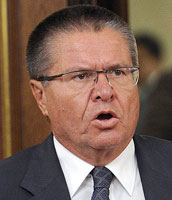 Alexey Ulyukaev
Commenting on the growth of the dollar in relation to the Russian currency, the head of the Ministry of Economic Development, Alexei Ulyukaev, said that he considers the ruble to be resold and in the future is waiting for its strengthening.
“I think that now the ruble is strongly resold against a combination of a number of circumstances: the third quarter is always a slightly worst trading balance compared to other quarters, the influence of capital, the conjuncture of oil prices and some signals that make us doubt the quality of our investment climate also have the effect.
Recall that the previous maximum was set on September 16 at a mark of 38.93 rubles per dollar. This happened after the news of the home arrest of the owner of the AFC System Vladimir Yevtushenkov . Then April records broke the euro, reaching 50 rubles.
Recall that Yevtushenkov was placed under house arrest on September 16 on charges of embezzlement of Bashneft shares. According to investigators, the oil company was sold AFK Sistema in 2009 by $ 500 million below the contract price.
Experts also associate today's sharp decrease in the course with this case - on September 26, the court arrested the Bashneft shares owned by AFK Sistema. In addition, low oil prices continue to provide pressure on the ruble. In recent months, oil has been stable cheaper, already breaking through the level of $ 95 per barrel and, obviously, the price will continue to decrease.
Another factor contributing to the fall of the ruble is the growth of speculative pressure on the Russian currency. Last week, despite the firm intention to release the ruble to free swimming before the end of this year, the Central Bank still had to enter the foreign exchange market to restrain the fall of the Russian currency, recalls NTV.
Experts note that the pressure on the ruble increases, and therefore they expect that next week the dollar will continue to grow, and the euro will grow to 50.50 rubles. In case of rise in the cost of the American currency above the level of 40 rubles, analysts do not exclude the intervention of the Bank of Russia.
When the previous dollar record was updated on September 16, and the cost of the bivalyut basket exceeded 44 rubles, the Central Bank conducted a one -day Operation Currency Swap - sold dollars for rubles with their subsequent redemption. In the evening of the same day, the dollar and the euro sharpened sharply, but not for long.
According to ITAR-TASS with reference to the materials of the Ministry of Economic Development (mayor), the stress scenario of the Russian economy developed by the Ministry implies the possibility of reducing the ruble exchange rate in 2017 to 42.8 rubles per dollar.
As the ministry explains, in the near future it is expected to “reduce the cost of products exported by Russia”, which will lead to a decrease in export income in 2015-2017 by $ 36-45 billion a year compared to the basic scenario. The mayor notes that this will weaken an exchange rate of up to 40 rubles per dollar in 2015 and up to 42.8 rubles per dollar in 2017.
Over the past month, the ruble is getting cheaper, updating historical minimums. So, on August 28, 2014, the Russian stock market decreased after the President of Ukraine Petro Poroshenko announced the entry of Russian troops into Ukrainian territory. Then the ruble exchange rate fell to 36,6995, closely approaching the historical minimum established in the spring of 2014 against the backdrop of an exacerbation of the crisis in Ukraine.
However, the Ministry of Finance considers the current Russian currency course balanced. The head of the Department of Long -term strategic planning of the Ministry of Finance of the Russian Federation Maxim Oreshkin previously explained that the ruble exchange rate at each particular moment in time reflects demand and supply, which is on currency at a particular point.
According to him, "now the currency is in a balanced state, so from this point it can go both up and down in the short term."
According to RBC , a significant strengthening of the dollar is pressure on the market of precious metals, which to date almost completely lost the previously obtained increase. In the morning on Friday, on Friday, on September 26, it was traded near the mark of $ 1220 per ounce, and the price of silver amounted to approximately $ 17.6 per ounce. Analysts believe that in the near future the dollar will continue to put pressure on the market of precious metals.
The agency recalls that from July 17, from the date of the crash of the Malaysian airliner Boeing 777, gold prices decreased by 7%. From this moment on, the tension between Russia and the West increased significantly, in addition, the situation in Syria and Iraq worsened. According to Barclays Capital analysts, if events of this scale are not able to maintain gold prices, this can only mean that other indicators of the market of extremely weak.
They note that although the demand for physical gold in Asia is growing in accordance with seasonal factors, the rate of increase in demand (both in India and in China) is much lower than the levels of 2013, when they were due to the search for benefits in conditions of a significant drop in prices.
“Although, as a result of a recent decline in gold prices, they were already at the level of our forecast for the IV quarter ($ 1220/ounce), the gold, apparently, still lack tactics and, possibly, strategies. We believe that in 2015, the price risk will still be shifted towards the decline and the price will continue to fall, ”Barclays Capital explained.
At the same time, Russia and Kazakhstan continue to buy gold, and analysts do not exclude that this takes place as part of the coordinated monetary policy of the two countries.
According to the IMF, the Central Bank of Russia in August bought 232,510 ounces (7.23 tons) of gold, and the total size of the country's gold and foreign exchange reserves amounted to 35.769 million ounces or 1112.5 tons. Kazakhstan also increased its gold reserves by 795.213 thousand ounces to 5.8 million.
Thus, Russia reached fifth in terms of gold reserves in the world. According to the World Gold Council Gold Council, over the past six months, Russia has increased its reserves by 54 tons, which has been the maximum increase since 2009.
Experts suggest that the increase in the gold reserves is associated with the introduction of the sanctions of the European Union and the USA in relation to Russia.
See also: the dollar exceeded the mark of 39 rubles, the ruble fell after refusing to let Yevtushenkov let the dollar exchange rates and euros go up Ilya Karpyuk ruble and oil rushed down, Ilya Karpyuk, the Russian market is waiting for positive news from Ukraine