
Translated material
Information cover
The law to limit foreign influence in the media creates the conditions for redistribution of property, in which many will have something to profit
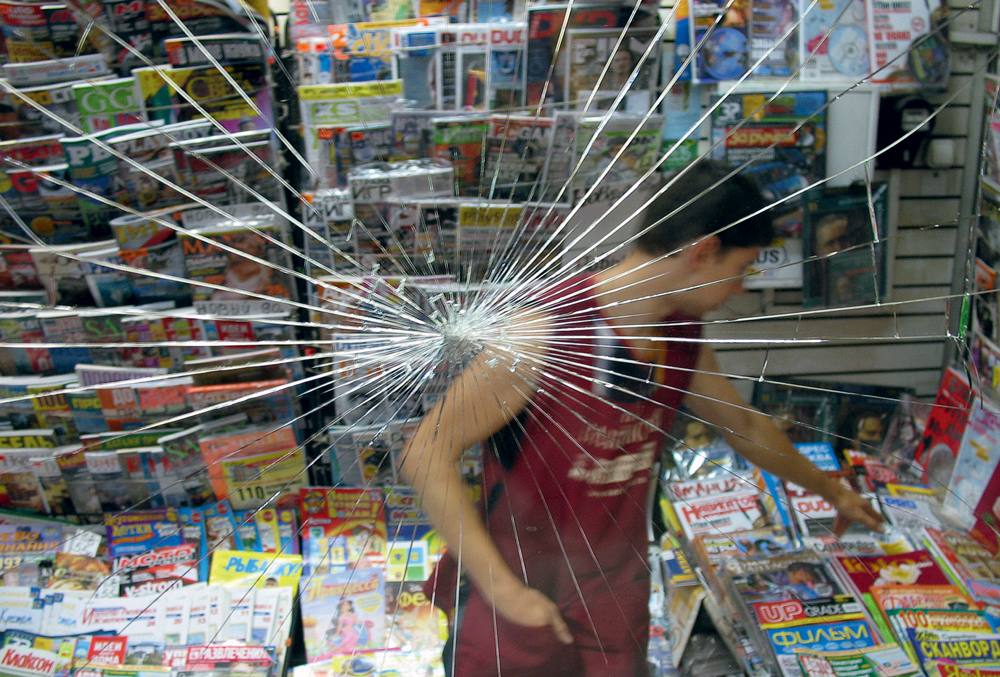
Photo: Sergey Mikheev/Kommersant
The ban for foreigners to control the Russian media only at first glance has the main goal of tightening censorship. If you look more closely at the fresh law, it turns out that someone’s selfish considerations are behind it. The calculation is simple: foreigners who own many qualitative means of information will be forced to either sell their projects or build complex schemes to maintain control like those that they already use in China. But Russia is not China, it is not so attractive to investors. So, most likely, they will make a choice in favor of selling assets.
Rupors of the enemy
A group of deputies of the State Duma representing the LDPR and “Fair Russia” proposed amendments to the Law on the media (and to some other related acts), which from January 1, 2016 limit the possibilities of owning the media (all), media establishment (any) and the media management of foreign citizens and organizations (unless otherwise provided The "Mir" and the television and radio company of the Union State of Russia and Belarus), as well as Russian citizens who have a second citizenship. The maximum share controlled by foreigners and persons equated to them cannot be more than 20 %, and they also do not have the right to establish the media. Previously, the restriction on foreign participation in 50% concerned only television and radio companies and did not affect the print media.
On Friday September 26, the State Duma in almost record time - in 10 days from the date of entry - approved the law as a whole. Only two deputies from the Fair Russia faction - Dmitry Gudkov and Sergey Petrov voted against.
The logic of the deputies who advocated the amendments was as follows: foreign owners and managers have the same affect the maintenance of their publications (broadcasting stations, magazines, sites and even blogs, which also completely fall under restrictions) that they become the rubble of enemy propaganda. Arguments: In essence, there are similar restrictions in other countries, deputies say, where they also protect the space of information from foreign influence.
Indeed, in many countries, including the “potential enemy” - in the USA and in the countries of the European Union - there is a restriction on ownership, first of all, broadcasting media (etheric television channels, radio stations) for foreigners (as it was with us). This is due to the fact that the number of broadcasting frequencies is limited - it is a dried up national resource. As for the fears that the owner is interfering in an editorial policy, there is a special clause in the media in the Fatherland, which prohibits the work of journalists.
In any case, the reference of the authors of the Duma law to international practice is, rather, a disguise of real goals and meanings of amendments. The restrictions on the ownership of foreigners in the United States do not interfere, for example, to conduct the Russian RT America to conduct quite anti -American propaganda activities on its territory.
The goals of the law
The genuine “meanings” of the proposals of the deputies-areolationists and their curators should not be sought on the field of information war, but in more mundane matters.
Political considerations. Which I really want to be declared the most important from the very beginning. When considering the issue in details, the political meaning does not even go to the second, but to the third plan. Currently, foreign owners are controlled - from politically significant - only Brends of Vedomosti and Forbes: partly with great reservations, you can bring one -in -law and E1.ru groups belonging to the Hearst/Skulev sites, and the free newspaper Metro, which is largely owned by the Swedish group of the same name, can be brought into the number of massive resources. With the exception of Forbes and Vedomosti, the remaining publications try to stay away from politics. Of course, the country's leading business publications have a fairly serious effect on the audience, which, however, does not rotate mass. (Relatively mass audience only at the Echo Moskvy radio station, 30% of which are, in the American trust, and the Media STS, where 37.9% belong to the Swedish MTG Group, and the blockpacket - in the Cyprus Telcrest Yuri Kovalchuk and his partners, the rest - in the circulation of the tag, writes forbes.ru.)
To offer the actual expulsion of foreign media companies from the market in order to publish Vedomosti the daily posture of the State Duma, and Forbes instead of the rating of billionaires, it was a rating of the usefulness of state -owned leaders? It is permissible, but doubtful. In addition, political motivation - especially in modern Russian conditions - the restriction or prohibition (and not stretched until 2017 stretched until 2017, which would be easier and more effective for the authorities from any point of view.
"
To expel foreign companies in order for Forbes instead of a rating of billionaires to a rating of the usefulness of state -owned leaders?
“Yes, now it is quite possible to quarrel at least with the Financial Times and Wall Street Journal (Vedomosti shareholders), even with Axel Springer (publisher Forbes) - they are already extremely critical of Putin's Russia. It is not even scary to quarrel with spoiled relations; and if for those months given to bring the property structure in line (by February 2017), the Kremlin “The Wind” will change ”?
Censorship considerations. They differ from purely political in that they are not an absolute ban on unwanted information, but the establishment of information and creptive control over it. Censorship in its modern form is not a dull character in a special room that reads the newspaper’s lanes before publishing and puts a stamp “allowed for printing” - this was the case in the USSR. Censorship today is a system of “red flags”, “early warnings” and the recommendations “pay attention”.
The key element of modern censorship is the editor’s “sanity” and his willingness to play by the rules: when necessary, write about “Kyiv junta”, when you need to suddenly stop.
The establishment of such control primarily involves “ownership of personnel”, the right to remove any editor or journalist who went “for flags”. The peculiarity of foreign publishers, as their practice shows in Russia, is that they do not give personnel control to the side. Even if they leave the editors or part with the “complex authors” - then for the reasons for their own problems and underlocations with them, and not under the pressure of the corresponding Kremlin “proposal, which cannot be abandoned”.
In the case when the foreign owner is forcibly withdrawn from among the shareholders with a decisive voice (and the share of 20 % is actually not even blocking the Russian Civil Code), there is always a government for “its subject”. However, the company's charter theoretically can prescribe the right of the owner of 20 % block any decisions or a special procedure for appointing managers, including chief editors. But that should be the good will of the owner of the remaining 80 %.
"
Media regulation in China, even slowly, but steadily liberalized - the direction of politics in the Russian Federation is the exact opposite
"
Economic considerations. There is an option in which the proposed restrictions have purely applied economic significance. For example, they aimed at reducing the value of assets that have interested someone influential and capable of ensuring the “political cover” of such an operation.
The level of current and promising risks matters in business: the risk of forced operations by the state - that in relation to capital, that in relation to activities is one of the strongest factors that reduce the value of the asset and increase the “agreement” of current owners during sale.
What is now sold in the Russian market? That's right, Sanoma Independent Media assets, including a share in Vedomosti. The price that the Finnish concern would like to receive is based on very high-quality revenue, profit, and market shares-as well as the long-term positive result of the business of the entire publishing house-and therefore, perhaps too high for someone of those interested. Why not “scare” Sanoma or potential foreign buyers of assets, hinting at the obviously threatening actions of the state? If other foreigners think about side effects and decide to sell their assets - what is bad? After all, they will go to the Fire Sale category - sales in panic, respectively, prices will be low.
In addition, any instability in the media business (publication, television channel, radio station) immediately affects relations with advertisers. Advertising does not like problem media. Even if it is not possible to cheaply acquire a specific asset of interest, then indirect benefit will be obtained in the form of advertising money that will go into more stable media, for example, related to the state.

Photo: Grigory Tambulov/ITAR-TASS
All to the exit
The guaranteed consequences of the adoption of the law include an inevitable decrease in the level of investment - not only foreign, but also internal, Russian - in any kind of business that can be subjected to the same “regulation”. This is just an additional risk: the threat of restrictions and expropriations, of course, does not add assets of investment attractiveness. For all the Russian love for pouting the cheeks - “our market is huge, we make the best television” and so on - the size and value of the Russian media market approximately corresponds to the size of the Russian economy (about 1.5 % in monetary terms from the world). Growth prospects that previously attracted foreign investors are sad for the entire national economy, and the media industry with its special risks is doubly.
What are the options for the media with foreign owners? Possible - as, for example, in China, where restrictions on the participation of foreign companies and individuals in the media are maximum - options for agreements in which Western publishers, in order not to lose profit, will transfer the business to the law -abiding Russian legal entity, concentrating on the withdrawal of profit through an increased fee for the publication license. Different “gray” solutions with casuistically rewritten charters of Russian companies, “blind trusts” and nominal banners-banks are possible. Another thing is that the quality and prospects of the Russian market are not as attractive as that of Chinese. In addition, regulation in China, albeit slowly, but steadily liberalized - the direction of politics in the Russian Federation is exactly the opposite.
Censorship today is not a person with a seal, but a system of “red flags”, “early warnings” and recommendations “pay attention”
"
It is much more likely that the “non -wealthy” publishers sink and go to agree on well -known cabinets on the Old Square or to Gazprommedia - where they will be offered favorable conditions for the “transfer of control”.
The law will cause nausea among the heads of foreign publishers and, especially, their financial managers. Do not think that they are primarily engaged in the execution of the instructions of the State Department to undermine United Russia - they are primarily responsible for money, for the capital of their shareholders. Having discovered the threat of capital, these managers will act in accordance with: reduce the influence of the “Russian segment” on their business, that is, close it and write off losses or sell it in order to somehow compensate for losses.
It is obvious that the beneficiaries of such an artificial crisis in the media market will be those few “truly Russian” owners who will buy assets or receive control over them, having agreed with their foreign shareholders about a particular form of exit. In the “National Media Group” Kovalchuk, for example, is not enough a successful journalist (Aram Gabrelyanov did not go magazine business). The Moscow government will be happy to receive control over Metro. And so on - although, of course, this is pure speculation. But - "A fairy tale lies, but in it a hint."
Better a terrible end than horror endlessly
A few days ago, a letter from President Putin was published to the Ukrainian President Poroshenko, in which the President of Russia, not particularly embarrassed in expressions, explains what Ukraine will pay, if Kyiv is too fast - and without taking into account the opinion of Moscow - will run into the EU's arms. Threats are most understandable, risks are unambiguous, especially taking into account the smoldering war in the east of Ukraine.
Such a “terrible end” in political rhetoric is certainly better than “horror endlessly”, which is prescribed for the Russian media industry (and, by and large, journalism) with amendments to the law on the media, which creates a “gray field” of consequences, allowing the actual beneficiaries of the law to catch in this muddy water of fatty fish.
It is possible and necessary to resist the "fishermen" - although this solution requires courage and readiness for self -sacrifice. The manifestations of these civil qualities should definitely not be expected from foreign publishers - so, as usual, everything will have to be done by ourselves.