
Translated material
"Too many Johnson"
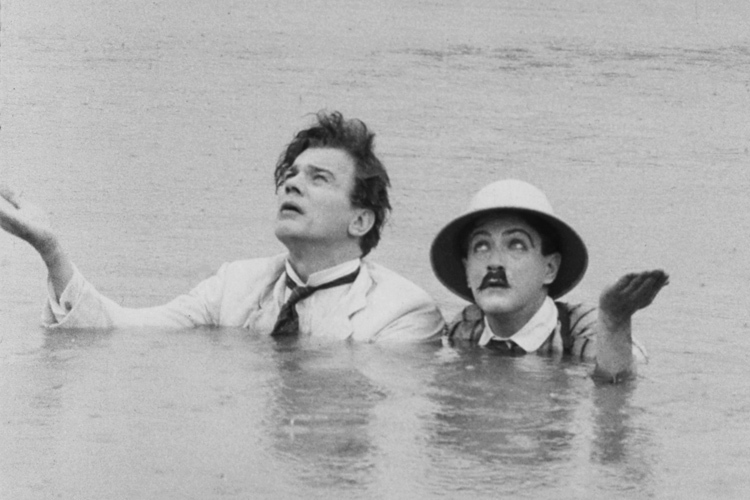
Probably, the main historical premiere of this kinoid is “too much Johnson”, the first film of Orson Wells, shot with a professional movie group. For a long time it was considered missing, but in 2013 it was discovered in a warehouse in Pordenon, and then restored by the efforts of the American National Film Fund.
Apart from the 1934 amateur film, the Hearts of the Century, an expressionist film parody of the old woman, which death overtakes in the piano, “too much Johnson” is the first dizzying film adventure of Wells, the very beginning of his rapid and tragic novel from the movie. The history of this picture is strangely reminiscent of the misfortunes of many Wells films - some of them were not lucky with a change (“Embersona”, “Lady from Shanghai”), some were not diluted for various reasons (“Don Quixote”), and some are still looking for a way to the viewer (“all this is true”, “the other side of the wind”). “Too many Johnson” is a classic American farce at the end of the 19th century, which Wells with Mercury intended to deliver to the Summer Theater of one of the resort suburbs of New Hayven. Famous by the self-cure handling of classic texts, Wells immediately decided to make something like a centaur from this play, to combine a frantic slapstick in a theatrical production and blossomed with a violent color in the 30th eccentric comedy. Wells wanted to revive the plot, which, as it seemed to him, was already giving naphthalin, due to the silent cinema facilities in the theatrical performance (by the way, the young Eisenstein acted in the production of 1925 “for every sage is quite simplicity”). Each of these cinema plants was supposed to be suggested by the first, second and third acts of the play, and all the action in total was to continue no more than an hour. Filming was carried out in August 1938, first in New York, then on the Atlantic coast of Connecticut.
"Hearts of the century", 1934
At the same time, Wales had another goal. In his 23 years, he was already a recognized theater star and radio and fell on the cover of Time magazine. Just a few months later, in the fall of 1938, its setting the “War of Worlds” will panic of American radio listeners. However, on the same days, Wells repeatedly says that the theater, in his opinion, is outdated and that he sees his future in the cinema. More recently, he rejected the MGM film studio’s proposal to become their director, since this contract implied that Wells would have to go through the training period under the start of King Vidor. The adventure with Johnson was supposed to show everyone that the young genius did not need any teachers.
Filming was conducted with great enthusiasm and took ten August days. Wells planned to mount the film on his own and even installed a professional installation table in his Manhattan apartment. According to the biographer Wells Simon Callow, the installation was moving neither Shatko nor Valkko - mostly Orson looked out and laughed loudly, while his assistants tried to find those fragments that would help tie the action together among the halls of the film. At this moment, reality intervened in the director’s plans - it turned out that in the summer theater, where the production was planned, there is not enough projection distance to show film fragments. For this reason, the installation of the film was never completed, and the performance itself without film stations did not use success and, apparently, was presented to the public only once.
Kevin O'Mmorrieson, who worked on this project with a lot, recalls what happened after this first and at the same time the last performance of “Johnson”: “When everyone got drunk champagne, Orson opened the script and asked:“ What do you think about this page? ” Joe Kotten studied the page and said: “Nya!” Then Orson asked me the same question, and I also answered: “Nya!” He pulled out this page, crumpled it and threw it away. Thus, we figured out the whole scenario - weanked pages and threw them away. We were drunk as gods and had no idea what we were doing. ”
A few words about the plot "too much Johnson." This is a comedy of errors, in the center of which the pathological liar Augustes Billings. Being married, he starts a mistress and seems to her like Johnson. One lie attracts another, and soon a jealous opponent, who wants to destroy it, starts to destroy in pursuit of Billings. The action moves to Cuba, where all the heroes meet a wealthy planter, whose surname is really Johnson. In the role of the finally ravaged womanizer, Billings on the screen was debuted by Joseph Kotten, by that time a former already famous Broadway actor. Subsequently, Kotten will become a permanent employee and close friend of Orson Wells - this friendship lasted until the death of the latter. Kotten himself presented himself as follows: “Wells considered his best film“ Citizen Kane ”, Hitchcock -“ Shadow of Doubt ”, Carol Reed -“ the third person ”, and I starred in all these films.”
In “too much Johnson”, Wells’s thrust to the diagonals and action in the depths of the frame is already noticeable, the camera rushes up, then sharply goes down to cover the action that takes place at once on several floors of the house or walking ship. One of the segments of the chant of the pursuit, where the hero of Kottena runs away from the roofs from the jealous, who made his lovers by surprise, greatly resembles both the “stranger” and “the third person”, but most of all - the films of Garold Lloyd with that significant difference that Lloyd often used combined shootings, and Wells and his company shot all this running and tricks with the stairs to the stairs to the stairs. sloping roofs without any insurance. In some frames of this segment, people are sometimes visible, who are surprised to watch the risky chatter of the cottage from the windows of neighboring offices - they probably thought it was a suicide.
Trekactic 25-minute film, most of which is a pursuit of jealous for Billings, mounted from three preface to the acts of the play
The unique opportunity to watch the full version of the film as it has been preserved: all the material captured by Wells with all the dumches and the re -created piano soundtrack
Of these two parts , the film is presented on the website of the National Cinema Fund . And, finally, the final chord is a miracle that survived a one-minute amateur film that captured 23-year-old Wells in a straw hat on the film set.