
Translated material
And - then the agent
On Tuesday, the Vakhitovsky District Court of Kazan refused the complaint of the Human Rights Association "Agora" to include it in the list of "foreign agents". This was done on the basis of the presentation of the prosecutor's office in the Ministry of Justice. The Law on Foreign Agents has been in force in Russia for more than a year and a half. According to this law, receiving money from abroad, which at the same time engage in political activities, should be included in the special register of “foreign agents”.
The mediazone correspondent visited Kazan at the court session on the complaint of Agora to include in the register and recalls how the events developed after the adoption of the law on “foreign agents”, with what difficulties Russian NPOs and specifically “Agora” faced.
The prosecutor's office goes to them
Inspections of NPOs began a few months after the adoption of the law on foreign agents in November 2012. Back in January, the head of the Ministry of Justice, Alexander Konovalov, spoke in the State Duma about the unprofitable law and that in order for him to earn, it will take years. To begin fan inspections of the NGO, the Prosecutor General’s Office needed a month.
“In February, they were preparing, and in March they began to come with checks. The principle was this: you get money from abroad-we are coming to you. At first, the Prosecutor General’s Office wanted to deceive everyone and conduct a campaign of inspections as a fight against extremism. But it did not work out, ”says the head of the Agora Pavel Chikov. It was “Agora” who began to protect many NPOs, so at some point five lawyers of the Association carried out about 100 organizations. Moreover, the Agora began to advise simply not to provide the prosecutors with documents - for this a fine of only three thousand rubles was provided.
“They changed the rules of the game along the way, raised a fine of up to 100 thousand with a possible suspension of activity,” says Chikov. In his opinion, the Ministry of Justice did not represent the scale of the inspections and, fearing accusations from the prosecutors of sabotage, was forced to join the campaign. “The ministry made a collision on the“ voice ”neat, hoping to achieve the goal with one shot. The only one, initiated by the Ministry of Justice. Nevertheless, they understood who the law was really adopted, ”Chikov notes. Nevertheless, the Ministry of Justice failed to avoid complaints: the Prosecutor General’s Office issued an inaction of inaction following the results of inspections to Konovalov.
In response to the audits, human rights activists began to apply to the courts and began to win them. Chikov is convinced that it was for the help of other organizations, both legal and informational, the Prosecutor General decided to pursue the association. “I know the head of one of the NGOs, who in the prosecutor’s office heard conversations about how“ Agora ”interferes with them. The seagull in August reported to Putin about the results of the audit. He mentioned two organizations, “Voice” and “Agora,” recalls Chikov.
By this time, the Tatarstan prosecutor's office actively checked the association. Chikov is sure that the audit was initiated from Moscow. Then the Agora compromised, which completely satisfied the regional prosecutor's office. Human rights activists made changes to the charter at the request of the supervisory authority and terminated the project to legal protection of bloggers, to which he had claims. But the General Prosecutor's Office demanded that the republican verification continue, as a result, it took eight months, from October 2013 to May 2014.
“During this time, they scrapped for a second performance,” says Chikov.
The essence of the claims to "Agore"
Despite the termination of the blogger legal protection agreement, the prosecutor’s office made claims to the protection of Internet activists. According to the supervisory authority, reports of the Association for Violation of Freedom on the Internet on the basis of “unilaterally evaluated and unverified information” form public opinion in order to change state policy. The prosecutor’s office complains of a negative assessment of legislative initiatives to regulate the Internet by human rights activists.
The supervisory authority accuses the Agora of protecting activists participating in street actions, quoting human rights activists on how to resist provocations, what to do during detention, how to avoid criminal liability.
“Thus, one of the elements of the Agora activity is to participate in the organization of political actions carried out in order to influence the decision -making of decisions and their state policy by consulting their organizers,” the prosecutor's office said.
Another argument for the prosecutor’s office was the statements of the head of the “Agora” Chikov as a member of the Presidential Council of Human Rights (HRC), which is part of the NPO Development Commission there. Among the priority tasks of the commission, the supervisory authority discovered "elements of political activity."
The seagull structure and the cooperation of the Agora with the Ministry of Justice as independent specialists in the anti -corruption examination is unhappy. The prosecutor's office is convinced that Agora has an impact on legal regulation, which "does not exclude lobbying the interests of foreign investors."
The prosecutor's office made a general conclusion about the receipt of foreign financing and political activities of the Association and demanded that the Agora be included in the list of foreign agents. On July 21, the Ministry of Justice of the Agorus included this list.
Appellation "Agora"
Human rights activists filed a lawsuit against the prosecutor's office. On Monday, the Vakhitovsky District Court of Kazan began consideration of a complaint of Agora on included in the list of foreign agents.
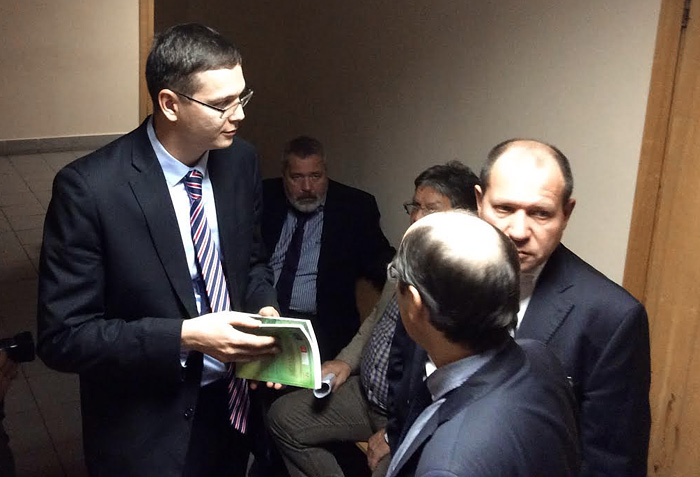
Lawyer Ramil Akhmetgaliev began a performance at a meeting with a request to introduce two research to the case file. One was carried out at the Nizhny Novgorod State University as a philologist, a linguist and a sociologist, and the second - a political scientist from the Perm State University. Despite the objection of the prosecutor, Judge Natalya Zybunova introduced research on the case file. Then the defender petitioned the call to the court of witnesses, among whom were representatives of the Special Acts Ilya Shablinsky and Igor Kalyapin (“Committee against torture”), editor -in -chief of Novaya Gazeta Dmitry Muratov, candidate of philological sciences Elizabeth Koltunov.
The prosecutor asked for time to get acquainted with new materials, and it came to the possible transfer of the meeting, which the representatives of the Agora did not want, since they specially invited witnesses from other cities to him. Judge Zybunov also went to meet human rights activists. She led a meeting with the sunglasses shifted on her forehead, holding her hairstyle. In Kazan, the second day in a row was cloudy.
After a twenty -minute break, the meeting resumed.
Akhmetgaliev’s lawyer expandedly answered all the claims of the prosecutor's office. He explained that it is impossible to confuse political participation with a political act. “It is one thing if the prosecutor goes to vote in the elections, and another - when he himself is nominated,” the lawyer gave an example.
Further, it was about publications in the press, which, according to the prosecutor's office, prove the political activity of the Agora. “What exactly materials are we talking about - prosecutors do not specify. The presentation contains information that Gazeta.ru wrote about Agore. Well, there is a publication for May of this year, where we protect in this Vakhitovsky court the victims of medical error. Is this the same political activity of "Agora"? " - Akhmetgaliev was perplexed.
The essence of his arguments came down to the fact that prosecutors deliberately confuse political activities with legal and public. As an example, the lawyer of Agora compared the actions of human rights activists and representatives of the supervisory authority. “The document of the prosecutor’s office says that Chikov gives an interview. So the prosecutor of the republic also gives an interview. Is this political activity? Or anti -corruption examination, which was engaged in Agora. And the prosecutor's office is engaged in her, ”continued Akhmetgaliev.
The prosecutor in response said that “Agora” receives foreign financing. He proposed to consider political activity including appeal. The prosecutor explained that the supervisory authority analyzed the work of the Agora and came to the conclusion that they are subject to the law. And then he began to quote the very idea, his objections to which the lawyer Akhmetgaliev had already brought.
At the same time, at the very beginning of the speech, the prosecutor promised to bring counterarguments to the position of "Agora". After the confused reading of the representative of the supervisory authority, the judge asked him if the prosecutor’s office conducted any examinations. “No,” the prosecutor answered confusedly.
Akhmetgaliev asked what the state policy on the Internet is regulated, which, according to the prosecutor's office, is contradicting the “Agora”. The prosecutor began to answer about sites blocking. "Which ones?" - the lawyer insisted. The representative of the supervisory department in response buried in the papers. “Good, but you turned to Roskomnadzor, which regulates the blocking of sites?” - continued the interrogation of Akhmetgaliev. “No,” the prosecutor breathed doomedly.
Akhmetgaliev asked to clarify some formulations of the presentation, including “unverified and one -sided conclusions” of human rights activists in the report on the Internet. “At present, I find it difficult to answer,” the prosecutor switched to the whisper.
The prosecutor answered all questions of the defender either by quotes from the performance or a single -syllable “no”.
The judge could not stand it and asked with a smile: “When the prosecutor's office gives its conclusion about some legal acts-is this also politics?” The prosecutor answered something slurred, trying to quote the performance again. At the same time, he was constantly stipulated that this document is advisory in nature.
“How is it? The prosecutor here for some reason is trying to clearly soften the position. The performance is mandatory for the Ministry of Justice. It was on the basis of him that we were included in the list, ”retorted Akhmetgaliev.
After a small break, the performance of the witnesses began. The candidate of philological sciences from the University of Nizhny Novgorod Elizabeth Koltunova spoke about the study conducted by experts. “We were not engaged in the analysis of the AGORA activity, we were engaged in reports. We attributed them to the scientific text. We were not interested in activity, but texts, ”said Koltunova. She added that the performance of the prosecutor's office does not rely on the facts, it contains a “number of unproven provisions”.
Koltunova, based on the opinions of experts, explained in detail what political activity is. “It is a narrow part of social activity and part of the civilian. If Chikov goes to be elected as the head of the organization, then it will be political activity, ”the philologist gave an example.
The next in court was the chief editor of Novaya Gazeta Dmitry Muratov. He talked about publications in the newspaper and about cooperation with Agora. Extremely emotionally, Muratov spoke about the murder of journalist Anastasia Baburova and lawyer Stanislav Markelov by neo-Nazis from Born, as well as about the accident on Leninsky Prospekt with the participation of Deputy Prime Minister Lukoil. In these matters, the lawyers of the "Agora" helped.
“Defenders, I will say right away, I did not agree with this, excluded the political component in these matters,” Muratov noted. The fact that they are included in the list of “foreign agents” due to political activity is extremely humiliating. Muratov told the court about the traditions of Russian human rights, the first member of the PMC, the writer Anton Chekhov, who inspected the prison on Sakhalin. He urged to follow the words of the famous lawyer Fedor Povleko and "not to confuse politics and humanism."
The prosecutor decided to ask Muratov with publications in his newspaper Agora reports and handed the chief editor to the printout from Gazeta.ru. Muratov, as if nothing had happened, began to answer the question, not immediately noticing that it was still about different publications. “But you had something similar,” the prosecutor tried to object uncertainly, whom the whole hall was already laughing at.
The judge announced a five -minute break, during which the prosecutor doomedly asked Chikov, how many witnesses had many more witnesses.
The next was Shablinsky from the HRC, who told the court that the prosecutor’s accusations against Chikov were inappropriately in the council. According to the rules of the Council, all its participants act in personal quality. “If he (Chikov) leaves the ranks of“ Agora ”, then he will remain in the Council,” Shablinsky explained.
The witness spoke about his cooperation with the Agora on Constitutional Court and the contest of the Law on Foreign Agents. “How this appeal will affect state policy, a lawyer and a lawyer should not think,” Shablinsky answered to the question of the prosecutor.
Another member of the HRC, the head of the “Committee against torture” Igor Kalyapin, developed this topic and shared his own experience. “The human rights organization, the head of which I am, did not coop me there, I did not advance from it and it has nothing to do with it. All statements by members of the HRC are made only in personal quality, ”said Kalyapin. He spoke about the long -term cooperation with the Agora and the work of a human rights organization, including monitoring for violation of human rights.
The shortest was the performance of the editor -in -chief of “Evening Kazan” Khasbulat Shamsutdinov. He said that many Kazan people turn to Agore for free legal assistance, and there have never been any publications on the legal activity of the Association in the newspaper.
At the end of the meeting, the legal analyst of Agora Damir Gainutdinov performed. He was a co -author of the report about the Internet, on the basis of which human rights activists were accused of political activity, as well as the head of the Kazan human rights center Igor Sholokhov.
The judge issued her verdict only the next day: to refuse the Agore's complaint.