
Translated material
Resist! | Colta.ru
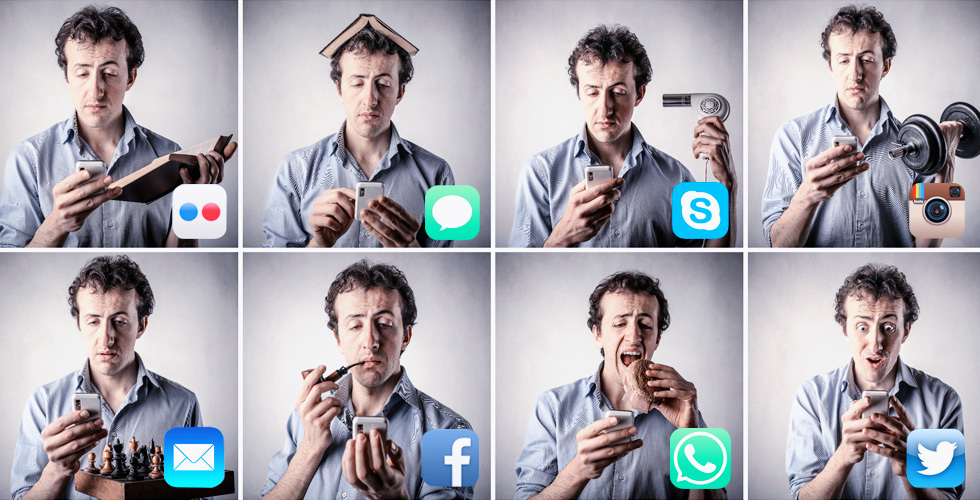
Media Guru Clai Shirki forbade his students to use digital devices in the audience. He explained this decision in a very curious article , which was published on her blog The Washington Post .
Clay Shirki has been teaching new media at the University of New York since 1998. All these years, he allowed students to bring and use devices. Firstly, it is somehow not good to prohibit what you study, and secondly, it was embarrassing to win competition for students' attention with a ban. Well, if you are a professor, then know how to distract the young man or girl from the device with your lecture. In addition, he professed Laissez-Faire Attitude , that is, he believed that the invisible hand of a rational choice would set up a reasonable attention balance in the audience. And after 16 years of struggle and suffering, he introduced “state regulation” on this “wild market”.
The fact is that, according to Shirki, every year the situation in the audience was getting worse. He tried to analyze: the professor seems to be the same, the same material (I will add from myself that the material was even enriched - over the years, Shirki published two turning -ends for the industry and became a world -class lamp). Students changed? Clay Shirki came to the conclusion that the problem is caused by the development of the devices themselves and the Internet ecosystem as a whole.
The driver knows the goal, but the elephant is stronger. Sometimes they act harmoniously, but if a conflict occurs, then the elephant usually wins.
The devices have become convenient and all -permanent. How to compete if the professor offers the topic “The influence of the Crimean War on the spread of a telegraph”, and Facebook offers the message “Your former noted you in the photograph”? Feel the difference, says Shirki. Not only is the content uncontrollably attractive in itself, so it still vibrates and saws. That is, it is simply physiologically impossible not to react and not to see what kind of photo is there. And all, the student is lost.
In the end, Shirka realized that this was initially an unequal competition. A army of well -equipped and highly paid engineers and designers who constantly improve attractive, that is, distracting, characteristics of Facebook , Wechat , Twitter , Instagram , Weibo , Snapchat , Tumblr , Pinterest , Mac , iOS , Windows , Android ... are working against him alone. The professor finally admitted to himself that the “invisible hand” of a rational choice against this armada will not have to be able to show authoritarianism.
Shirki used to limit the use of gadgets for special occasions earlier and noticed that fresh air was added in the audience. The discussion became sharper, and, paradoxical, the students themselves were relieved. I think many have noticed this effect: if an external, violent reason for a while to lose access suddenly falls out, people tend to note this condition as a special, worthy of mention. Often in a positive light - people rejoice in turning off. But not for long - exactly so much as to feel the difference. Then they are pulled back - to the interesting prison.
Analyzing his own reflection on such a difficult solution, Clay Shirka recalls the metaphor of the elephant (emotion) and the drove (mind). The driver knows the goal, but the elephant is stronger. Sometimes they act harmoniously, but if a conflict occurs, then the elephant usually wins. This metaphor helped Shirki to stop thinking about students as people who make a conscious choice between the temptation of emotional distraction and the effort of intellectual concentration. The younger the person, the stronger the elephant in him, while the drummer is still a newcomer. And vice versa: the more experienced the drummer (rations), the more obedient the elephant (emotions).
Many of us physically feel that if someone has entered the network in the audience or group of interlocutors, then the contour of the common space is opening.
All these engineers and Internet designers are only busy luring our elephant, so that he tore the reins and drop the drummer. Moreover, they, unlike the professor, do not require any counter obligations from the student. They just take what they manage to take away - time.
Moreover, Professor Shirki thinks, the inclusion of someone in the class causes the effect of passive smoking. Others are also distracted by a monitor luminous for someone. In the class, there is a feeling that, being at a lecture, you can not be on it. This is true-many of us physically feel that if someone has entered the network in the audience or group of interlocutors, then the contour of the common space is opening. Somewhere nearby appears hollowing of meaning of meaning into a virtual abyss. This hollow does not allow the meanings to accumulate - neither in the head or in the team. And where they disappear, they just melt with a worthless haze, there is too rarefied there.
The magnates of the digital world will continue to seduce and brake our elephants. Shirki notes that the reverse tendency is ripening - there are applications that serve the resistance movement: notifications, dumbfounds of video, etc.. From myself, I will add that this trend is demonstrated by the screen itself. After that, Steve Jobs, who forbade his children to use an iPhone . Then Madonna, who forbade her children to watch TV . They know what they deal with. Digital neoluddism is already discussed by media experts. Subscription and Tolstoy will find a shelter in the reserves of digital austerity.
A few more notes on the sidelines of the Article Shirki.
1) Media literacy is a time management. In an environment, where time is currency, media graphicity will become the main physiological skill.
2) Convenities are enslaved. Well -established convenience seeks to take all the time that a person is physically able to spend on him. Therefore, ecosystem designers are not aimed at the quality of content transmission (what many media are on) and not even taking attention. They are aimed at our convenience. Convenience is the best trap for time released from real life.
3) resist. There will be no special result, but - resist. The future is inevitable, the present is doomed, but humble resistance adds at least a little dignity to the bustle of temporal acceleration.