
Translated material
Peaceful call for conflict
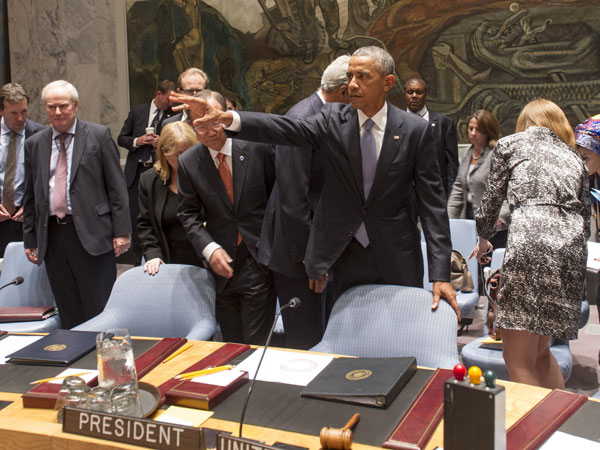
On September 24, US President Barack Obama spoke at the General Assembly of the UN with a forty -beloved speech . At first, he talked about how much the quality of life increased even in the poorest parts of the world - thanks to technical progress and common political regulation. Then he moved to a conversation about aggressors, threatening to undermine this improved life. Among these, Russia was featured by its actions against Ukraine, which is fraught with a violation of the world order. The main theme of the performance was the call to the cohesive struggle against extremist groups in the Middle East, primarily with the Islamic State. Speech received a lot of comments in the press. Among the reviews there are approving (Obama finally took a decisive position), skeptical, as well as pragmatic.
The author of Ny Times, Mark Landler (Mark Landler), described Obama’s speech as “sharp” (Bluntly Worded). In this speech, he listed the main problems that the United States has now encountered and which they have to solve. The threat emanating from the “Islamic state” is only one of them, albeit requiring the most operational solutions. But in other cases, “from the confrontation between Russian aggression to Ukraine to coordination of work to eliminate the Ebola outbreak in West Africa; From mediation in the formation of a new government of unity in Afghanistan to organizing a new campaign to combat global warming. ”
“This president,” the author comments, “was strikingly different from the one who turned to the skeptical world leaders at the General Assembly last year - two weeks after he canceled the strike on Syria, which was to be a reaction to the use of chemical weapons there. In that speech, Mr. Obama presented a rather meager list of American priorities in the Middle East and did not show a great tendency to pompous rhetoric or policy of intervention, unlike his predecessor George Bush Jr.. ”
This time, Obama, according to Landler, showed himself a real leader who, at difficult for everyone, declared his readiness to cooperate with other countries, but at the same time confirmed that in the end the United States would remain the final guarantor of maintaining international order. However, despite the tough tone, the author continues, it is difficult to judge in this speech about how actually the foreign policy strategy was rethought and whether the president is really ready to give the Islamic state a decisive rebuff and protect the United States from a terrorist threat.
It was also noteworthy that in it Obama spoke about Russia in the most tough terms for all the time. However, even more remarkable, according to Landler, what Obama did not talk about or spoke only in passing. In particular, the significant events of the last year were the conclusion of a nuclear transaction with Iran and the beginning of negotiations on the civil war in Syria. In this speech about Iran, it was only said that the US position under the terms of the transaction would remain the same. Regarding Syria President Bashar Assad Obama, nothing said at all, although the last time he erupted in his address by criticism (for the use of chemical weapons). In this speech, Obama noted the rigidity of the Syrian regime, but did not personally say anything about Assade, who recently supported him in his intention to use aviation to combat the Islamic State in Syria. Also, according to the author’s assessment, the Israeli-Palestinian conflict was relatively small and very common.
The commentator Jeffrey Goldberg from The Atlantic found Obama’s speech in the UN with some breakthrough compared to its previous statements on international issues. In his tone in this speech, he reminded the author at the same time Hillary Clinton at the peak of her militancy and John McCain in the most calm state. As well as George Bush Jr. during his second term. ” “Critics of Obama,” the author admits, “will say that he abandoned his former position of uncertainty on problems in the Middle East, because sociologists explained to him that the Americans want less“ academic ”president. But from observations of him in recent weeks and from conversations with people who know him well, I got the impression that his way of thoughts has really changed in terms of the relative significance of the “soft power”, the nature of the opponents of America and, ultimately, the roles in the world politics that the United States should play in order to keep its opponents under control. ” In particular, he realized that “the new Russian king understands only the language of power and does not heed the voice of reason,” and also appreciated the depth of the disaster caused by the spread of the “Islamic state”. “In other words,” Goldberg concluded, “Obama now understands that the United States is a nation completely indispensable in the world.”
Another commentator from Ny Times, Timothy Egan, recalls the episode about this speech when Obama received the Nobel Prize of the world in 2009 - “Perhaps the only Nobel, which was given for good intentions ... And now the president with the most prestigious prize for abandonment for violence is forced to turn to military rhetoric, kill, kill Religious extremists and bombing the seventh Muslim country. ”
However, the author notes, one does not interfere with the other, since circumstances have developed. It is important to consider the context in which this speech is uttered, and the strategy that it offers. It is also important to emphasize that a tough position does not mean that Obama automatically moves to Bush’s rhetoric. Of course, there are some parallels. “However, the war of Bush in Iraq was arrogant pressure on the nation, after which state building began, based on ignorance. According to the doctrine of Obama, the actions against the IG are aimed, first of all, to protect entire communities of people who find themselves in the war zone, from the fanatics killed them. His strategy is aimed at protecting Muslims, the main victims of Middle Eastern terrorism, from other Muslims. ”
Thus, so far nothing testifies to the fact that the award of the Obama of the Peace Award may be fair. Although for it to become fair, Obama will have to make efforts - first of all, this applies to politics in the Middle East. The author considers pressure on the Sunnis in this regard that they themselves begin to suppress jihadist movements in their environment.
The author of the Nobel Prize of the World was also addressed by the author of Washington Post Dean Milbank Milbank ), but in a different tone: “This is how the Nobel Prize laureate declares war. He smiles warmly to members of the UN General Assembly. He recalls the village of his grandmother in Kenya and notices that "Islam teaches the world." He admits that his country has its drawbacks and praises the “path of diplomacy and peace”, and also claims that real achievements are never the fruit of the use of military force. Thus, he spends 19 minutes of his 40-minute speech (with an official regulation of 15 minutes), before moving to the main point: "The terrorist group, known as ISIS, should be broken and completely destroyed."
Milbanks also notes the striking differences between this speech and the former statements of Obama - in particular, in Cairo five years ago, when he declared the beginning of a new era in relations between America and the Muslim world. Tatically, these performances had a lot in common, but the emphasis shifted. Obama-2014 became much more demanding of Muslims, more apologizes for the actions of the United States and instructs Muslim leaders how they need to fight extremists. According to the results of his speech, the US president gave the world homework demanding to report on the work done in a year. The result was a imitation of Bush’s rhetoric, expressing the idea of American exclusivity, and at the same time an elegant move, with the help of which a leader, without leaving the role of a peacekeeper, openly calls for a conflict.
Analyst from the British Guardian Julian Borger believes that Obama’s performance was the next diplomatic course designed to solve the practical task: to observe the shabby equilibrium between the call to the new war against Islamic extremism (which is achieved from him in his homeland) and not to repeat the “War with Terrorism” On the sample of Bush Jr.. Actually, this was the main theme of the performance. Hard rhetoric against Russian and Syrian politics was contextual, while the main message of speech was a call to mobilizing forces against the “Islamic state”. At the same time, he constantly emphasized that this time everything would not be at all like Bush: “I already said that America would not build its foreign policy exclusively around the reaction to terrorism. America will be a educated and constructive partner. On the one hand, we will not be tolerant of terrorist refugees, but on the other hand, and we will not behave like invaders. ”
Another British newspaper, Telegraph , summed up the following result. First of all, this speech of Obama was the most belligerent of what they had ever spoken. If earlier he called for reconciliation and universal cooperation, then here he harshly distinguished the enemies that we must fight, and the allies, who should rely on this struggle. In addition, this speech was the most pro -American. In such a patriotic tone Obama, at international sites, he had not yet been expressed before (“When the world needs help, it calls on America”). He cited the events around Ferguson as an example of an internal problem with which the country honestly works and wants everyone the same careful approach.
The rejection of the Russian intervention on Ukraine continues to be relevant: although the purpose of speech was the consolidation of forces to combat the Islamic State, the speech was a significant episode where Russian foreign policy aggression was criticized, as well as European indifference in the confrontation of this aggression.
As another significant item, it is noted that Obama critically responded about Israel's policy and at the same time said nothing about Hamas. Finally, it is emphasized that China was not mentioned in speech - at least directly. Indirectly, he included a replica "We will insist that all states follow the rules and solve their territorial contradictions peacefully, in accordance with international law." The author interprets this as evidence that in the conditions of war in the Middle East and confrontation with Russia, the United States does not want to get involved in another conflict - with China. This subtext, in turn, can be interpreted by China in two ways: both as a warning and as a carte blanche.