
Translated material
The day of the leukocyte
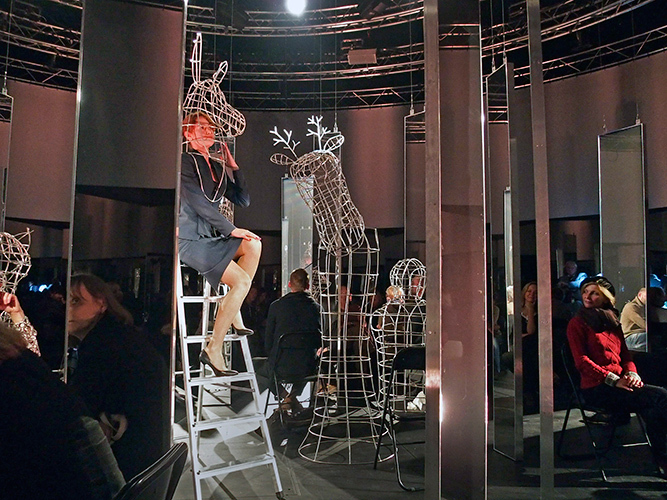
Marat Gatsalov became not only the director, but also the scenaographer of the flagship performance of the new stage of the Alexandrinsky Theater, and the decoration he had invented much fewer questions than the actual scenic text. Having placed the audience in a maze from mirror panels swaying on the curtains, Gatsalov canceled normative audience optics. Its “telluria” can and should be watched in different ways, not afraid not to see something or in return to see your reflection in the mirror. It is also possible to review, apparently, both in different ways, and exactly the opposite.
On the one hand, the first theatrical production of the fresh (and excellent) novel by Vladimir Sorokin was not at all congenal to the book. The Alexandrinskaya "telluria" not only does not work as a reading room, even the advertising avenue from it is worthless. Instead of reveling in the individual style and wit of fifty chapters of the novel-antiotopia, selecting for each appropriate type of theatrical aesthetics (which seemed before the premiere, if not the only possible, then the optimal directorial decision), Marat Gatsalov drowning the text in the software slurry. It would seem that the first solo exit of the artist Alexander Lushin with a monologue about the fertile properties of the state, who suddenly begins to serve with the intonations of a priest who serves the liturgy, promises the viewer a fascinating diversity of acting techniques and reincarnations. But this is only a trick, if not a stinging curtsy addressed to the former leader of the new stage of Andrei Mogeli, who left her for the sake of the BDT: the “Ivanes” of the mighty began at a similar reception.
“Telluria” can and should be watched in different ways, without afraid to not see something. It is also possible to review, apparently, both in different ways, and exactly the opposite.
You can tell Lobanov about the types of acting in the “telluria”, not highly shouting your soul through costumes. It is either deliberately parody, as if stitched for the Tyuzovsky matinee, color decorations (such is the tunic of the president of telluria, Franesu Trokar performed by Synnik seeds), or faceless office jackets with unforgettable price tags. The text of the classic of Russian social art and conceptualism in the performance either exaggerate, playing to a tangible fake, or they are submitted for a while, stammering, apologizing and peering into the cheat sheet. On the encircling space of the performance of a circular video panorama (the authors of this unique in technical complexity of the visual attraction-media artists Anton Yakhontov and Yuri Dadevich) from time to time flash the stops of Soviet series, as if fixing the bad infinity of domestic social reality. Sorokina here is noticeably and unfairly tremble, applying his own deconstructivist tools for him. The apogee of Autodafe is eating a cream cake in the form of Vladimir Georgievich’s head - a daring materialization of the concept of “death of the author”.
But, as was said, everything is ambiguous. On the other side of the mirror there is a material for an inspired critical response. Gatsalov very timely staged a performance about intoxication by socially orienting discourse. In the days when texts are pouring out of TV and radio receiver that can compete with the Sorokinsky by the phantasmagoric absurdity, the idea of a spectacular performance, grinding in their slow jaws, and flexible religious campaigns, and preoccupied Xenophobic invectives, which seems very suitable. The acting team of the performance, stabbing, grimacing and yawning (it is very funny to observe how the patented profiles of the Alexandrinsky troupe imitate sluggish amateur insanity), plays the leukocytes operapping and paralyzing aggressive bacteria of social insanity. No matter how strange and incomprehensible the performance of Gatsalov is for an unprepared viewer, the idea that a lie, including theatrical one, lies outside of humanity, that humanity is coughing, grimaces and stuttering, to an unprepared viewer who has a sympathetic to the end of the play, guaranteed to reach. However, I would like to throw away the mirrors and ask the director face to face, why he used Roman Sorokin for his noble purposes, and not modern newspaper editorials. By golly, it would be both more relevant and harmonious.