
Translated material
Writer Milenko Ergovich - about shame and nationalism
"I have not seen Ukrainian fascists"
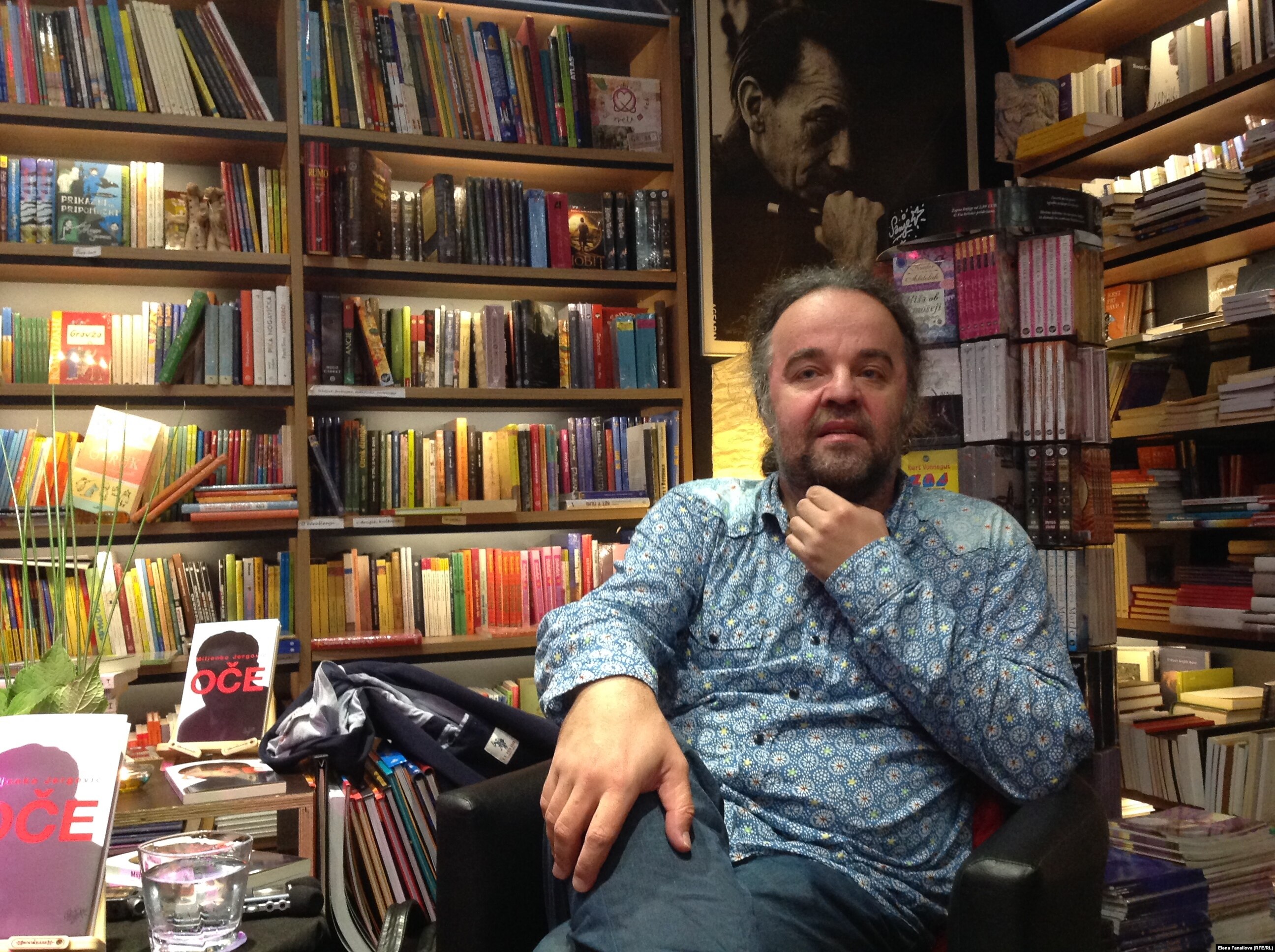
Writer Milenko Ergovich, one of the main authors of the post -Yugoslav space, a native of Saraev and a resident of Zagreb, the laureate of the prestigious European Angelus Prize, released a new novel called “Father”, where, using the example of his family, he finds out relations with Croatian nationalism of the time of the Second World War. The novel, inscribed in the context of the modern history of the southeast of Europe, in which in which they echoing with current events in the post-Soviet territories can be considered as the continuation of the family chronicle “Rod”. Elena Fanailova visited the presentation of the novel in Ljubljana and asked the writer who recently returned from the Lviv Book Forum, about the similarity and difference between military conflicts in eastern Ukraine and in the former Yugoslavia in the 1990s.
- You wrote a lot about the feelings of people during the war. These were very different feelings: fear, hatred, love. I wanted to ask about a feeling of shame. Should the peoples be ashamed of their rulers, wiring wars? For example, the Serbs are Milosevich, and the Russians are Putin?
- I am sure that the peoples should be ashamed of not only their rulers, but also actions that during historical events (now or in the past) are performed on behalf of these peoples. In the 90s, Milosevich pursued his policy on behalf of the Serbian people, and Zagreb leader Tudzhman pursued a policy on behalf of all Croats, despite the fact that some Serbs and Croats were against such a policy. This should cause a feeling of shame. Now about Russian-Ukrainian history. In Lviv, it seemed to me very important that from anyone there I did not hear anything bad about the Russians and did not feel any signs of hatred for the Russians. Basically, it was bad, but more often they jokingly talked about Putin. I saw T -shirts with humorous inscriptions dedicated to Putin. And this is a big difference: whom we imagine as an enemy, whether we are talking about a ruler or about the whole people.
- I will ask about the most terrible scarecrow of Russian and European media: Ukrainian nationalism. Have you seen Ukrainian nationalists? Is this fascism?
- I have not seen Ukrainian fascists. In general, any nationalism is dangerous and malicious, but more dangerous and more malicious nationalism of a large nation, one that is more aggressive and better armed. Therefore, in this part of the world, Russian nationalism concerns more Ukrainian. Russia is an endless country in every sense, both positive and in negative. Since I am inclined to the painful search for the positive in life, it turned out to be very important to me after returning from Lviv to see the television portions about the march of the world on Moscow streets, to see yellow-blue Ukrainian flags on the streets of Moscow. This is a very positive feeling - to see Ukrainian flags in today's Moscow. And the most positive thing you can see and hear in Lviv are people who are free, without fear, speak Russian. It is important to understand how small, weak feels in one place or another. We are responsible for our nationalism, for our fascists, for our dictators, and until we refuse this responsibility, we have a chance of salvation. The tragedy of Yugoslavia of the 90s is that the feeling of such responsibility at some point completely disappeared, and only one answer was found to fascism-fascism. Therefore, I would not compare the Russian-Ukrainian history with Yugoslavskaya and would not want Russian-Ukrainian history as Yugoslavskaya ended.
- Can pacifism be abstract? A large procession was held in Russia against the war, but there they did not specify what of the warring parties the march participants oppose. I can imagine discussions in Belgrade and Sarayev from the 1990s. What means can people stop the war? Do they become enemies of their state? Can citizens of the country who is subjected to aggression be sincere pacifists?
- Abstract pacifism is a meaningless thing. Pacifism should be very specific. The meaning of Ukrainian pacifism is not to say: let the Russian tanks go to the stop, to the western border of Ukraine. The meaning of Ukrainian pacifism is to fight - how much
Waving the Ukrainian flag does not make sense in Kyiv, but it makes sense in Moscow
Perhaps - for the preservation of national identity in any sense of the word: both the territorial integrity and the essence of the people. Part of this identity is a bilingual culture, a common Christian and multi -religious community. What is the meaning of Moscow pacifism? I think it consists in these yellow-blue Ukrainian flags. Ordinary Russian citizens can do little, except to raise the flag of Ukraine in their country, and this is very important. Waving the Ukrainian flag does not make sense in Kyiv, but it makes sense in Moscow.
-You described the story of your grandfather, and it is important for you that he is an employee of the Austria-Hungary railway. When you write about your father, the mythology of multinational Saraev is important, it is important that your father is Croat, that his relatives were associated with radical nationalists, tires. How does the study of the history of the writer have the understanding of crisis situations?
- Myths have a negative impact on history. Myths determine the continuation of the old wars and the beginning of new ones. We must study the past much deeper. I think that family history needs to be engaged in a different way, just as public, national memory. We must treat responsibility to evil, which is committed on our behalf and on behalf of our community, regardless of exactly what kind of community is religious, national, political.
-Talking about the family, family history, Austria-Hungary and the times of Yugoslav socialism-this is your answer to the question, who am I now and what should I do next?
- All people born in countries like ours were born, including due to some political circumstances. If there were no certain political circumstances, then my great -grandfather, a German from the Romanian part of the banat, would not have come to Bosnia and would not have met my great -grandmother there, and I would never be born. This applies to all countries of the world, be it tsarist Russia, the USA, Yugoslavia or the USSR. Outside the socio-political circumstances, only peasants give birth to children living in remote villages, although this is also a question.
-You once said that you want to write a large, voluminous novel for small literature, which you consider Bosnian or Croatian. Did you succeed? Which of your novels do you think so?
- I can't answer you. The most important for me is my book - always the last in time of exit. And I am not the most grateful reader of my own books.