
Translated material
Poisonous primacy imitates cobra
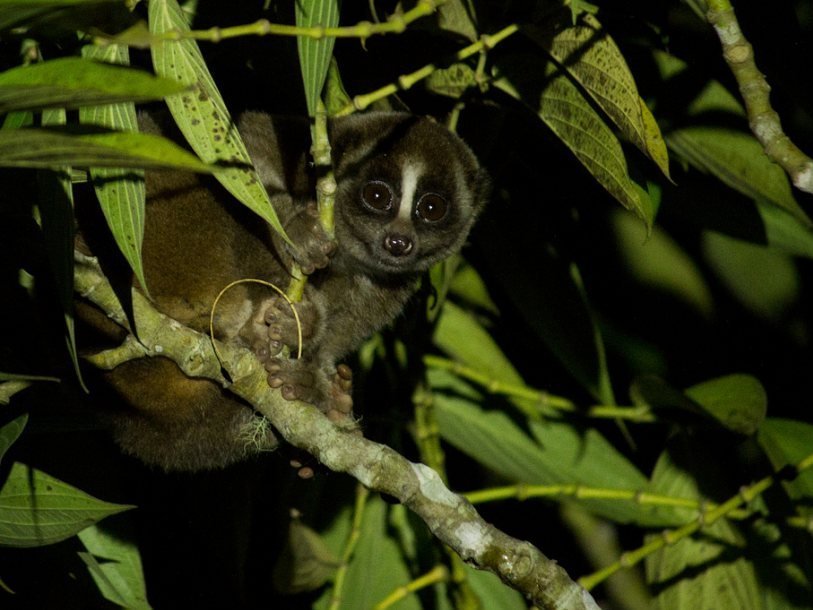
The type of primate living on the Malay Peninsula and the islands of Indonesia is a slow Lori ( Nycticebus Coucang ) belongs to rare poisonous mammals. On the inside of the forearms, these animals have special glands, the secretions of which, mixing with saliva Laurie, become poisonous. If Lori licks his hands, his bite will be poisonous. Recently, scientists have found that these slow Lori imitate other poisonous animals - cobrahs with their behavior.
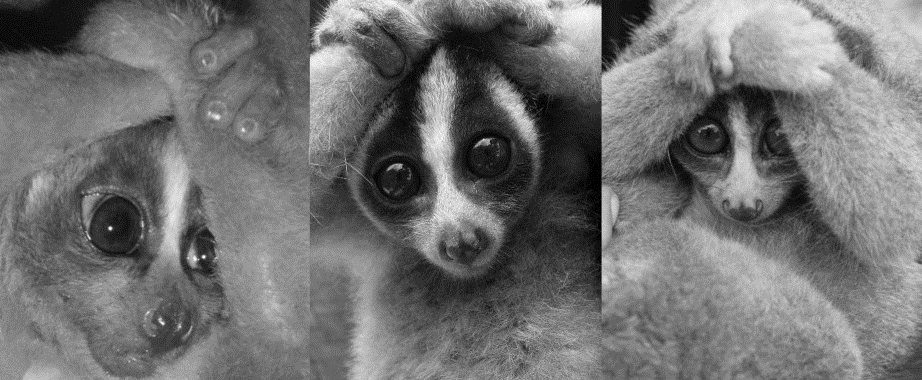 Lori of three types in a defensive position
The authors of the article published in the Journal of Venomous Animals and Toxins Including Tropical Diseases argue that the imitation of cobras arose as another protective reaction of slow Lauries. When these animals take a defensive pose with the hands of their hands linked over their heads (this provides them with quick access to the poisonous gland), the appearance of their heads with light hair on the nose and dark around the eyes resembles a pattern on the hood of an angry cobra. The effect is aggravated by the fact that Lori at this moment swaying on the hind legs and hisses, like a snake.
Interestingly, the first to pay attention to this behavior of slow Lauries back in 1905, naturalist John Still, who lived on Sri Lanka. Hearing a characteristic hiss, he thought that the cobra attacked Laurie, whom the scientist was holding in his room. But, when John Still hurried to the rescue, he discovered that it was Lori, swaying and hissing, scares a cat who approached him.