
Translated material
Director Yuri Lyubimov died
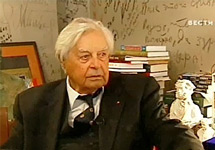
Director Yuri Lyubimov died at the 98th year of his life, Interfax reports. The founder of the Taganka Theater was taken to the Botkin hospital three days ago in serious condition.
“Yuri Petrovich died this morning at 11:40 Moscow time, his departure was calm, he died in a dream,” said TASS, director Katalin Lyubimova.
She expressed gratitude to all doctors of the Botkin Hospital, who until the last fought for Lyubimov’s life. “Next to Yuri Petrovich there were highly professional doctors who did everything in their power and even more,” Katalin Lyubimova concluded.
Yuri Lyubimov was born in 1917 in Yaroslavl. The first role was played in 1934 in the play "Prayer for Life" in the studio at the Moscow Art Theater-2. Participated in the Covet-Finnish war; In 1941-1945, the NKVD song and dance ensemble spoke directly on the front line.
In 1963, he staged the play "Good Man from Set" based on the play by Bertolt Brecht, whose performers in 1964 compiled the core of the troupe of the Taganka Theater.
Among the best productions are “Galileo’s life” by Brecht, “Hamlet” by Shakespeare, “And the dawns here are quiet ...” According to Boris Vasiliev’s story, the poetic performances “Fallen and Living”, “Listen!”, “Comrade, believe ...”.
The uncompromising productions of Lyubimov gained great fame not only in the USSR, but throughout the world, and his theater was called the "Island of Freedom in a non -free country." The performance based on Dostoevsky’s novel “Crime and Punishment”, shown in 1983 in London, was awarded the Eventing Standard Prize.
In the 1980s, after the death of Vladimir Vysotsky, the situation around the theater was heated. The authorities banned the performance dedicated to the memory of the artist. The production of Yuri Lyubimov "Boris Godunov" and the rehearsals of the Bulgakov "Theater Roman" were also prohibited.
Despite his talent and merits, in 1984, Yuri Lyubimov was deprived of the citizenship of the USSR. This happened after the publication in the Times of Lyubimov Brian Appliard, in which the director expressed a critical position on cultural policy in the USSR.
At the time of deprivation of citizenship, Lyubim was in London, the decision was made in absentia, formalized in the form of a decree of the Presidium of the Supreme Soviet of the USSR, by signature of Chernenko. The name of Lyubimov was shot from all posters and the programs of the theater on Taganka, and even the mention of him was put on the ban.
After deprivation of citizenship, he worked in Israel, the USA, England, Scandinavia, France, Italy, Germany. He put both dramatic and opera performances. Including, in Covent Garden, La Scala and Grand Opera.
In May 1988, Lyubimov arrived in Moscow. On May 23, 1989, Soviet citizenship was returned to him. He was restored previously prohibited performances "Boris Godunov", "Vladimir Vysotsky", "Living".
After the return of Lyubimov in the theater on Taganka, a conflict broke out, followed by a split, as a result of which part of the troupe under the leadership of Nikolai Gubenko separated. Subsequently, they formed a new theater - "The Commonwealth of the Actors of Taganka."
In June 2011, on tour in the Czech Republic, the theater actors publicly demanded that they give them a fee for the played performance. The desire of the actors offended the director and prompted him to file a resignation. On July 6, 2011, the Moscow Department of Culture announced the liberation of Lyubimov from the post of artistic director and director of the theater on Taganka of his own free will. The chief director left the Taganka Theater on July 16, not saying goodbye to the actors.
In 2012, Lyubimov at the Vakhtangov Theater presented a 4-hour production of "demons" Fedor Dostoevsky. The premiere of the opera "Prince Igor" in the production of Yuri Lyubimov on the historical stage of the Bolshoi Theater took place on June 8, 2013.