
Translated material
Dzhango enslaved
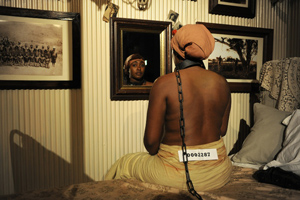
As part of the Territori festival , a scandalous Exhibit B project will be brought to Moscow , the show of which in the London cultural center Barbican was interrupted by activists blocked by the building in late September . The project of the South African artist Brett Bailey consists of a series of performances with the participation of black volunteers imitating a racist attraction from the 19th century. COLTA . RU found out why the theme of the “human zoo” is relevant in the 21st century and why EX Hibit B affects the audience.
The practice of exhibiting African slaves or inhabitants of colonies in the general public was popular in European metropolis and the USA in the 19th and early 20th centuries. The “exhibits” showed tricks, performed national dances, or simply sat in shackles in front of hundreds of curious ones. For the first time, the modern audience “remembered” the practice of the “human zoo” in 2011 at the exhibition “Human Zoos: the Invention of the savage” , which opened in Paris. The peace -loving predecessor Exhibit B told about the history of the phenomenon in artifacts and illustrations with a typically museum intonation: "That's how it happened."
However, the Western press has focused on this exhibition. Reviews turned into historical excursions, where sometimes interesting details surfaced. It turned out that London was considered the capital of the “human zoo” - there this kind of show was tour more often than usual. In addition, journalists were amazed that the racist amusement that disappeared with the advent of mass cinema in the 1930s suddenly arose again in 1958, when the Africans were shown to the Belgian public during the EXPO World Fair in Brussels.
The fact that this case in Belgium is far from the last was shown by a story from China. In 2012, in the province of Jiangsi during a religious holiday, beggars asking for alms from the temple, they put in cages so that they would not scare away tourists. Then the article about this case received a wide resonance. The most amazing was that many British and readers from other “First World countries” supported the Chinese way of fighting beggars. Comments rang out from “that would be so with us” to frankly racist speeches, which the author of the article in Vice spoke rather caustically causing.
The analogue of the "human zoo" can be found in India . There, for several years, travel agencies took excursions to the islands where the Jarava tribe lives. Every day, crowds of tourists blinded them with flashes and unceremoniously invaded the life of the tribe. In 2014 alone, human rights activists managed to achieve through the court a ban on the “natural” “human zoo”. However, in other places those who have become popular among the inhabitants of the “First World”, introductory and entertainment tours in the slums of the world “third” also exist to this day.
But the truly world community argued about the “human zoo” in the spring of 2014, when two Norwegian artists decided to recall the centenary of a large-scale attraction at a fairy in Oslo. In 1914, in the city center, which was then called Christiania, a whole Congolese village ( Kongolandsbyen ) operated, where immigrants from Africa dressed up in folklore clothes and settled in fake huts - that exhibition visited one and a half million people. Lars Kutsner and Mohammed Ali Fadlabi, himself from Africa, together with the volunteers recreated the Congo Villadge in the Central Park of the Norwegian capital.
According to the artists, their goal was to remind the Norwegians of the shameful page in the history of the country and interrupt the “collective amnesia” of the nation. The action caused a scandal in the country and beyond (it is enough to see the “press” section on the website of the artists . - Ed .), Since it was perceived as a real “human zoo”, as a mockery of natives from Africa living in Norway. As in the case of Exhibit B , the artists paradoxically came up for the rights of Africans' rights. On Twitter , the # someonetellnorway tag was popular, under which you can still find the angry accusations of Kutzner and Fadlaby of racism.
The Exhibit B project is similar to the “Congo Villadge”, however, if the Norwegians restored a mocking fun attraction with the fair, then Brett Bailey reproduced the “human zoo” as an intimate kunstamer. Living people are sitting in shackles, with shut -up mouths, tied hands and not only allow themselves to be considered, but also look closely in response.
The performance finds the viewer by surprise, immerses in a critically awkward situation and provokes a reflection on a personal attitude to slavery. Bailey’s idea is simple - to use the monstrous racist practice in the 21st century to make a modern person feel shame. Shame for his ancestors - racists and slaveholders. Shame on a large -scale oppression of man by man, which, in essence, never ended.
The presentation of the Exhibit B project will be held at the Moscow Museum of Contemporary Art on Gogolevsky Boulevard from October 10 to 14 . Brett Bailey promised to localize the project for Russia. According to the organizers, the new performances of Bailey will be about migrants, migrant workers and refugees from the CIS.